
Comparison
Road development contributions by German state
Which states have abolished road development contributions, where does the municipality decide, and why can first-time servicing still cost money?
On this page
Two contributions, two different situations
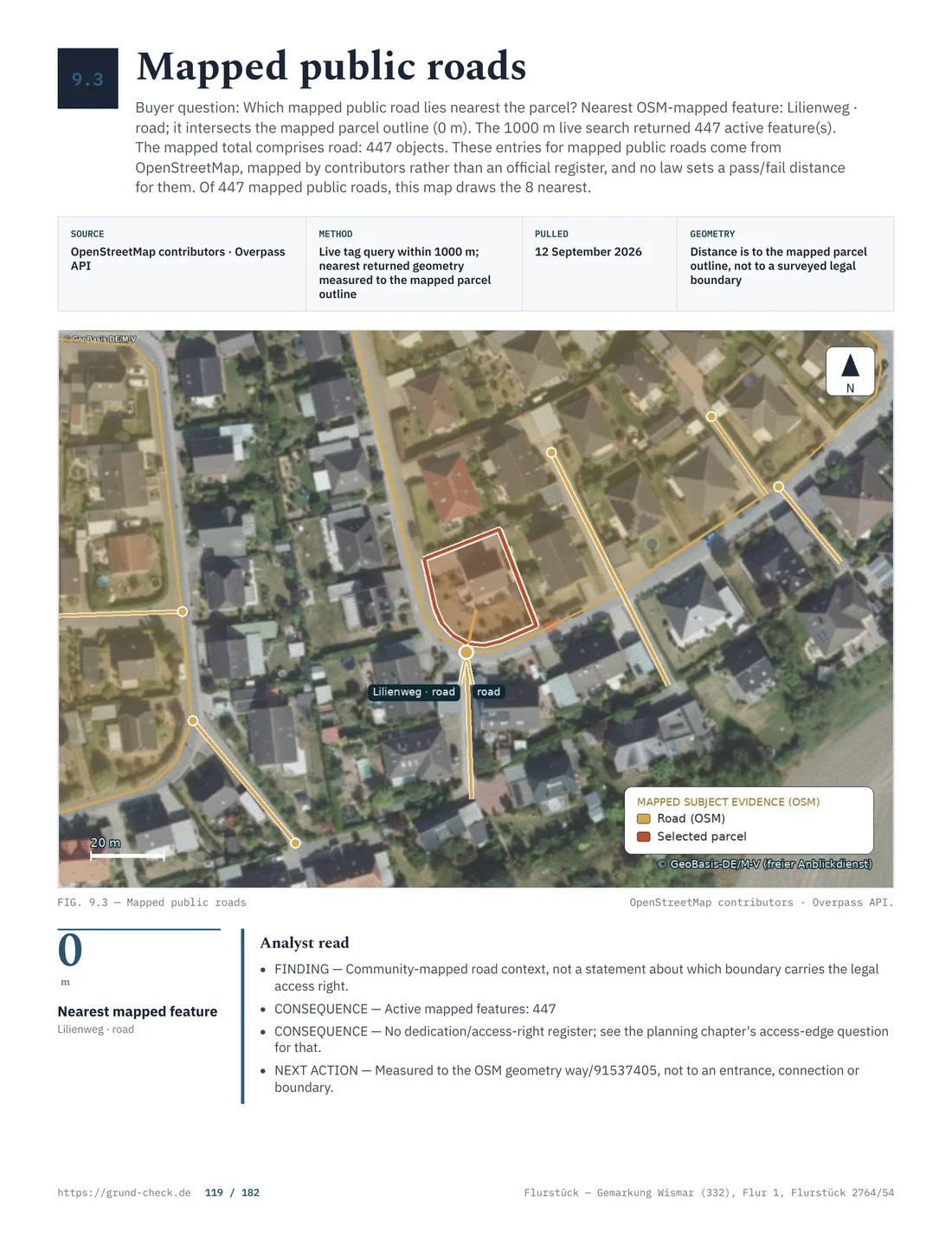
A Straßenausbaubeitrag, the contribution for improving or renewing an existing public road facility, concerns a road that is already in place. It may arise when an existing road is fundamentally rebuilt, widened or technically renewed. Whether owners share the cost depends on state law and the municipal by-law.
This must be separated from the Erschließungsbeitrag, the contribution for the first and final construction of a development facility. That distinction decides whether the statement "road contributions have been abolished" is relevant to the plot being offered. Ask the municipality which facility serves the parcel, whether the work is first-time construction or later improvement, and whether an assessment or advance payment is pending.
- Why the states take different approaches
- What "abolished" means in practice
- The municipality determines the specific bill
- Cut-off date, seller duties and the contract
- Review order before the notary appointment
Source: BauGB §§ 127 to 135 and municipal-charges acts of the 16 states; checked August 2026
Why the states take different approaches
Germany has no single state-law status for improving existing roads. The federal government regulates first-time servicing through §§ 127 ff. BauGB, the Federal Building Code. State law, by contrast, governs municipal contributions for later improvements or renewals and allocates the decision between the state and the municipality.
A state may abolish, prohibit or exempt the charge, or allow municipalities to impose it. In other states, charging is mandatory, while the by-law and billing area determine the practical implementation. Political funding is not an answer about one parcel.
Status in the sixteen states
The table follows the state-specific legal position and gives the legal basis, source and special cases for each state. "Abolished" refers to state-law road development. "Optional" does not mean that an invoice is impossible: the municipal by-law and the specific project still require checking.
The town or municipality situation deserves close attention in Bremen, Hesse, Lower Saxony, Saxony and Schleswig-Holstein. Local rules can determine the practical result. Rhineland-Palatinate and Saarland point in the opposite direction: state law does not allow the charge to be treated as settled without further review.
| State | Value | Legal basis | Source |
|---|---|---|---|
| Baden-Württemberg | State road expansion: abolished or no general state law collection regime Baden-Württemberg does not have a general state Straßenausbaubeitrag regime; This is to be separated from federal law on Erschließungsbeitrags according to §§ 127 ff. BauGB. | § 20 KAG BW | Source Baden-Württemberg |
| Bavaria | Straßenausbaubeitrags: abolished No Straßenausbaubeitrags will be charged for improvement or renewal measures on the local roads mentioned in Art. 5; Art. 5a and Erschließungsbeitrags remain unaffected. Transition: Old notices Transitional regulations apply to contributions set until the end of 2017; Notices issued from January 1, 2018 must be revoked according to Art. 19 Abs. 7. | Art. 5 Abs. 1 Satz 3, Art. 19 Abs. 7 BayKAG | Source Bavaria |
| Berlin | Straßenausbaubeitrag: abolished Berlin no longer charges a Straßenausbaubeitrag under state law; this does not affect the Erschließungsbeitrag after §§ 127 ff. BauGB. | Gesetz zur Aufhebung des Straßenausbaubeitragsgesetzes | Source Berlin |
| Brandenburg | road contributions according to KAG: abolished No road contributions are charged for streets, paths and squares dedicated to public transport; § 20 Abs. 3–4 will handle transition cases starting January 1, 2019. This remains separate from the federal Erschließungsbeitrag to BauGB. | § 8 Abs. 1 und § 20 Abs. 3–4 KAG Brandenburg | Source Brandenburg |
| Bremen | State legal framework: optional § 17 Absatz 1 BremGebBeitrG allows municipalities to collect contributions and provides for them for the construction of roads, paths and squares, unless federal Erschließungsbeitrag law applies. Bremerhaven: collected The city of Bremerhaven collects road contributions based on its road contribution location law of March 21, 2002. | § 17 BremGebBeitrG, zuletzt geändert durch Gesetz vom 2. Mai 2023 (Brem.GBl. S. 434) | Source Bremen |
| Hamburg | Expansion contributions for the expansion/improvement of existing development facilities: abolished Until the reform, residents contributed 30-70% of the eligible expansion costs, depending on the road category; A transitional regulation under the old law applies to contribution obligations that arose before the change in the law. Erschließungsbeitrag for the first final production (§§ 127-135 BauGB): existing unchanged. The abolition only affects expansion contributions, not the federal Erschließungsbeitrag for the first production. | Gesetz zur Änderung des Hamburgischen Wegegesetzes und der Einheitssätze-Verordnung vom 16.11.2016 (HmbGVBl. 2016 S. 473) | Source Hamburg |
| Hesse | Expansion of public transport facilities: optional municipalities can charge contributions for renovation and expansion; The municipal statutes and the specific expansion are crucial. | § 11 KAG Hessen | Source Hesse |
| Lower Saxony | Municipal collection: optional § 6 NKAG gives municipalities the opportunity to collect contributions for transport facilities; The specific collection depends on the municipal statutes. | § 6 NKAG | Source Lower Saxony |
| Mecklenburg-Western Pomerania | Road expansion measures from January 1, 2018: abolished For road construction measures that begin on January 1, 2018, contributions (road contributions) will no longer be charged according to § 8a KAG M-V; this remains separate from the federal law Erschließungsbeitrag after the BauGB. Compensation of the municipalities: State allocations The state compensates the municipalities for the lost contributions through flat-rate annual allocations (2020-2024: EUR 25 million/year; from 2025: EUR 30 million/year), distributed according to weighted road lengths from the municipal road register. | § 8a KAG M-V; Gesetz zur Abschaffung der Straßenbaubeiträge vom 24. Juni 2019 (GVOBl. M-V S. 190) | Source Mecklenburg-Western Pomerania |
| North Rhine-Westphalia | Expansion contribution as of the deadline: abolished There is a ban on the collection of contributions for road expansion measures that were decided from January 1, 2024 or were in the 2024 budget; the state reimburses the municipalities for the losses. Old measures: transitional law Transitional and reimbursement rules may apply to previous measures; the initial development according to §§ 127 ff. BauGB remains a different contribution regime. | § 8 Abs. 1 Satz 3 KAG NRW | Source North Rhine-Westphalia |
| Rhineland-Palatinate | Recurring Straßenausbaubeitrags: collected The KAG generally obliges municipalities to collect recurring contributions in accordance with the legal requirements and municipal billing areas. Erschließungsbeitrag: separate legal area Contributions according to §§ 127 ff. BauGB are not repealed by this state law statement. | § 10a KAG Rheinland-Pfalz | Source Rhineland-Palatinate |
| Saarland | Straßenausbaubeitrag according to § 8 KAG Saarland: collected The state has not abolished the expansion contribution and does not exempt it from the municipalities: Article 3 of Law No. 1987 obliges every municipality to put an expansion contribution statute into force in accordance with the §§ 8 und 8a KAG. The contribution covers the production, acquisition, expansion, improvement and renewal of existing transport systems. Recurring contributions according to § 8a KAG: selectable The municipality can charge recurring contributions for billing areas according to § 8a KAG instead of one-off contributions according to § 8 KAG. This choice concerns the form of the survey, not the question of whether it is collected at all. Differentiation from Erschließungsbeitrag: separate The expansion contribution according to Kommunalabgabengesetz is to be separated from the Erschließungsbeitrag for the initial production according to §§ 127 ff. BauGB. Example from local law: the Ottweiler statutes on the collection of contributions according to § 8 KAG expressly excludes measures to which the Erschließungsbeitrag law of the building code applies. | §§ 8, 8a Kommunalabgabengesetz (KAG) Saarland; § 83 Absatz 2 Kommunalselbstverwaltungsgesetz (KSVG); Artikel 3 und 5 des Gesetzes Nr. 1987 vom 12. Februar 2020 | Source Saarland |
| Saxony | Straßenausbaubeitrag according to SächsKAG: optional The survey is based on the SächsKAG and the municipal statutes; this is separate from the federal law Erschließungsbeitrag to BauGB. | §§ 26 ff. SächsKAG | Source Saxony |
| Saxony-Anhalt | Straßenausbaubeitrags according to KAG-LSA: abolished For road expansion projects for which the material obligation to contribute arose after December 31, 2019, municipalities are no longer allowed to collect Straßenausbaubeitrags. This is separated from Erschließungsbeitrag to §§ 127 ff. BauGB. | § 18a KAG-LSA; Gesetz zur Abschaffung der Straßenausbaubeiträge vom 15.12.2020 | Source Saxony-Anhalt |
| Schleswig-Holstein | Straßenausbaubeitrag: optional The obligation to collect has been abolished; Municipalities can collect contributions within the legal framework through their statutes. Erschließungsbeitrag: separate Erschließungsbeitrags according to BauGB must be distinguished from Straßenausbaubeitrags according to KAG. | Art. 2 des Gesetzes zur Aufhebung der Erhebungspflicht für Straßenausbaubeiträge vom 4. Januar 2018 (GVOBl. Schl.-H. 2018 Nr. 2, Ausgabe 25. Januar 2018, S. 6) | Source Schleswig-Holstein |
| Thuringia | Straßenausbaubeitrag according to ThürKAG: abolished The law repeals the state road Erschließungsbeitrags; For the initial development according to §§ 127 ff. BauGB, the independent federal law Erschließungsbeitrag continues to apply. Transition: Retroactive repeal from January 1, 2019 The law is shown in the official gazette of laws and regulations with the retroactive start of application on January 1, 2019. | § 7 Abs. 2 ThürKAG i.d.F. des Zehnten Gesetzes zur Änderung des ThürKAG vom 10. Oktober 2019 (GVBl. 2019 Nr. 11, S. 396), Art. 2 | Source Thuringia |
The table gives neither a contribution rate nor an invoice amount. Even where contributions are charged, eligible costs, the owners' share, plot area, floor or use measure and due date depend on the by-law and the project. The status is a screening point, not a cost calculation.
What "abolished" means in practice
For abolished regimes, the relevant cut-off date must be identified. Depending on the state, the decisive event may be the resolution, the start of the project, the creation of the substantive contribution liability or the issue of the notice. A road completed today may therefore be treated differently from a project whose decisive step occurred earlier.
Transitional law may cancel old notices, regulate refunds or preserve liabilities that have already arisen. Before buying, the data room should show whether the municipality resolved on, tendered, started or billed a project. A general assurance from the seller does not replace that review.
First-time servicing remains a separate cost block
First-time construction of a road, pavement or lighting falls within the Erschließungsbeitrag regime. Under § 123 BauGB, servicing is generally a municipal task, but that does not create a right to free construction. § 127 BauGB defines the facilities that can attract a contribution.
§ 129 BauGB and § 133 BauGB are relevant to allocation and when the liability arises. A plot can therefore carry an outstanding first-time servicing risk even where road development contributions have been abolished. The access and infrastructure review must identify the road, section and contribution type.
The municipality determines the specific bill
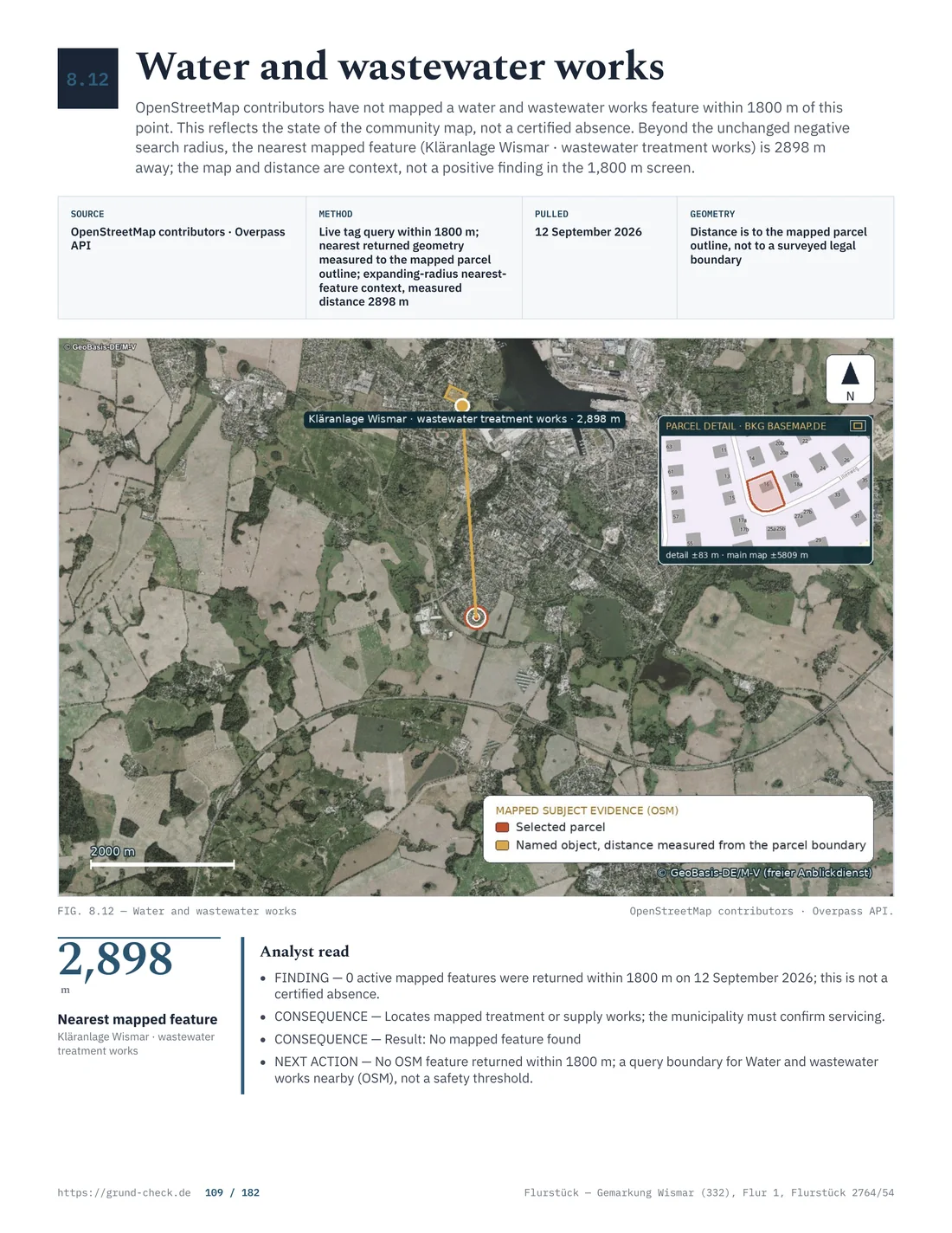
A municipal by-law defines the road category, the costs included and how the owners' share is allocated. It also covers the billing area, special benefit, advance payments and whether a project has several construction phases. The municipality may assign information requests and notices to different offices.
Request the current by-law and the relevant resolutions. Do not ask only about the phrase "road development contribution": ask about development, improvement, renewal and first-time servicing measures for the exact road section. A spoken "nothing is due" is too vague if the sewer, pavement or lighting is handled separately.
Documents buyers should request
The plot file should identify the Flurstück (official cadastral parcel) number, road name and precise position beside the public road facility. Request contribution notices, advance-payment notices, settlement agreements, deferrals and correspondence with the municipality. A new development area also requires the development agreement.
The property due diligence checklist should include a dated written contribution statement. Grundbuch and ALKIS, the land register and cadastral information systems, help reconcile the parcel and owner, while the notary process and closing help allocate claims that have already arisen.
- First developmentFederal BauGB contribution remains
- Later road improvementState law: abolished, optional or levied
- Actual assessmentCheck local by-law, reference date and owner
Source: BauGB §§ 127 to 135 and municipal-charges acts of the 16 states; checked August 2026
Cut-off date, seller duties and the contract
An outstanding claim may legally concern the seller or buyer, while the contract distributes the economic burden differently. The decisive points are when the claim arose, when the notice was served and what the contract says. A clause stating that the buyer bears "all public charges" should not be accepted without a time limit.
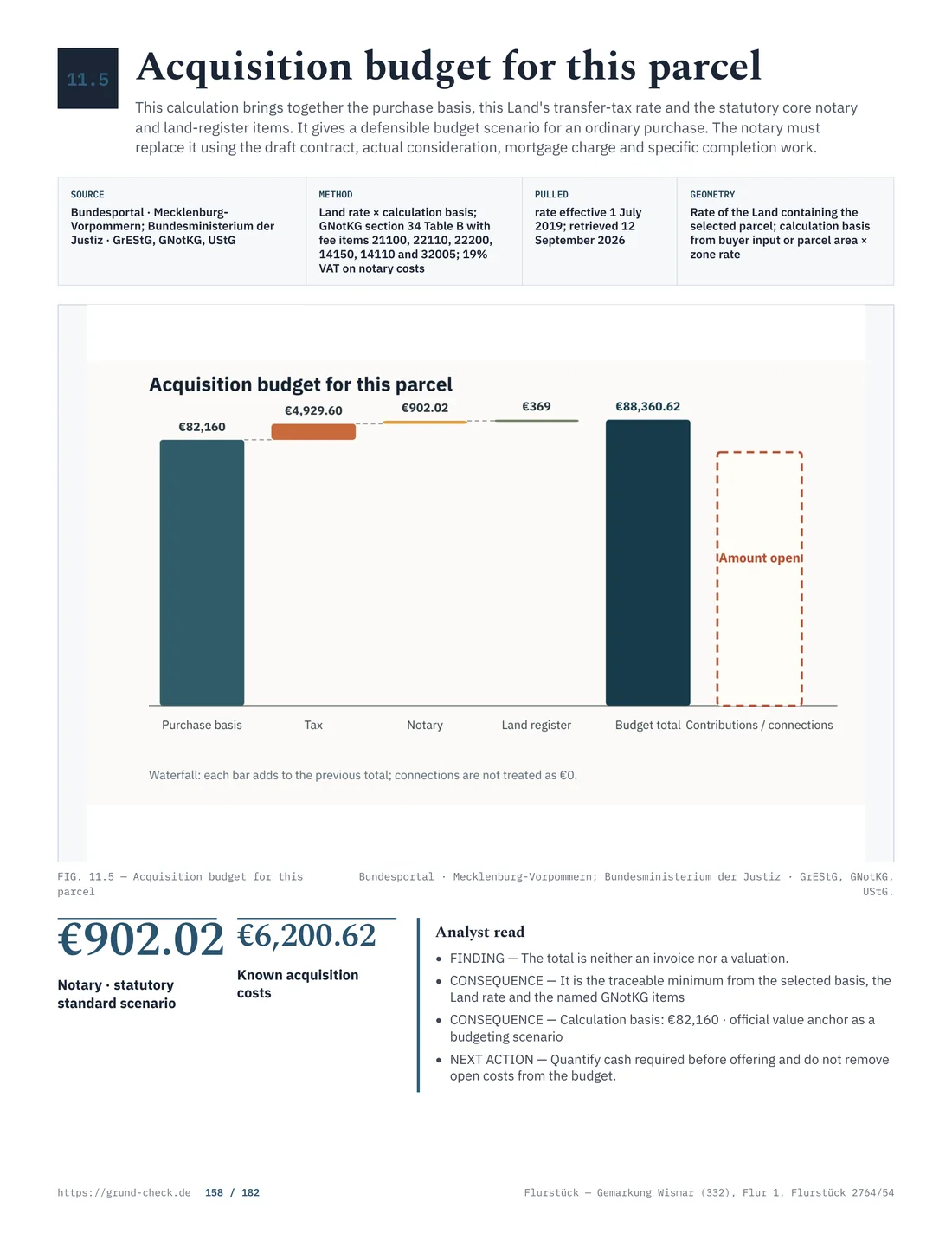
For an ongoing road project, the contract should state the cut-off date, current cost position and municipal information. Options include retention of funds, an indemnity for earlier projects or a seller obligation to pay a notice personally. Purchase costs and property charges must then be budgeted separately from real estate transfer tax, the notary and the land register.
Price risk and financing
An announced road renewal can affect the plot's value and liquidity even when the exact amount is not known. Banks often ask about outstanding public charges and servicing. A low purchase price offers little protection if a later claim has to be paid from equity.
The amount can be assessed properly only after reading the by-law, improvement plan and current cost position. The Bodenrichtwert and land value, the standard land value and market context, do not show the buyer's personal contribution liability. If planning is ongoing, ask the municipality to identify the affected section in writing.
Review order before the notary appointment
First establish whether the issue is first-time servicing or improvement of an existing road. Then review state status, the municipal by-law and the file for the specific section. Only afterwards assess the share, due date and allocation between the parties.
If the information does not match the parcel boundary or road section named in the listing, resolve the discrepancy before notarisation. An unclear notice warrants advice on municipal contribution law. Approvals and public procedures and the zoning and buildability check can provide further clues about planned servicing.
Clarify road costs before buying. A GrundCheck report organises the parcel, location and publicly visible property risks for the next stage of review. Check a property.
For comparison, see setback rules by state, land transfer tax by state, monument protection by state, permit-free building by state and geoportals by state.
Sources and review date
The federal distinction for first-time servicing rests on § 123 BauGB, § 127 BauGB, § 129 BauGB and § 133 BauGB. The state sources for the sixteen status entries appear in the table. The municipal by-law and the specific road section remain necessary for an individual review.
Stand: August 2026. This is general information and does not replace a municipal contribution-law review of a specific notice or plot.
Further reading: access and infrastructure, costs, taxes and fees, property due diligence checklist, land transfer tax by state, setback rules by state, building obligations by state, monument protection by state, permit-free building by state and geoportals by state.