
Costs and taxes
German land purchase costs: tax and fees
Every euro that lands on top of a German plot's purchase price, who bills it, when it arrives, and what it adds up to on a worked example.
On this page
The short answer, before the detail
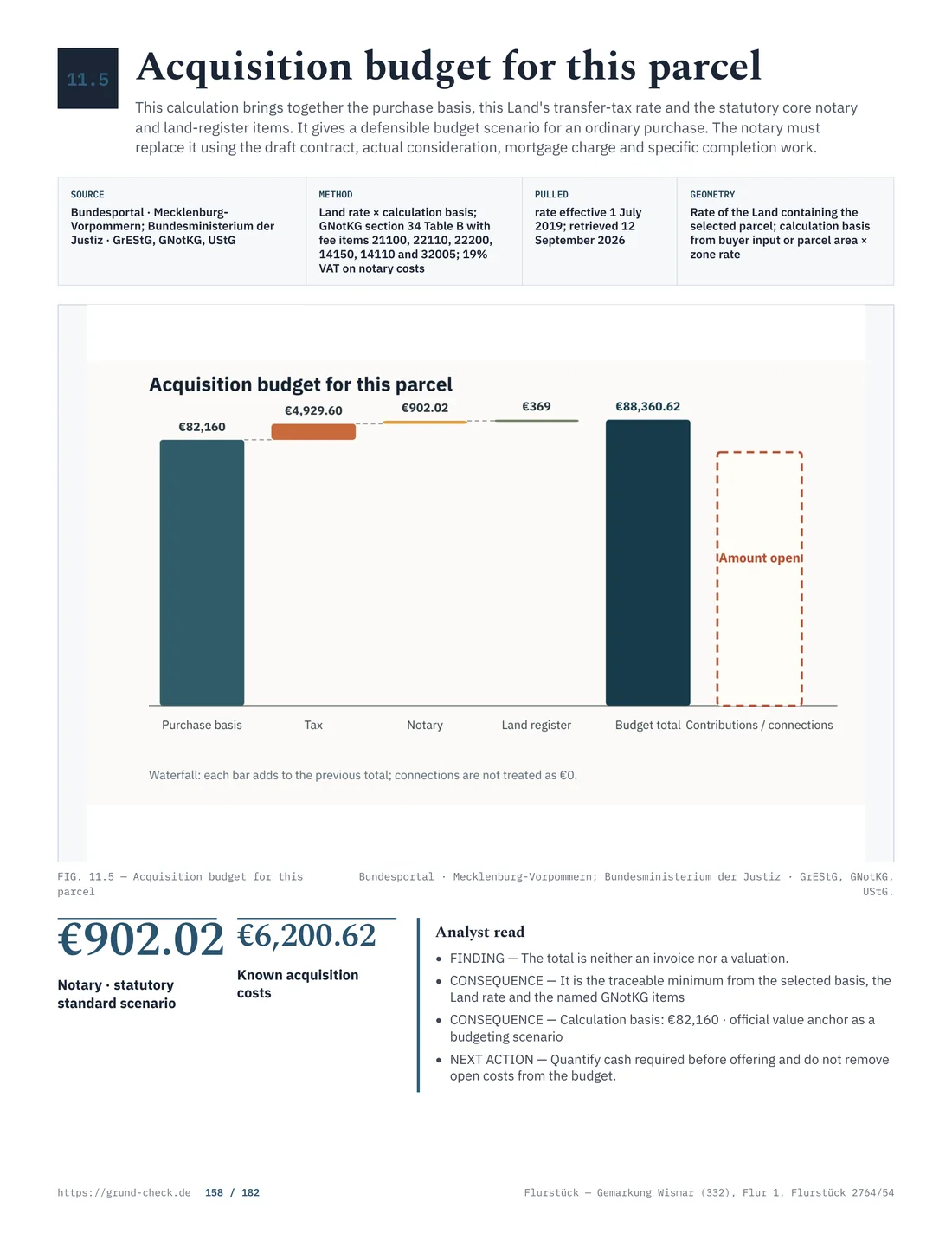
For a German plot bought without an agent, budget roughly eight percent on top of the purchase price for tax, notary and land registry. With an agent, budget fifteen. Then treat three further items as open questions rather than percentages, because they depend on the parcel and not on the price: a possible Erschließungsbeitrag for the road, connection charges for water, sewer and power, and the annual Grundsteuer.
Worked through on a real example. An 800 square metre plot in the wider regional market, priced at the 2025 regional average of 111 € per square metre (market report 2025), costs 88,800 €. Add 5,772 € of transfer tax and about 1,200 € of notary and registry charges and you are at 95,772 € before a single connection has been applied for. Federal law fixes transfer-tax, VAT and notarial rules; state law sets rates and fee ordinances; the municipality sets local charges through its by-law. Put the same plot in a metropolitan ring at 318 € per square metre and the purchase is 254,400 €, the tax alone is 16,536 €, and the notary and registry share falls to roughly one percent because the fee table rises far more slowly than the price does.
Grunderwerbsteuer: the rate depends on the state
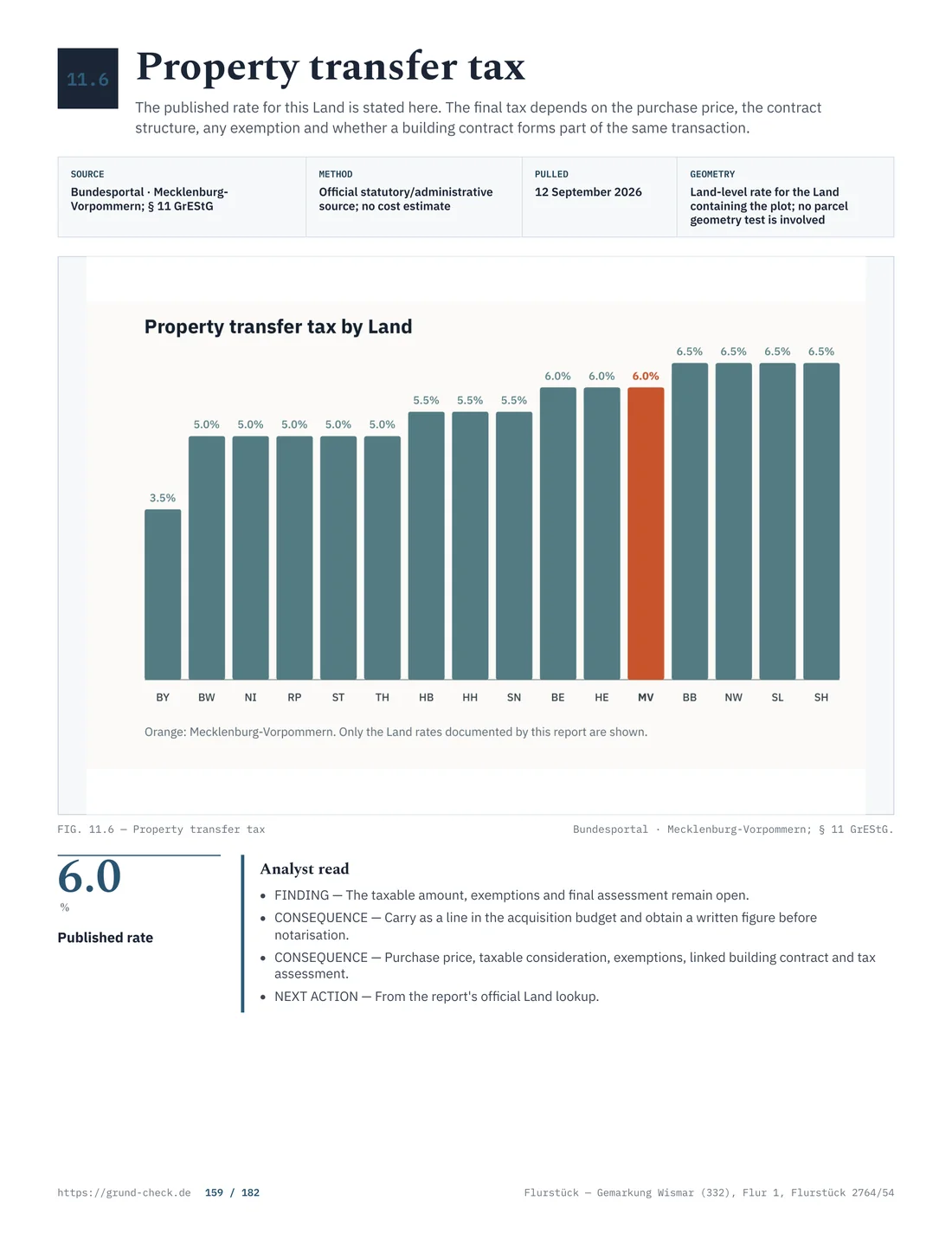
Brandenburg charges 6.5 percent transfer tax on land purchases, one of the highest rates in Germany. It has applied to every transaction concluded from 1 July 2015 under the state's law setting the transfer tax rate; before that it was 5 percent. The responsible tax offices publish the current rate and the filing route. The state-specific schedules in the comparison use § 1 of the relevant rate law, § 1 Abs. 2 GrEStFG, § 11 GrEStG and § 11 Abs. 1 GrEStG as their legal bases.
The base is the consideration under § 8 GrEStG, which is normally the purchase price plus anything else you take on, such as an assumed loan or a commitment to the seller. Moveable items sold alongside the land, for example a shed's contents or a caravan, are not land and can be listed separately in the contract at a defensible value, which lowers the base. Do not invent that value. The tax office compares it with reality.
Both parties are liable to the tax under § 13 GrEStG, and contracts almost always place it on the buyer, but the liability stays joint: if the buyer does not pay, the office can turn to the seller. The notary reports the deed, the tax office issues an assessment, and payment is due one month after the notice under § 15 GrEStG unless a different date is set.
§ 3 GrEStG exempts a short list of cases. The two that come up most: purchases where the taxable value does not exceed 2,500 €, and purchases between spouses, registered partners, former spouses in the division of property after divorce, and relatives in the direct line, which includes parents, children and grandchildren along with stepchildren. Siblings are not in the direct line and are not exempt.
Why registration waits for one piece of paper
§ 22 GrEStG forbids the land registry from entering a new owner until the tax office has issued the Unbedenklichkeitsbescheinigung, its clearance certificate. That single rule sets the rhythm of the whole transaction. Signing does not make you the owner; ownership passes on registration, and registration waits for the tax.
The gap is normally a few weeks and can be longer in busy districts. It is bridged by the Auflassungsvormerkung, a priority notice entered for the buyer soon after signing, which blocks the seller from selling or mortgaging the parcel to anyone else in the meantime. Never release the purchase price before the notice is registered and the agreed conditions are confirmed by the notary. That sequencing is the single most valuable thing a German notary does for a buyer.
Before you budget, know what you are buying. A GrundCheck preflight report resolves the address to an official parcel and flags the planning and risk context that decides whether the extra costs are 8 percent or a different number entirely. Check a parcel.
Notary and land registry: how the bill is actually built
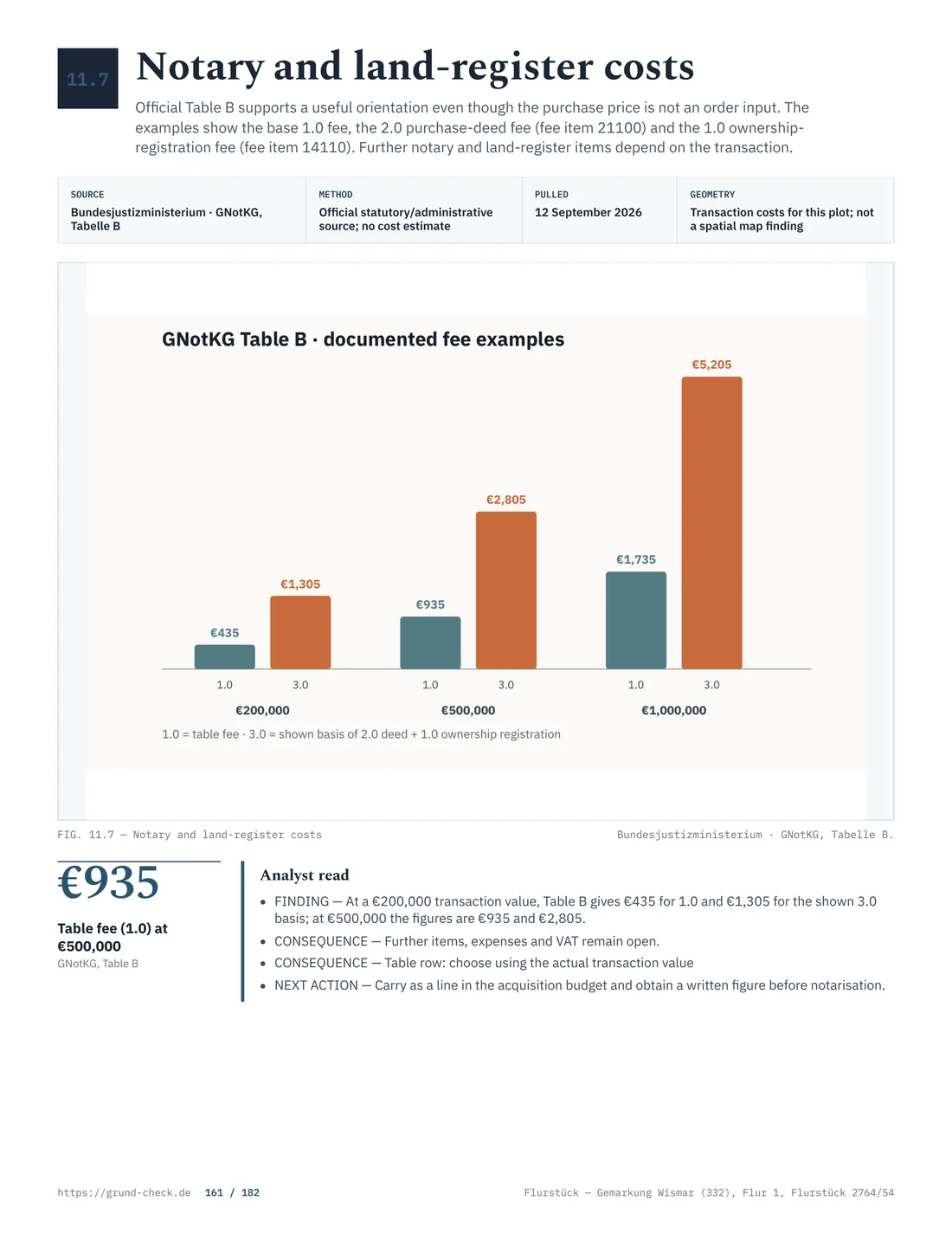
Notary fees in Germany are not negotiable and not a percentage. They come from the GNotKG: a Geschäftswert, normally the purchase price, is looked up in Tabelle B to give a base fee, and each act in the schedule of charges is a multiple of that base. Every notary in the country charges the same, so shopping around on price is pointless.
Take the 88,800 € plot. The base fee at that value is 246 €. The deed itself is charged at twice the base, so 492 €. The land registry charges half the base for the priority notice, 123 €, and one full base for registering the new owner, 246 €. Those four figures are fixed by law and come to 861 €. On top sit the notary's execution and supervision fees, small disbursements, and 19 percent VAT on the notary's share but not on the court's. The realistic total lands between 1,050 € and 1,250 €.
Two lines are easy to forget. A mortgage costs extra: registering a Grundschuld of 200,000 € adds roughly 435 € to the notary and the same again to the registry. And a Grundbuch extract is cheap and worth having: 10 € for a plain print, 20 € for a certified one, both fixed amounts in the same schedule.
No VAT on the land, VAT on the services
The sale of land is exempt from VAT under § 4 Nr. 9a UStG, because it is already caught by the transfer tax. Buyers from abroad often assume 19 percent is hiding somewhere in the price. It is not. VAT does appear on the services around the purchase: the notary's fee, the agent's commission, the surveyor, the architect. Court and registry fees carry none.
The agent's commission, and the rule that does not apply to plots
Since December 2020, §§ 656a to 656d BGB have forced agents to split their commission evenly between buyer and seller. That protection covers flats and single-family houses bought by consumers. It does not cover an undeveloped plot. § 656c BGB and its neighbours simply do not reach a bare building plot, so on land the whole commission can be, and often is, loaded onto the buyer.
In the metropolitan market that usually means 7.14 percent including VAT, which on a 254,400 € plot is 18,164 €, more than the transfer tax. It is negotiable, unlike the tax. Agree the figure, who pays it and what triggers it in writing before you make an offer, and check whether the commission clause survives if the purchase fails on a condition.
Surveying: sometimes optional, sometimes unavoidable
Boundaries in the cadastre are data. Boundaries on the ground are marks, and the two do not always agree. A Grenzfeststellung by a publicly appointed surveyor establishes the legal boundary and sets the markers, and it is charged from the state surveying fee ordinance, whose tariffs were revised with effect from 1 January 2026. Budget for it whenever the boundary is unmarked, the plot is being split, a fence or building sits close to the line, or a neighbour has a different idea of where the line runs. A split of a parcel always needs a surveyor, and the new parcel numbers have to exist before the notary can convey the piece.
Source: § 11 GrEStG and the rate statutes of the 16 states; checked August 2026
Erschließungsbeitrag: the bill that arrives after you own the plot
This is the item that ruins budgets, because it is not tied to the purchase at all. When a municipality builds a public road, footway, square or the associated lighting and drainage for the first time, § 127 BauGB lets it recover the cost from the adjoining owners. § 129 Abs. 1 BauGB requires the municipality to carry at least ten percent itself, so up to ninety percent is spread over the plots. Under § 133 BauGB the charge only arises once the facility is finally completed, and the municipality may demand advance payments before that.
The consequence is blunt: a plot on an unmade road can be sold today and billed in four years, and the bill follows the person who owns it when the charge arises, not the person who owned it when the road was planned. There is only one way to handle this. Ask the Gemeinde in writing whether the road serving the parcel has been finally completed within the meaning of § 133 BauGB, whether any Erschließungsbeitrag or advance payment is still outstanding, and whether any expansion is in the current programme. Put the answer in the contract.
Do not confuse this with two other charges. The Straßenausbaubeitrag for rebuilding existing roads was abolished by the relevant state law of 19 June 2019, backdated to 1 January 2019, so no municipality may levy it for work from that date. And the connection contribution for water and sewer runs on a different track entirely, under § 8 of the applicable municipal charges act and the by-law of the responsible utility association. The utility connection guide works through those figures, which on a typical plot run from a few hundred euros for the contribution to several thousand for the physical connections.
Grundsteuer: what you pay every year from now on
The applicable state applies the federal Grundsteuer model from 1 January 2025. Three factors multiply. The tax office sets a Grundsteuerwert, which for an undeveloped plot is simply the area times the Bodenrichtwert under § 247 BewG. That is multiplied by the Steuermesszahl in § 15 GrStG, which is 0.34 per mille for undeveloped land and 0.31 per mille for residential property. The municipality then applies its Hebesatz under § 25 GrStG. State models add their own rules: Bavaria's area model cites Art. 1 and Art. 3 BayGrStG, while Hamburg's model uses § 4 HmbGrStG.
On the 800 square metre plot with a Bodenrichtwert of 110 € per square metre, the value is 88,000 €, the assessment amount is 29.92 €, and the annual tax is that times the local rate. the worked state's rates for Grundsteuer B in 2025 ranged from 150 to 610 percent, so the same plot costs between 45 € and 183 € a year depending purely on which municipality it sits in. Look up the actual figure in the Hebesatz register before you buy, and read the overview from the tax offices for the assessment route. Once a house stands on the plot the value and the rate both change, usually upwards.
The costs nobody quotes a foreign buyer
If you do not speak German well enough to follow the deed, the notary either translates personally or brings in an interpreter, and you may ask for a written translation of the contract as well. Both are chargeable. A sworn interpreter for a notary appointment in Germany typically costs a few hundred euros, and a written translation of a purchase contract is priced by the line, so a normal deed runs into the high hundreds. Ask for both figures when you ask for the cost estimate, and send the draft contract for translation early rather than on the morning of the appointment.
Two more items belong in a cross-border budget. If you cannot attend, a power of attorney has to be notarised and, outside the EU, usually apostilled, which adds cost and roughly two weeks. And paying from a non-euro account exposes the purchase price to the exchange rate and to the bank's spread, which on a 250,000 € purchase is easily a four-figure difference between a good and a careless transfer. Neither item appears in any percentage rule of thumb, and both are real money.
The whole budget on one page
| State | Verification point |
|---|---|
| Baden-Württemberg | Current real-estate transfer tax: consult the current state guide and confirm the applicable official value or rule for the parcel. |
| Bavaria | Current real-estate transfer tax: consult the current state guide and confirm the applicable official value or rule for the parcel. |
| Berlin | Current real-estate transfer tax: consult the current state guide and confirm the applicable official value or rule for the parcel. |
| Brandenburg | Current real-estate transfer tax: consult the current state guide and confirm the applicable official value or rule for the parcel. |
| Bremen | Current real-estate transfer tax: consult the current state guide and confirm the applicable official value or rule for the parcel. |
| Hamburg | Current real-estate transfer tax: consult the current state guide and confirm the applicable official value or rule for the parcel. |
| Hesse | Current real-estate transfer tax: consult the current state guide and confirm the applicable official value or rule for the parcel. |
| Mecklenburg-Western Pomerania | Current real-estate transfer tax: consult the current state guide and confirm the applicable official value or rule for the parcel. |
| Lower Saxony | Current real-estate transfer tax: consult the current state guide and confirm the applicable official value or rule for the parcel. |
| North Rhine-Westphalia | Current real-estate transfer tax: consult the current state guide and confirm the applicable official value or rule for the parcel. |
| Rhineland-Palatinate | Current real-estate transfer tax: consult the current state guide and confirm the applicable official value or rule for the parcel. |
| Saarland | Current real-estate transfer tax: consult the current state guide and confirm the applicable official value or rule for the parcel. |
| Saxony | Current real-estate transfer tax: consult the current state guide and confirm the applicable official value or rule for the parcel. |
| Saxony-Anhalt | Current real-estate transfer tax: consult the current state guide and confirm the applicable official value or rule for the parcel. |
| Schleswig-Holstein | Current real-estate transfer tax: consult the current state guide and confirm the applicable official value or rule for the parcel. |
| Thuringia | Current real-estate transfer tax: consult the current state guide and confirm the applicable official value or rule for the parcel. |
| State | Verification point |
|---|---|
| Baden-Württemberg | Current property-tax model: consult the current state guide and confirm the applicable official value or rule for the parcel. |
| Bavaria | Current property-tax model: consult the current state guide and confirm the applicable official value or rule for the parcel. |
| Berlin | Current property-tax model: consult the current state guide and confirm the applicable official value or rule for the parcel. |
| Brandenburg | Current property-tax model: consult the current state guide and confirm the applicable official value or rule for the parcel. |
| Bremen | Current property-tax model: consult the current state guide and confirm the applicable official value or rule for the parcel. |
| Hamburg | Current property-tax model: consult the current state guide and confirm the applicable official value or rule for the parcel. |
| Hesse | Current property-tax model: consult the current state guide and confirm the applicable official value or rule for the parcel. |
| Mecklenburg-Western Pomerania | Current property-tax model: consult the current state guide and confirm the applicable official value or rule for the parcel. |
| Lower Saxony | Current property-tax model: consult the current state guide and confirm the applicable official value or rule for the parcel. |
| North Rhine-Westphalia | Current property-tax model: consult the current state guide and confirm the applicable official value or rule for the parcel. |
| Rhineland-Palatinate | Current property-tax model: consult the current state guide and confirm the applicable official value or rule for the parcel. |
| Saarland | Current property-tax model: consult the current state guide and confirm the applicable official value or rule for the parcel. |
| Saxony | Current property-tax model: consult the current state guide and confirm the applicable official value or rule for the parcel. |
| Saxony-Anhalt | Current property-tax model: consult the current state guide and confirm the applicable official value or rule for the parcel. |
| Schleswig-Holstein | Current property-tax model: consult the current state guide and confirm the applicable official value or rule for the parcel. |
| Thuringia | Current property-tax model: consult the current state guide and confirm the applicable official value or rule for the parcel. |
| Item | Legal basis | Who bills you | 800 m² at 111 €/m² | 800 m² at 318 €/m² |
|---|---|---|---|---|
| Purchase price | Contract, § 311b BGB | Seller, via the notary | 88,800 € | 254,400 € |
| Grunderwerbsteuer 6.5 % | GrEStG, state rate law | Tax office | 5,772 € | 16,536 € |
| Notary and land registry | GNotKG | Notary, Amtsgericht | about 1,200 € | about 2,400 € |
| Agent, if involved | Free agreement for plots | Agent | up to 6,340 € | up to 18,164 € |
| Grundschuld registration | GNotKG | Notary, Amtsgericht | about 500 € | about 950 € |
| Grenzfeststellung, if needed | VermGebO | Surveyor | quoted per case, four figures is normal | |
| Erschließungsbeitrag | §§ 127, 129, 133 BauGB | Gemeinde | ask in writing; can arrive years later | |
| Water and sewer contribution | § 8 KAG and by-law | Zweckverband | by-law rate per square metre | |
| Grundsteuer, yearly | GrStG, BewG | Gemeinde | 45 to 183 € | varies with the local rate |
When each item actually falls due
- At the notary appointment: nothing, in most cases. The deed is signed and the notary starts the machinery.
- Within days: the priority notice is applied for and the notary reports the sale to the tax office.
- Two to six weeks: the transfer tax assessment arrives, payable one month later.
- After the conditions are met: the notary calls the purchase price. Only then does the money move.
- After tax clearance: the registry enters the new owner, usually a few weeks to a few months after signing.
- The following January: the first Grundsteuer notice.
- Whenever the municipality finishes the road: the Erschließungsbeitrag, which may be years away.
What to have in the file before you sign
- A written statement from the Gemeinde on Erschließungsbeitrag status and any advance payment.
- The connection contribution by-law of the water and sewer association, with the current rate per square metre.
- The municipality's current Hebesatz for Grundsteuer B and the Bodenrichtwert for the zone from state BORIS register.
- The notary's written cost estimate for the deed, the priority notice, the transfer and, if applicable, the mortgage.
- The agent's commission agreement, with the amount, the payer and the trigger.
- A current Grundbuch extract, so that the charges in Abteilung III are known before the price is set.
- Written quotations for the connections you will need, not estimates from the seller.
One parcel, one document, before the notary. Order a GrundCheck preflight report and take the parcel identity, planning context and risk flags to your bank in the same week you make the offer. Check a parcel.
Source: Worked table in this article; GrEStG, GNotKG and GBO; checked August 2026
Where these rules are written
- Transfer tax: state rate law, § 3, § 8, § 13, § 15 and § 22 GrEStG.
- Notary and registry charges: GNotKG Tabelle B and the schedule of charges. Notarial form: § 311b BGB. VAT exemption on land: § 4 Nr. 9a UStG.
- Agent commission: §§ 656a ff. BGB.
- Development contributions: § 127, § 129 and § 133 BauGB; utility contributions: applicable KAG.
- Annual property tax: § 15 and § 25 GrStG, § 247 BewG, state Hebesatz register.
- Surveying fees: state VermGebO. Market figures: property market report 2025.
Rules and figures were checked in August 2026. This is general information for buyers, not tax or legal advice on your transaction. Read next: the notary and closing process, what the Grundbuch and ALKIS each prove, utility connection costs and the full due diligence checklist.
Where the price alone does not answer the question, two texts help: land that is expected to become building land, dividing a plot.
What differs between states
Transfer-tax rates, property-tax models and some road charges differ by state. Confirm the current rate and municipal assessment basis.
Which level of government sets the rule?
Federal law governs the notarial transfer and fee framework; state and municipal rules determine several taxes and local charges.