
State
Buying land in Baden-Württemberg: checks and costs
Baden-Württemberg adds its own rules on setbacks, land values, Baulasten, water margins and real-estate transfer tax to the purchase check.
On this page
The Baden-Württemberg purchase framework
Buying a plot in Baden-Württemberg means applying federal law together with the Landesbauordnung für Baden-Württemberg, abbreviated LBO, the state's building code. The municipality adds the binding Bebauungsplan (binding local development plan), local building by-laws and other Satzungen. The main risks arise where those rules overlap: a plot can look clear in a public portal and still be less usable because of a setback, access route, Gewässerrandstreifen (a protected strip along a watercourse) or Baulast (a public-law building obligation recorded in a separate register).
The general framework remains in § 5 LBO. The current state-law text is available in the Baden-Württemberg LBO in Landesrecht and in the Landesbauordnung PDF. For the wider planning context, use the zoning and buildability check and the property due-diligence checklist.
- Setbacks under the LBO
- Baulasten and the land register
- BORIS-BW and the purchase price
- Watercourse margins
- Monuments, agriculture and neighbours
Source: LBO BW; Geoportal Baden-Württemberg; BORIS-BW; Bodenschutz- und Altlastenkataster; checked August 2026
Setbacks under the LBO
§ 5 Abs. 7 LBO sets the ordinary setback at 0.4 H and at least 2.5 m. In core areas the factor is 0.2 H, again with a minimum of 2.5 m. In commercial areas it falls to 0.125 H with the same minimum depth.
The rule has a special case for a narrow side: where a wall is no more than 5 m wide, the depth may not be less than 2 m. That is not a blanket exemption for every small plot. Building height, wall width, zoning category and the particular Bebauungsplan must be read together. A local building by-law can add design rules or regulate the urban situation differently.
Preliminary decisions and the local procedure
A Bauvoranfrage can settle the decisive uncertainty before purchase. Under § 57 LBO, a Bauvorbescheid, a preliminary building decision, remains valid for three years; an extension may be requested under the statutory conditions. The contract should identify the particular decision and the assumptions on which it rests.
Baden-Württemberg uses the Kenntnisgabeverfahren for its state-specific route. A separate Genehmigungsfreistellung with one uniform building-class limit and a blanket weekly deadline is not confirmed for the term examined here. Under § 52 LBO, the municipality participates and may require a normal approval procedure where the statutory conditions allow it. The Service-BW responsibility finder helps identify the correct application. A verfahrensfreies Vorhaben is not automatically lawful under planning law.
Baulasten and the land register
§ 72 LBO provides for the Baulastenverzeichnis, the register of public-law building obligations. A Baulast is normally administered by the municipality, city administration or local building-law authority. Before buying, obtain the register information and do not rely only on the Grundbuch, the land register. The Serviceportal Baden-Württemberg Baulasten service describes the request.
The checked source does not confirm a state-wide private-law substitute with the same effect. Without a confirmed answer, it remains unclear whether parking, access, setbacks or service lines are secured under public law. The guide to easements and building obligations explains why a land-register entry does not replace a Baulastenverzeichnis extract. Both checks must identify the same Flurstück (cadastral parcel) and match the intended use.
ALKIS and ownership information
The Liegenschaftskataster, the official real-estate cadastre, is supplied in Baden-Württemberg through ALKIS. Official extracts and products of the surveying administration are not generally free under § 2 VermG BW. The LGL ALKIS product page distinguishes free open-data map products without ownership details from fee-based data containing ownership details.
There is no confirmed general free online plot enquiry with owner data. Before applying, decide whether the need is a map extract, an official cadastral extract or an owner-related enquiry. Private services should not be mistaken for the surveying administration. The land-register and ALKIS guide helps keep parcel identity and ownership information separate.
BORIS-BW and the purchase price
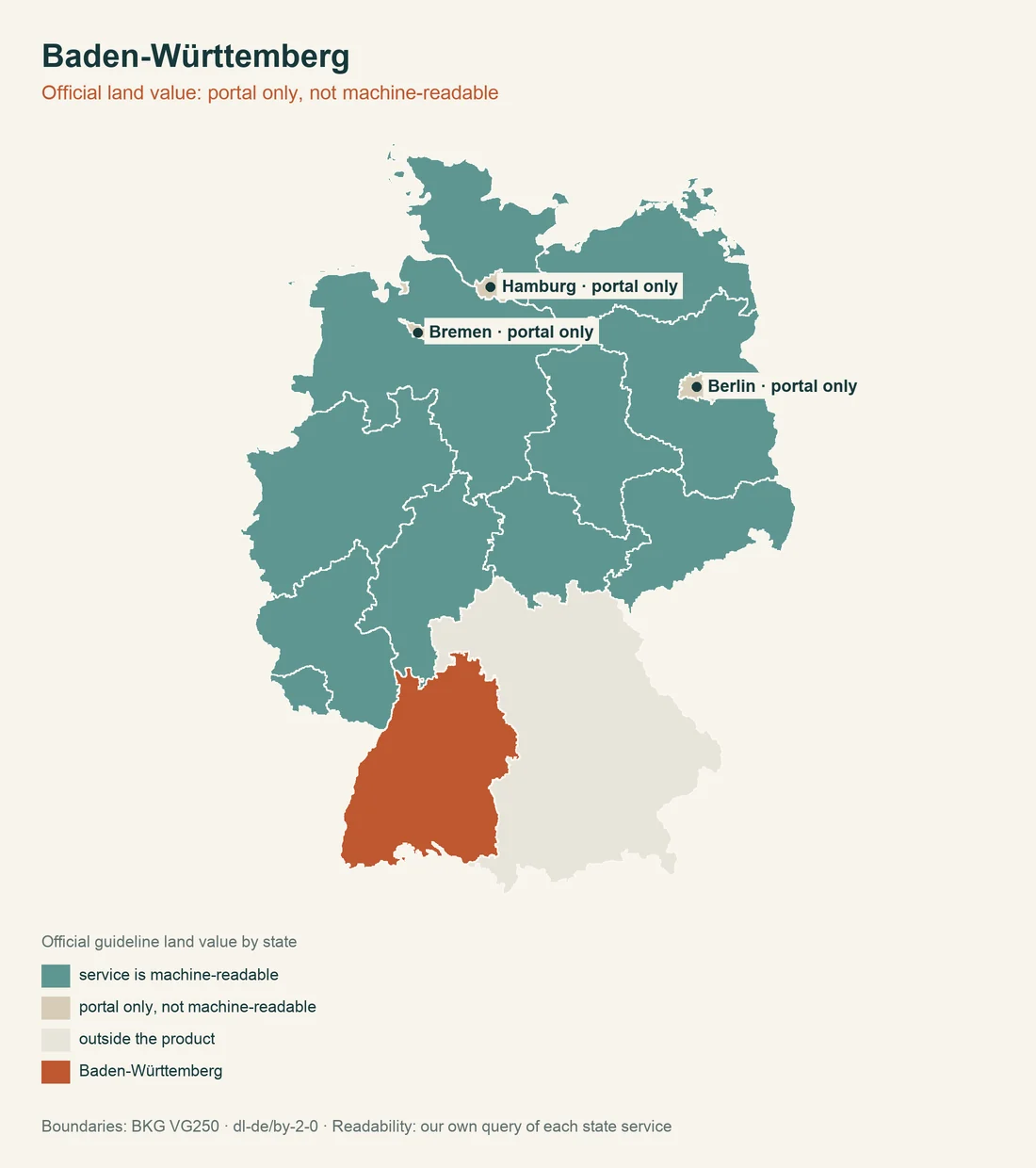
§ 196 BauGB and § 12 Gutachterausschussverordnung BW provide the framework for Bodenrichtwerte, official average land values. The official BORIS-BW portal publishes the values online free of charge. A value describes a zone and a standardised plot, not automatically the exact Flurstück.
The Baden-Württemberg statistics give an average 2024 purchase value for baureifes Land of 362.06 EUR per m². That state average is a statistic, not a Bodenrichtwert. Location, development status, servicing, shape and burdens can move the asking price. The Bodenrichtwert and land-value guide explains the general terms; for this state, the particular BORIS-BW entry controls the comparison.
What differs in your state
The setback figure is a useful cross-state screening point. Use the generated table as a first comparison, then apply the Baden-Württemberg rule to the actual plot and the municipality's plan.
| State | Value | Legal basis | Source |
|---|---|---|---|
| Baden-Württemberg | Standard rule: Generally 0.4 H, at least 2.5 m. Core areas: In core areas, 0.2 H applies, at least 2.5 m. Commercial areas: In commercial areas, 0.125 H applies, at least 2.5 m. Narrow sides: For walls up to 5 m wide, the depth must not be less than 2 m. | § 5 Abs. 7 LBO | Source Baden-Württemberg |
| Bavaria | Standard case: 0.4 H, at least 3 m. The building setback is 0.4 H, at least 3 m. Commercial and industrial areas: 0.2 H at least 3 m. In commercial and industrial areas it is 0.2 H, at least 3 m. Large cities with over 250,000 inhabitants: 1 H; on up to two external walls 0.5 H Art. 6 Abs. 5a contains this special rule outside certain areas if the surrounding area is characterized accordingly. | Art. 6 Abs. 5 BayBO | Source Bavaria |
| Berlin | As a rule: 0.4 H at least 3 m building setbacks must be kept clear in front of external walls and roofs; basically 0.4 H, at least 3 m. Commercial and industrial areas: 0.2 H at least 3 m. The special statutory scale applies to certain commercial or industrial areas. | § 6 Abs. 5 BauO Bln | Source Berlin |
| Brandenburg | Standard case: 0.4 H, at least 3 m. The depth of the building setback is 0.4 H, at least 3 m. Commercial and industrial areas: 0.2 H at least 3 m. In commercial and industrial areas, 0.2 H is sufficient, at least 3 m. Building classes 1 and 2 with a maximum of three floors above ground: 3 m In front of the outer walls, a depth of 3 m is sufficient. | § 6 Abs. 5 BbgBO | Source Brandenburg |
| Bremen | § 6 Abs. 6 Satz 1 BremLBO – Standard case: 0.4 H at least 3 m The depth of the building setback is 0.4 H, at least 3 meters. § 6 Abs. 6 Satz 2 BremLBO – Commercial and industrial areas: 0.2 H, at least 3 m. In commercial and industrial areas, a depth of 0.2 H, at least 3 meters, is sufficient. § 6 Abs. 6 Satz 3 BremLBO – small buildings: 3 m In front of external walls of buildings in building classes 1 and 2 with a maximum of three floors above ground, 3 meters is sufficient. § 6 Abs. 6 Satz 4 BremLBO – neighbour-protecting effect: 0.75 Only three quarters of the required depth, but at least 2.50 meters, have a neighbour-protecting effect. | § 6 Abs. 6 BremLBO | Source Bremen |
| Hamburg | Standard case: 0.4 H at least 2.5 m § 6 Abs. 5 Satz 1 HBauO: Depth of the building setback 0.4 H, at least 2.50 m. Commercial and industrial areas: 0.2 H at least 2.5 m § 6 Abs. 5 Satz 2 HBauO: 0.2 H, at least 2.50 m; the standard rule (0.4 H) applies again at borders to other building areas. Bebauungsplan with different regulations: as set in the Bebauungsplan § 6 Abs. 5 Satz 3 HBauO: If a Bebauungsplan sets other distances, these take precedence. Garages and outbuildings without their own building setback: wall height up to 3 m, length up to 9 m per property line § 6 Abs. 8 HBauO allows garages, building-independent solar systems, retaining walls/enclosures and heat pumps without their own building setback, a maximum of 15 m in total per property. | § 6 HBauO | Source Hamburg |
| Hesse | Standard rule: 0.4 H at least 2.5 m. The depth is generally 0.4 H; according to the current version, at least 2.50 m applies. Commercial and industrial areas: 0.2 H at least 2.5 m The reduced depth only applies in the legally specified areas and not to areas of other use. Narrow sides and border developments: Special rules according to § 6 Abs. 6 und 11 HBO Separate requirements apply to certain subordinate components and border garages; Bebauungsplan and local statutes remain to be checked additionally. | § 6 Abs. 5 HBO | Source Hesse |
| Lower Saxony | As a rule: The distance is 0.5 H, at least 3 m. Commercial and industrial areas: In commercial and industrial areas, 0.25 H applies, at least 3 m. Narrow sides: special legal rules For border development and narrow sides, § 5 contains further special rules; they cannot be reduced to a single general factor. | § 5 Abs. 2 NBauO | Source Lower Saxony |
| Mecklenburg-Western Pomerania | Building classes 1 to 3: 3 m Fixed building setback depth of 3 m in front of the external walls, regardless of the building height (§ 6 Abs. 5 Nr. 1). Building class 4: 4 m Fixed building setback depth of 4 m (§ 6 Abs. 5 Nr. 2). Building class 5: 5 m Fixed building setback depth of 5 m (§ 6 Abs. 5 Nr. 3). Commercial and industrial areas as well as antenna systems in the Außenbereich: 0.2 H at least 3 m 0.2 H, at least 3 m (§ 6 Abs. 5 Nr. 4). Otherwise (fallback rule outside the building class circumstances): 0.4 H at least 3 m 0.4 H, at least 3 m (§ 6 Abs. 5 Nr. 5). | § 6 Abs. 5 LBauO M-V (Änderungsgesetz vom 26. Mai 2026, GVOBl. M-V 2026 Nr. 16 S. 524) | Source Mecklenburg-Western Pomerania |
| North Rhine-Westphalia | Standard rule: 0.4 H, at least 3 m. The depth is 0.4 H, at least 3 m. Commercial and industrial areas: 0.2 H at least 3 m. In commercial and industrial areas, 0.2 H is sufficient, at least 3 m. Core areas: 0.25 H at least 3 m In core areas 0.25 H applies, at least 3 m; Special rules apply to certain public areas. | § 6 Abs. 5 BauO NRW 2018 | Source North Rhine-Westphalia |
| Rhineland-Palatinate | Standard case: 0.4 H at least 3 m. The depth of the building setback is generally 0.4 H, at least 3 m. Special cases: Border garages and subordinate buildings § 8 Abs. 9 LBauO contains special requirements for systems without their own building setback; Location, wall height and boundary length must be checked individually. | § 8 LBauO Rheinland-Pfalz | Source Rhineland-Palatinate |
| Saarland | Normal case (§ 7 Abs. 5 Satz 1 und 5 LBO): 0.4 H, in all cases at least 3 m Residential buildings in building classes 1 and 2 with a maximum of three floors above ground (§ 7 Abs. 5 Satz 2 LBO): 3 m is sufficient as the depth of the building setback Commercial and industrial areas (§ 7 Abs. 5 Satz 3 LBO): 0.2 H, at least 3 m Core areas and non-recreational special areas (§ 7 Abs. 5 Satz 4 LBO): depth less than 0.4H may be permitted, but at least 3 m; not a fixed factor in the law Wind turbines (§ 7 Abs. 8 LBO): 0.25 H in the Außenbereich or in special areas for wind energy, otherwise 0.4 H Antennas including masts in the Außenbereich (§ 7 Abs. 9 LBO): 0.2 H Walls without openings in commercial and industrial areas (§ 8 Abs. 1 LBO): 1.50 m or 2.50 m depending on fire resistance and building materials, not opposite property boundaries | § 7 Abs. 5 LBO | Source Saarland |
| Saxony | Standard rule: 0.4 H at least 3 m. The depth is generally 0.4 H, at least 3 m. | § 6 Abs. 5 SächsBO | Source Saxony |
| Saxony-Anhalt | Standard case: 0.4 H at least 3 m § 6 Abs. 5 Satz 1 BauO LSA: The depth is 0.4 H, at least 3 m. Commercial and industrial areas: 0.2 H at least 3 m § 6 Abs. 5 Satz 2 BauO LSA: In commercial and industrial areas 0.2 H is sufficient, at least 3 m. Residential buildings, building classes 1 and 2: 3 m In front of the outer walls of certain residential buildings of building classes 1 and 2, a depth of 3 m is sufficient according to § 6 Abs. 5 Satz 3. | § 6 Abs. 5 BauO LSA | Source Saxony-Anhalt |
| Schleswig-Holstein | Standard case: § 6 Abs. 5 LBO determines 0.4 H, at least 3 m. Commercial and industrial areas: In commercial and industrial areas, the legal requirements are 0.2 H, at least 3 m. Residential buildings, building classes 1 and 2: Special regulations For residential buildings of building classes 1 and 2, § 6 contains further special rules. Narrow-side privilege: yes § 6 contains a special legal regulation for certain narrow pages; the specific application is property-specific. | § 6 Absatz 5 LBO SH (Bekanntmachung der geltenden Fassung vom 5. Juli 2024, GVOBl. Schl.-H. 2024 Nr. 8, S. 504/522) | Source Schleswig-Holstein |
| Thuringia | Standard case: 0.4 H The depth of the building setback is generally 0.4 H, at least 3 m. Commercial, industrial and comparable special areas: 0.2 H In commercial and industrial areas as well as comparable special areas, the special depth of 0.2 H applies, at least 3 m, provided the legal requirement is met. | § 6 Abs. 5 ThürBO (Fassung vom 2. Juli 2024, GVBl. 2024, 298, Gültig ab 19.07.2024) | Source Thuringia |
Watercourse margins
§ 29 WG BW distinguishes the setting. In the Außenbereich, the outer planning area, the Gewässerrandstreifen is 10 m. In the Innenbereich, the built-up area, it is 5 m. The municipality may set a different Innenbereich width by by-law with the water authority's agreement.
The Regional Government watercourse-margin guidance should be checked against the local bank and cadastral boundary. A watercourse at the edge can affect the garden, buildable area and access position. For the planning map, use the Geoportal BW.
Contamination, ordnance and mining
Under § 9 LBodSchAG, the lower soil-protection and contaminated-land authorities maintain the Bodenschutz- und Altlastenkataster (BAK), the soil-protection and contaminated-land register. The LUBW contaminated-land information does not confirm general public online access to every plot-specific record. Request the particular information from the competent authority, and expect that a fee may apply.
The Kampfmittelbeseitigungsdienst Baden-Württemberg at Regierungspräsidium Stuttgart handles unexploded ordnance. The exact service name is Kampfmittelbeseitigungsdienst Baden-Württemberg (Regierungspräsidium Stuttgart), and advice, searching and clearance are provided against full reimbursement of costs. For historic mining, § 69 BBergG makes the Landesbergdirektion im Landesamt für Geologie, Rohstoffe und Bergbau (Regierungspräsidium Freiburg) the state-wide contact; its mining and resources information covers the subject.
Monuments, agriculture and neighbours
§§ 1 and 2 DSchG protect Kulturdenkmale, protected cultural monuments; entry in the Denkmalliste is declaratory. The same applies to Bodendenkmale, archaeological monuments, and the state-law Schatzregal makes qualifying finds state property under the statutory conditions. The Landesamt für Denkmalpflege map is a starting point, but the exact authority is Landesamt für Denkmalpflege im Regierungspräsidium Stuttgart; untere Denkmalschutzbehörden. The legal background is in the DSchG implementation guidance.
For agricultural and forestry land, § 1 ASVG generally sets a threshold of 1 ha; wine-growing and horticulture can involve 0.5 ha, and the Swiss border area can involve 0.1 ha. § 16 NRG generally gives a 2 m boundary distance for pome and stone fruit and 8 m for vigorous species. The confirmed source says there is keine allgemeine Pflicht für jedes Grundstück to fence. The Baden-Württemberg neighbour-law brochure and municipal tree-protection by-laws belong in the file. An Eigenjagdbezirk begins under § 7 BJagdG at 75 ha; no state departure from the federal figure is confirmed.
Tax and administrative fees
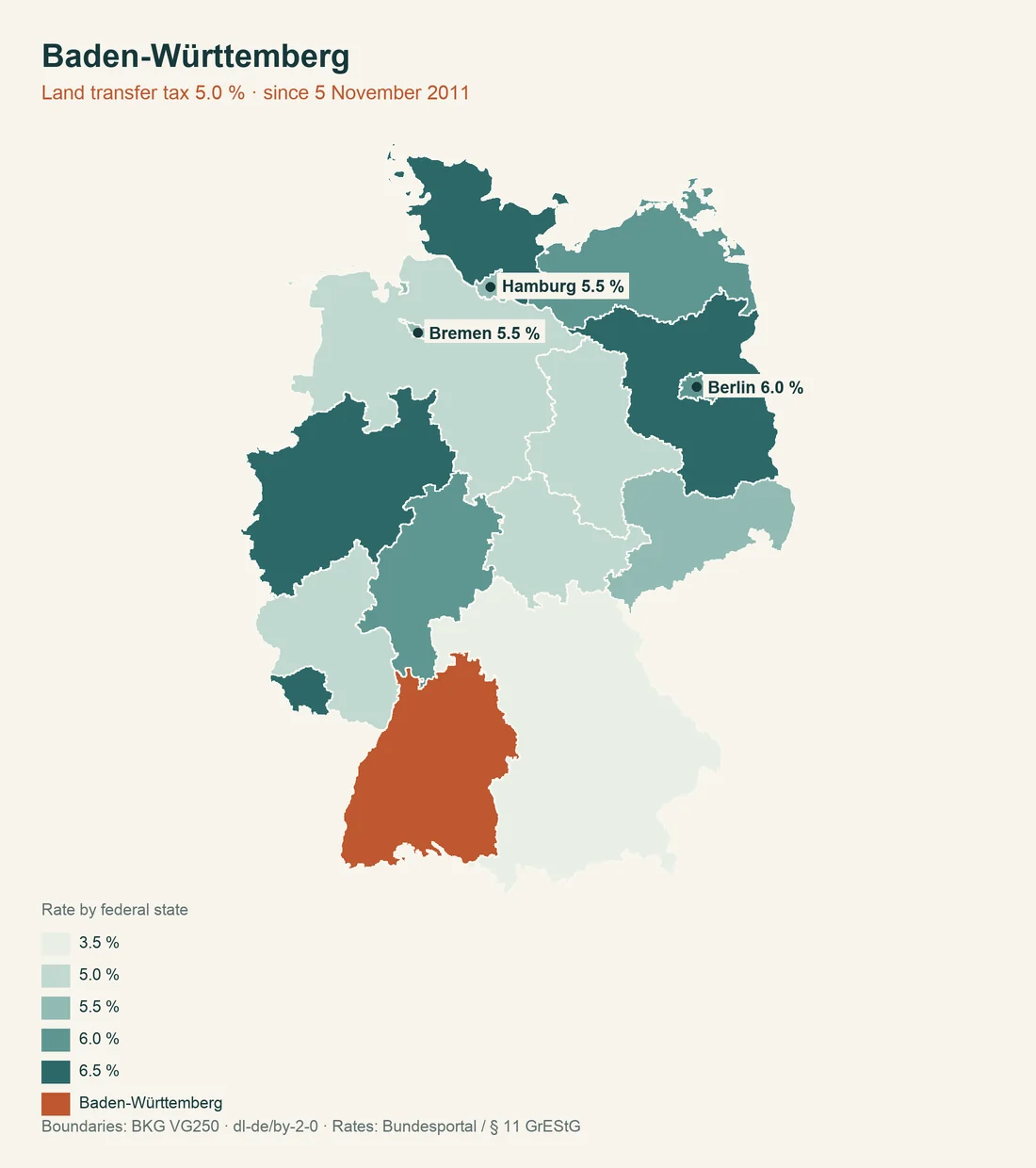
Real-estate transfer tax in Baden-Württemberg is 5 percent. The Baden-Württemberg tax administration explanation gives the rate and points legally to § 11 GrEStG together with the state rate statute. For Grundsteuer B, Baden-Württemberg uses the modifiziertes Bodenwertmodell under § 1 LGrStG. The municipality sets the Hebesatz.
The GebVO MLW contains the state fee framework for building-law administrative acts under § 1. The Gebührenverordnung MLW in the gazette does not replace checking the fee notice for the particular application.
- Planning lawMunicipality or building authority
- Parcel and mapGeoportal Baden-Württemberg
- Soil, value and hazardsSpecialist portal and competent authority
Source: LBO BW; Geoportal Baden-Württemberg; BORIS-BW; Bodenschutz- und Altlastenkataster; checked August 2026
A fixed purchase sequence
Start by confirming the Flurstück and ownership information through the appropriate ALKIS product. Place BORIS-BW, the Bebauungsplan, local building by-law and setback drawing together. Request the Baulastenverzeichnis, BAK, ordnance and historic-mining information from the competent offices. Then check the water margin, monument protection, neighbour distances and woodland or agricultural rules.
Responsibility is spread across offices. Landesrecht supplies the text; the Bebauungsplan map leads to the state-wide thematic map; the municipality confirms whether an individual plan is binding. For the next step, use the contaminated-site guide and the access and infrastructure guide.
Check the actual cadastral parcel. A GrundCheck property check brings registers, planning law and location risks together.
Comparisons and the authority's answer
For a state comparison, use the 16-state transfer-tax comparison and the 16-state setback comparison. For an application, name the plot, building envelope, use, access and legal question precisely enough for a reliable response. Under § 57 LBO, the three-year validity of a Bauvorbescheid is a time window, not a guarantee that a later design can depart from the approved assumptions.
Archive the state-law version with the municipal response. A site plan with setbacks and the water margin drawn on it is more useful for the designer and lender than a list of paragraph numbers. Do not schedule the notary appointment while contamination, ordnance or water distances have no responsible office.
Resolve open points before the notary appointment. A GrundCheck property check keeps state-law evidence and municipal answers tied to one parcel.
Keep every answer tied to the same parcel number and retrieval date; that simple discipline prevents a general portal result from becoming a false promise about the purchase.
Sources and checking date
Checked on 6 August 2026. The information is general and does not replace an answer from the responsible municipality, building-law authority or specialist office. Read next: Bodenrichtwert and land value, easements and building obligations, monuments and archaeology and building permits and pre-application. For the LBO itself, consult the Landesrecht text, the LBO version, the state-law source, the current legal text and the Baden-Württemberg law portal.
Addressing the state authorities
Identify the municipality, lower building authority and relevant specialist office, and use the exact parcel identifier in every request.
Record the open question
If an authority has not answered before notarisation, document the missing answer and address the resulting risk in the contract.