
State
Buying land in Saxony-Anhalt: planning, tax and heritage
Saxony-Anhalt has its own rules for setbacks, Baulasten, water, monuments and agricultural land transfers. Put these checks in the file before notarisation.
On this page
What is different when buying land in Saxony-Anhalt
Buying a parcel in Saxony-Anhalt means working with the building code of the state, the BauO LSA, and with other state-law authorities. For the individual plot, the Bebauungsplan (legally binding local development plan), and the Grundbuch are not enough. Baulasten, contamination records, watercourse buffers, mining and monument protection can all limit the intended use.
The practical state-specific issue is often responsibility. The state portal supplies the framework, while the municipality or district answers the question about the actual parcel. The property due-diligence checklist helps set the order. Every request should name Gemarkung, the cadastral district, Flurstück (official cadastral parcel) and the intended project.
Put the documents in order before the notary appointment. A parcel check connects planning law, the cadastre, protection rules and public-law burdens.
- Setbacks under § 6 BauO LSA
- Contamination and DSBA
- Planning and permit exemption
- Watercourse buffers in the state
- Neighbour law: trees and fences
Source: BauO LSA; Sachsen-Anhalt-Viewer; BORIS LSA; DSBA; checked August 2026
Setbacks under § 6 BauO LSA
Under § 6 Abs. 5 BauO LSA, the depth of the Abstandsfläche, the required building setback, is generally 0.4 H, at least 3 m. In commercial and industrial areas, 0.2 H, also at least 3 m, is sufficient. For certain residential buildings in building classes 1 and 2, the provision gives a depth of 3 m. The confirmed state rule does not list a separate general core-area ratio.
This matters on a tight building plot. The position of the building has to be checked against height, area designation, the Bebauungsplan and local building rules. Do not transfer a number from a neighbouring state. The BauO LSA setback rule is the starting point. The site plan should show the external walls and the setbacks on the owner's land. If the plot is divided, show the future boundary in the same check.
Baulastenverzeichnis and building supervision
§ 82 BauO LSA confirms the Baulastenverzeichnis, the register of public-law building obligations. A Baulast (public-law building obligation) becomes effective through entry, binds legal successors and is kept by the Bauaufsichtsbehörde, the building supervision authority. A normal Grundbuch extract is therefore not enough. Inspection or a copy requires a legitimate interest.
The local building supervision authority is responsible for the actual register and answer. The source does not confirm a state-wide private-law substitute of equal effect. The rule in § 82 BauO LSA and the Saxony-Anhalt legal portal belong in the purchase file. Baulasten and building restrictions explains the distinction from private rights.
Contamination and DSBA
The Landesamt für Umweltschutz maintains the soil-protection and contaminated-site information system. The Datei schädlicher Bodenveränderungen und Altlasten, abbreviated DSBA in the FIS Bodenschutz, is the statewide register reference. The lower soil-protection authority of the district or independent city supplies the parcel-specific answer.
A general public view of every individual DSBA record is not confirmed. A missing map result is therefore not a negative certificate. The request should clearly identify Flurstück and Gemarkung, as well as the intended use. The LAU specialist page on contamination describes DSBA and the authority route. The contaminated-site guide helps separate a register entry, a soil survey and the contract.
ALKIS, geoportal and Bodenrichtwert
ALKIS information and Liegenschaftskataster extracts are supplied through the geodata portal of the Landesamt für Vermessung und Geoinformation Sachsen-Anhalt. Personal services require a legitimate interest. The available official source does not establish that every online extract is free.
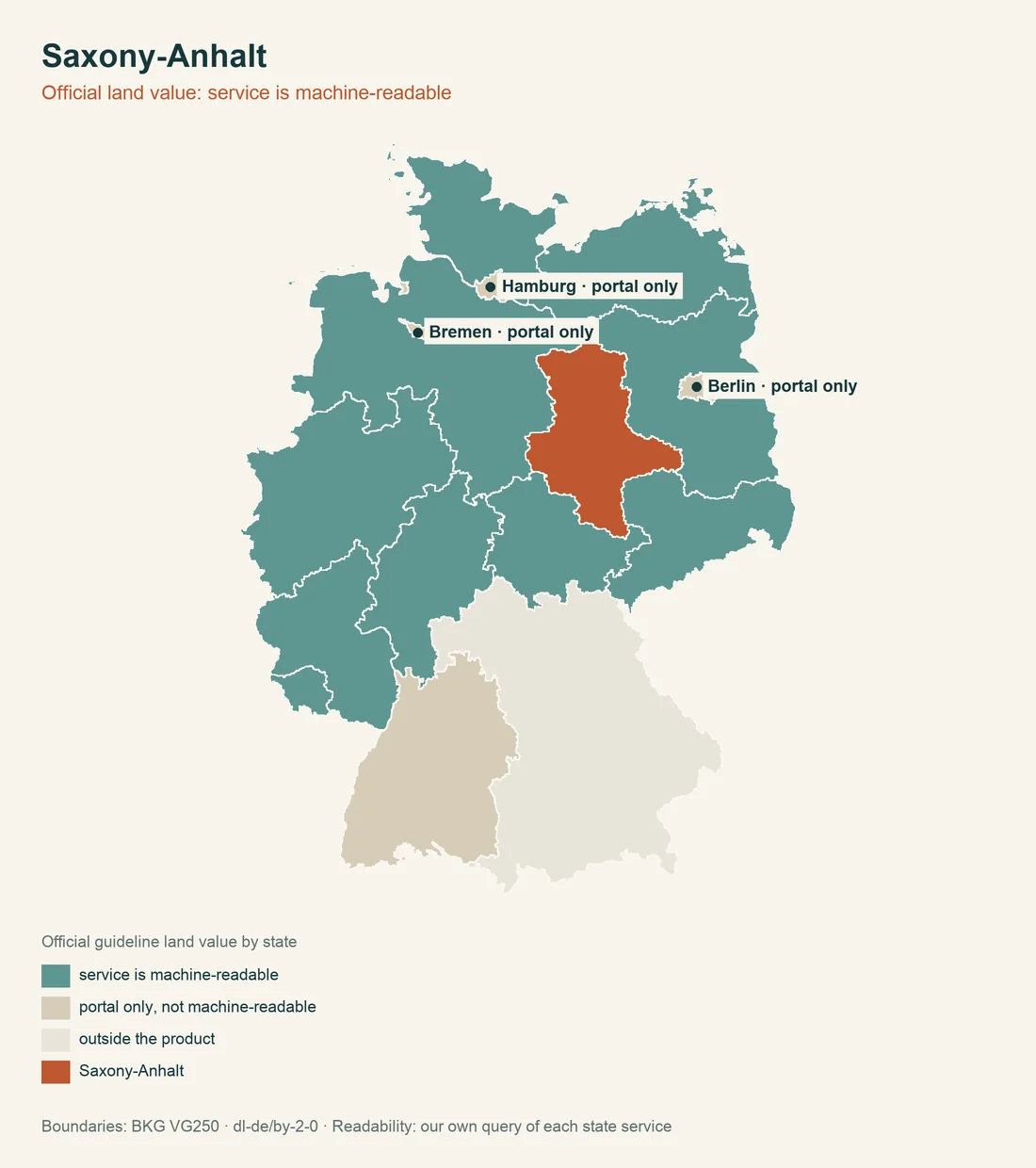
BORIS-ST does provide free online viewing of Bodenrichtwerte, standard land values for a zone; written information may be a separate service. Under § 196 BauGB, a Bodenrichtwert describes a location and use, not automatically the value of the actual Flurstück. The LVermGeo ALKIS service, BORIS-ST information and the Saxony-Anhalt geodata portal provide different information. The land-register and ALKIS comparison helps keep the documents separate.
Planning and permit exemption
The Central State Portal for spatial and building planning provides a research entry point for current planning procedures. The municipality's by-law and publication remain legally decisive. A portal notice alone does not answer whether a project on a particular parcel is lawful.
§ 61 Abs. 1 and Abs. 3 BauO LSA provide Genehmigungsfreistellung, permit exemption, under conditions. These include residential buildings in building classes 1 to 3, other buildings in classes 1 and 2, conformity with the Bebauungsplan and secured access. Work may begin one month after the required documents have been submitted to the municipality; the municipality can require the simplified building-permit procedure.
Read the Saxony-Anhalt planning portal and the permit-exemption provision together. For the general planning level, see zoning and buildability.
Preliminary decision under § 74 BauO LSA
A Bauvorbescheid, a preliminary building decision, can answer individual questions before the complete building application. Under § 74 BauO LSA it is valid for three years. On written application, the period can be extended by up to one year at a time.
The Bauvoranfrage should name the actual plot, intended use, building position and access. A general statement that the land is buildable leaves too much open. The decision binds only within the scope of the questions asked and answered. File the decision's date and period with the contract.
The Saxony-Anhalt rule on the preliminary decision belongs with the site plan. The nationwide procedure is set out in building permits and pre-application.
Watercourse buffers in the state
§ 50 WG LSA differs from the basic rule in § 38 WHG. In the Außenbereich, the outer planning area, the buffer is 10 m beside first-order watercourses and 5 m beside second-order watercourses. Inside built-up areas it is 5 m; a municipality may depart by by-law where the statutory conditions allow.
Do not infer the watercourse classification or planning area from an arbitrary map. Buildings, access roads, fill and planting must be checked against prohibitions and exceptions. A water edge at the plot is therefore a separate purchase check. Read the WG LSA water-buffer rule beside § 38 WHG. The flood and nature-risk guide adds the wider context.
Monuments, finds and mining
The state monument statute is known as DSchG ST. Protection of built and archaeological monuments is declaratory: entry in a list does not create protection for the first time. For a parcel, the specialist location assessment matters as much as a list entry.
The Landesamt für Denkmalpflege und Archäologie Sachsen-Anhalt carries out specialist work, while the local monument authority remains decisive for the individual case. § 12 DSchG ST also contains a Schatzregal, state ownership of qualifying finds, subject to statutory conditions. A separate effective date for that rule is not confirmed.
The Saxony-Anhalt monument law page, the LAGB information on former mining and monuments and archaeology cover different risks.
Neighbour law: trees and fences
Neighbour law is not contained in the building code. Under § 34 Abs. 1 NbG, plants have different boundary distances according to height: up to 1.50 m high, 0.50 m; up to 3 m, 1 m; up to 5 m, 1.25 m; up to 15 m, 3 m; and above 15 m, 6 m. The plant category must be established on site.
No general duty to fence every plot is confirmed. § 22 NbG connects the duty to a request and to concrete, more than insignificant interference. A buyer of land with an old hedge or boundary fence should document the line, maintenance and possible claims separately. The Saxony-Anhalt neighbour-law statute is the state source. The boundaries and land-survey guide adds the practical check.
Tax, agriculture and access
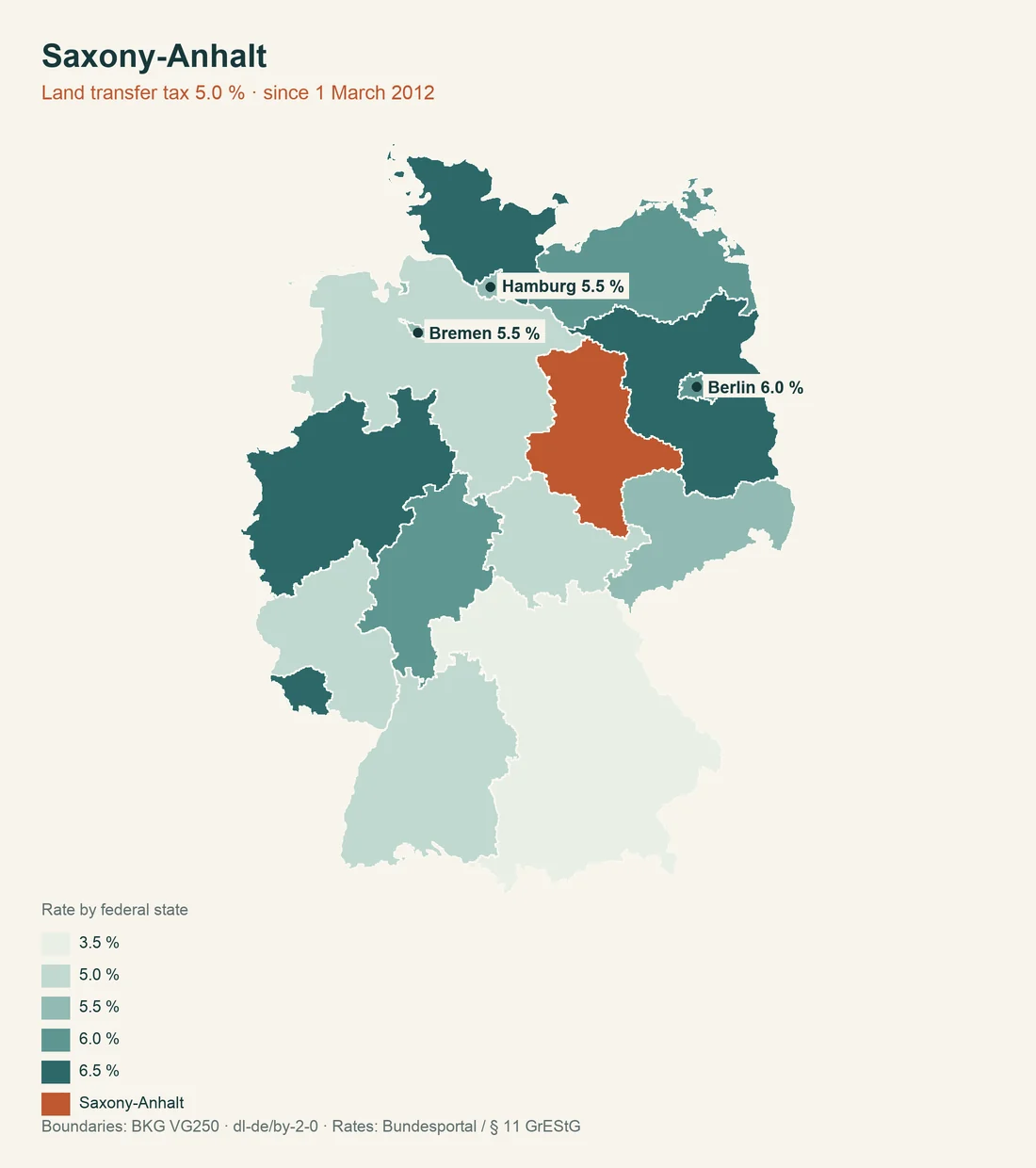
Real-estate transfer tax in Saxony-Anhalt is 5 percent under § 1 GrEStFestG ST. The state generally uses the federal property-tax model; the municipality's multiplier then matters. The two taxes answer different questions and both belong in the purchase calculation.
For selling undeveloped agricultural land smaller than 2 ha, § 1 Abs. 1 AG-GrdstVG confirms an exemption from approval. Special situations and the responsible office still need an individual check. Land below that threshold is not automatically building land. The transfer-tax rule and the property-tax information address different taxes. For access, see access and infrastructure.
- Planning lawMunicipality or building authority
- Parcel and mapSachsen-Anhalt-Viewer
- Soil, value and hazardsSpecialist portal and competent authority
Source: BauO LSA; Sachsen-Anhalt-Viewer; BORIS LSA; DSBA; checked August 2026
Land value and official checks
Federal law and state law meet here, and the municipality may add a by-law. The statistical office reports an average purchase value of 65.42 EUR per m² for baureifes Land in Saxony-Anhalt in 2024. For all undeveloped land, the source gives 29.33 EUR per m². This purchase-value statistic is not a Bodenrichtwert and not an appraisal of the individual Flurstück.
For a reliable view, consider use, access, shape and the local Bodenrichtwert zone together. The year of the statistic should be recorded in the file. The state statistical land-price source belongs beside BORIS-ST. The comparisons state transfer-tax comparison and state setback comparison show the legal framework, not the answer for the parcel.
| Saxony-Anhalt check | Confirmed state rule | What to prove before buying |
|---|---|---|
| Setbacks | § 6 Abs. 5 BauO LSA: 0.4 H as a rule, 0.2 H in commercial and industrial areas | site plan and local rule |
| Baulasten | § 82 BauO LSA: Baulastenverzeichnis | building-authority extract |
| Water buffer | § 50 WG LSA: 10 m or 5 m in the Außenbereich, 5 m inside built-up areas | watercourse order and area |
| Land value | 65.42 EUR per m² for baureifes Land in 2024 | compare with BORIS-ST |
| Transfer tax | 5 percent under § 1 GrEStFestG ST | calculate purchase costs |
Public pre-emption right and forest
Nature-protection law can give the state a pre-emption right over certain environmentally relevant land under statutory conditions. § 31 NatSchG LSA is therefore a separate contract point for land in protected settings. Exercise and exclusions must be checked for the actual parcel; a map note is not the authority's decision.
Changing the use of forest generally requires approval under § 8 Abs. 1 LWaldG. The state source does not state one uniform reforestation period. Planned clearance, replacement planting and the responsible lower forest authority should be clarified in writing. The nature pre-emption rule and the forest-law rule protect different interests.
Ordnance and fees
The Kampfmittelbeseitigungsdienst des Landes Sachsen-Anhalt, the state bomb-disposal service, handles unexploded-ordnance risks. Parcel enquiries and clearances go to the responsible security authority. No uniform cost status for every enquiry is confirmed because the reason and procedure matter.
The Baugebührenordnung, BauGVO, is the state source for building-law fees. The actual amount depends on the official act and procedure. The BauGVO fee-index information is not a flat promise for every project. Separate these charges from transfer tax, property tax and private expert costs.
Order of checks before notarisation
Start with the Flurstück, Bebauungsplan and secured access. Then request the Baulastenverzeichnis, DSBA, ALKIS, Bodenrichtwert, water information, monument information and former-mining information. For an older property, add unexploded ordnance and neighbour law. For every result, record date, authority, parcel reference and the question asked.
A map hit is a reason to ask, not a complete negative answer. The Saxony-Anhalt bomb-disposal service information names the state service but does not confirm a uniform cost status. Notary process and closing and parcel check come next only after each authority answer is tied to the right Flurstück.
Do not merge information from several parcels. A Baulast can affect a different parcel from a contamination notice, and a water buffer follows the actual watercourse order. Former-mining information does not answer the monument question. For the contract, record parcel, authority, date and open result in every line. A written answer should be attached to the contract; oral hints are notes, not a decision.
Keep each authority answer with the parcel. A written file makes the next notary step easier. Check a parcel.
Sources and further reading
Checked on 07.08.2026. The linked state authorities, legal portal and statistical sources were used. This is general information and does not replace the answer of the responsible authority. Read next: notary process and closing, zoning and buildability, and access and infrastructure.