
Comparison
German land transfer tax: 16-state comparison
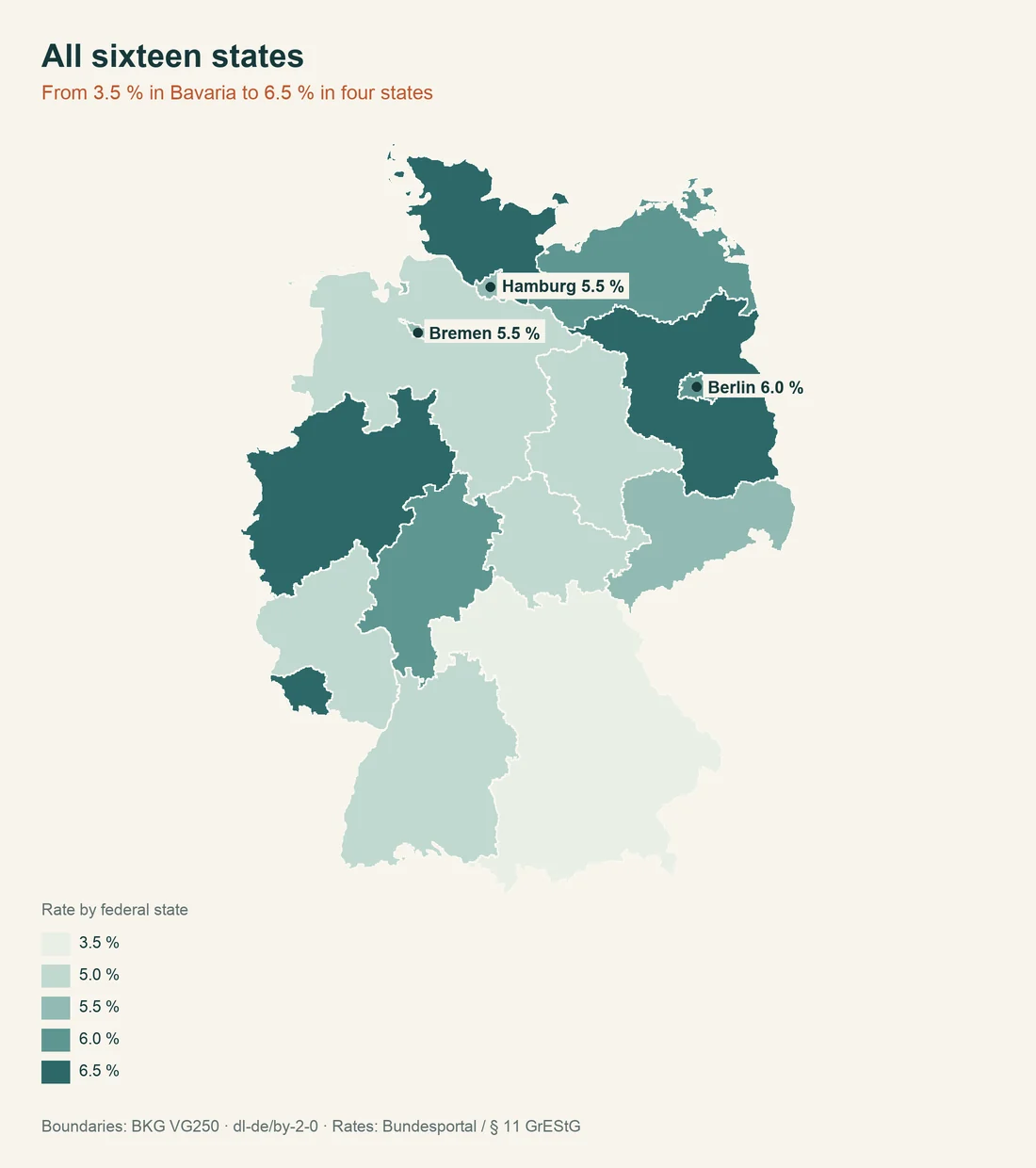
How much does land transfer tax differ between Germany's federal states when buying a plot?
On this page
The short answer for buyers
When land is bought, the tax rate depends on the state where the plot is located. The federal government defines the taxable transaction and the tax base in the Grunderwerbsteuergesetz, while the states may set the rate themselves under Art. 105 Abs. 2a GG. The purchase price alone is therefore not a sufficient cost plan. The location, the time when the acquisition is completed and the contents of the notarial contract all matter.
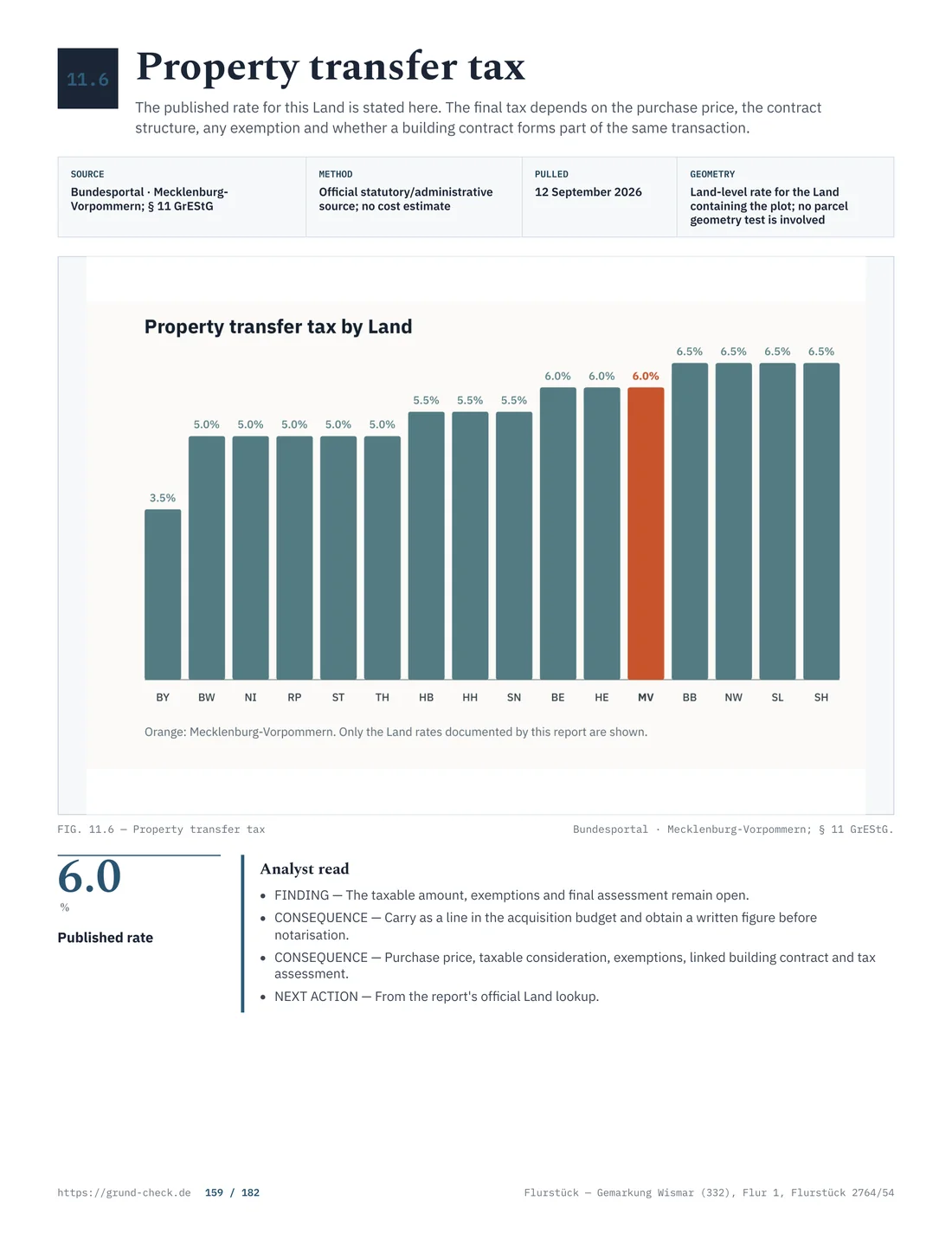
The current range runs from the federal rate applied in Bavaria to 6.5 percent in several states. On a purchase price of 300,000 euros, one percentage point means 3,000 euros. That difference is due promptly and belongs in the financing plan, even though it is not part of the land purchase price.
- Why the states have their own rates
- What is actually taxed
- Who pays and when payment is due
- Which exemptions may apply
- How to read the state rates
Source: GrEStG § 11 and the property-transfer-tax acts of the 16 states; checked August 2026
Why the states have their own rates
§ 11 GrEStG gives the federal starting rate as 3.5 percent. Since the Föderalismusreform, the states have been able to depart from it. The rate is not a measure of soil quality and says nothing about whether land is ready for development, serviced or affected by contamination. It is a state revenue decision.
A change takes effect through a state law. The date of signature is not automatically decisive. The usual question is when the taxable acquisition transaction is completed. If a contract has a suspensive condition, requires an approval or involves a later exercise of a right, the notary must classify the actual sequence.
What is actually taxed
§ 1 GrEStG mainly covers the purchase contract for a plot located in Germany. The tax attaches to the legal acquisition transaction, not merely to the later entry in the Grundbuch, the land register. Certain exchanges, conveyances and changes under company law may also fall within the statute. In an ordinary purchase, the notarial contract is the starting point for the review.
Under § 8 GrEStG, the tax base is the Gegenleistung, the consideration. Usually this is the purchase price. Assumed encumbrances, a loan taken over by the buyer or other contractual duties may be added. Movable items such as a fitted kitchen or a garden shed sold with the plot can be valued separately if the contract states a plausible value. The Finanzamt, the tax office, may correct an artificial allocation.
For land with a building, the entire single purchase price is generally considered. A construction contract with the same seller or a connected provider may therefore be assessed together with the land purchase. A supposedly low land price does not protect the buyer if the contracts economically form one building project.
Who pays and when payment is due
Under § 13 GrEStG, buyer and seller are statutory tax debtors. The notarial contract normally assigns payment to the buyer. The statutory structure still matters towards the Finanzamt, for example if the buyer does not pay or the contract is unwound.
The notary reports the contract to the Finanzamt. The Finanzamt then issues the tax assessment notice. Under § 15 GrEStG, the tax is generally due one month after notification. The buyer should include it in the liquidity plan before the notice arrives. Banks often require evidence that acquisition costs are covered by equity or financing.
Under § 22 GrEStG, the Grundbuchamt, the land registry office, may register the change of ownership only once the Unbedenklichkeitsbescheinigung, the tax clearance certificate, is available. Ownership transfer is not replaced by payment alone. Payment of the price, priority notice, tax notice and registration are separate stages that must be coordinated in the contract.
- Notarial purchase deedTax event and assessment base
- Tax assessmentState rate applied to the consideration
- Tax clearance certificateAfter payment, required for registration
Source: GrEStG § 11 and the property-transfer-tax acts of the 16 states; checked August 2026
Which exemptions may apply
§ 3 GrEStG contains exemptions, including certain acquisitions between spouses, registered civil partners and relatives in the direct line. An acquisition with a taxable value of up to 2,500 euros may also be exempt. Siblings are not relatives in the direct line. In an estate partition or divorce settlement, the precise legal basis of the transfer is decisive.
An exemption cannot be inferred from a family relationship alone. The contract must fit the statutory case. The Finanzamt also checks whether several steps belong together. Before transferring property within a family, the notary should address the tax classification expressly.
How to read the state rates
The table below comes directly from the state-law records used for this comparison. It separates the value from its legal basis and links the relevant official source. For historical stages, it states when the acquisition transaction must have occurred. Bavaria has no separate state law recorded here, so the federal rate under § 11 GrEStG applies.
| State | Value | Legal basis | Source |
|---|---|---|---|
| Baden-Württemberg | Baden-Württemberg: 5.0%. The state rate has applied since November 1, 2011. | § 11 GrEStG i.V.m. Gesetz über die Festsetzung des Steuersatzes bei der Grunderwerbsteuer | Source Baden-Württemberg |
| Bavaria | Bavaria: 3.5%. Bavaria has not enacted a separate state rate, so the federal rate under § 11 GrEStG applies. | § 11 Abs. 1 GrEStG | Source Bavaria |
| Berlin | Berlin: 6.0%. The rate applies to transactions involving property in Berlin completed on or after January 1, 2014. | § 3 des Gesetzes über die Festsetzung des Steuersatzes für die Grunderwerbsteuer | Source Berlin |
| Brandenburg | Brandenburg: 6.5%. The state rate applies to transactions involving property in Brandenburg completed on or after July 1, 2015; federal law continues to define the taxable transaction. | §§ 1 und 2 Gesetz über die Festsetzung des Steuersatzes für die Grunderwerbsteuer | Source Brandenburg |
| Bremen | Bremen: 5.5% for acquisitions completed on or after July 1, 2025. Earlier acquisitions: 5.0%. That rate applied from January 1, 2014 until June 30, 2025. | Gesetz über die Festsetzung des Steuersatzes für die Grunderwerbsteuer (Bremen) | Source Bremen |
| Hamburg | Hamburg: 5.5%. The Gesetz über die Festsetzung des Steuersatzes bei der Grunderwerbsteuer (GrEStFestG HA) has applied since January 1, 2023 and replaces the federal rate of 3.5% under § 11 GrEStG for property in Hamburg. | § 1 GrEStFestG HA | Source Hamburg |
| Hesse | Hesse: 6%. This state rate applies to acquisitions in Hesse; the taxable transaction itself is defined separately by the federal Grunderwerbsteuergesetz. | Gesetz zur Änderung des Gesetzes über die Festsetzung des Steuersatzes für die Grunderwerbsteuer vom 16.07.2014 (GVBl. 2014 S. 179), § 11 Abs. 1 GrEStG | Source Hesse |
| Lower Saxony | Lower Saxony: 5.0%. The state rate has applied since January 1, 2014. | § 1 Abs. 2 GrEStFG,NI | Source Lower Saxony |
| Mecklenburg-Western Pomerania | Mecklenburg-Western Pomerania: 6%. Consistent secondary sources date the rate from July 1, 2019; the previous rate was 5%, preceded by the nationwide rate of 3.5%. The official tax portal confirms the current rate but does not state its effective date. | Landesrechtliche Festsetzung des Grunderwerbsteuersatzes für Mecklenburg-Vorpommern | Source Mecklenburg-Western Pomerania |
| North Rhine-Westphalia | North Rhine-Westphalia: 6.5%. The rate applies to acquisitions involving property in North Rhine-Westphalia completed on or after January 1, 2015. | § 1 Gesetz über die Festsetzung des Steuersatzes für die Grunderwerbsteuer NRW | Source North Rhine-Westphalia |
| Rhineland-Palatinate | Rhineland-Palatinate: 5%. This is the statewide rate; federal law separately defines which transactions are taxable. | § 11 Abs. 1 GrEStG i.V.m. rheinland-pfälzischer Steuersatzregelung | Source Rhineland-Palatinate |
| Saarland | Saarland: 6.5% for acquisitions completed on or after January 1, 2015. Under the second sentence of Art. 105 Abs. 2a GG, the Saarland rate statute replaces the federal rate of 3.5% under § 11 Abs. 1 GrEStG. Earlier Saarland rates: 3.5% until December 31, 2010; 4% in 2011; 4.5% in 2012; and 5.5% from January 1, 2013 to December 31, 2014. The date on which the acquisition is completed determines the applicable rate. | § 1 Gesetz über die Festsetzung des Steuersatzes bei der Grunderwerbsteuer (Saarland), in der Fassung des Artikels 1 des Haushaltsbegleitgesetzes 2015 (Gesetz Nr. 1845, Amtsbl. I 2014 S. 447) | Source Saarland |
| Saxony | Saxony: 5.5%. The rate applies to transactions involving property in Saxony completed after December 31, 2022; federal law separately defines which transactions are taxable. | § 1 SächsGrEStSatzG | Source Saxony |
| Saxony-Anhalt | Saxony-Anhalt: 5%. The amended state rate has applied since March 1, 2012; the taxable transaction itself is defined separately by the federal Grunderwerbsteuergesetz. | § 1 GrEStFestG ST | Source Saxony-Anhalt |
| Schleswig-Holstein | Schleswig-Holstein: 6.5%. The state rate has applied since January 1, 2014. | Gesetz über die Festsetzung des Steuersatzes bei der Grunderwerbsteuer | Source Schleswig-Holstein |
| Thuringia | Thuringia: 5.0%. The official financial report confirms that the rate fell from 6.5% to 5.0% on January 1, 2024; federal law separately defines which transactions are taxable. | § 1 GrEStSatzG TH (Fassung vom 22.09.2023, gültig ab 01.01.2024) | Source Thuringia |
Comparing percentages is only the first step. The table does not decide whether a particular contract is taxable, which consideration the Finanzamt will accept or whether an exemption applies. A later change to state law may also be irrelevant to a transaction that was already completed.
The hierarchy is clear: federal law defines the taxable transaction, state law defines the rate, and the municipality can create further land costs through by-laws.
What the tax rate does not tell you
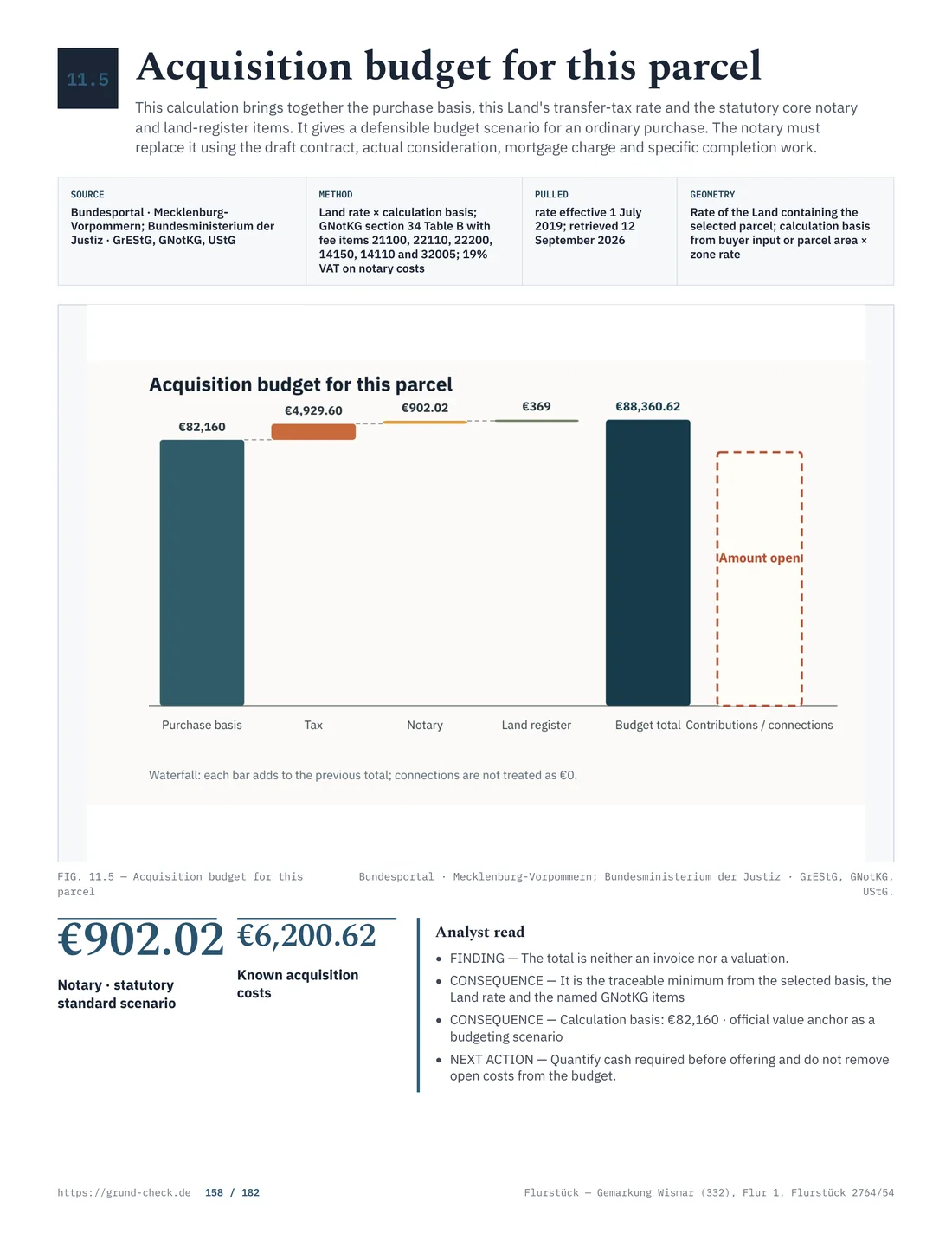
The tax says nothing about the other acquisition costs. Notary and land registry fees follow the Gerichts- und Notarkostengesetz, the court and notary costs statute. An agent's commission may be allocated differently for undeveloped land than for an apartment purchase. Road improvement contributions, surveying, utility connections and a possible soil investigation depend on the plot and the municipality.
Financing also changes the comparison. A higher tax rate may be partly offset by a lower purchase price; a plot that looks cheap can become much more expensive because of outstanding contributions. The decision therefore needs a complete acquisition-cost calculation alongside the state rate. The overview of costs and taxes and the notarial purchase process help put the figure in context.
Checks before the notary appointment
Before notarisation, the exact Flurstück (official cadastral parcel) designation, should be correct. The rate follows the plot, not the buyer's place of residence. If several parcels in different states are included, allocating the purchase price may matter for tax purposes.
Request the draft contract early and mark every assumed obligation. Check separate values for movable items, conditions and rights of withdrawal. The comparison of the Grundbuch and cadastral data helps prevent a wrong area or a parcel that is not part of the sale from entering the calculation.
Do not calculate the tax in isolation. A GrundCheck report places the specific parcel, its location and other purchase-relevant risks in context. Check a plot.
Further comparisons: setback rules across the states, building obligations across the states, road contributions by state and heritage protection by state. Other comparison topics include permit-free building projects and state geoportals.
Cross-check the data before buying. The plot review connects the parcel, its location and the relevant public records. Check a plot.
Where to verify the legal position
For the federal framework, § 1 GrEStG, § 3 GrEStG, § 8 GrEStG, § 13 GrEStG, § 15 GrEStG and § 22 GrEStG are material. The state sources appear in the comparison table; further information is available from the Finanzamt portal and the Bundesfinanzministerium information.
Stand: August 2026. This is general information and does not replace tax advice on an individual contract. Read next: setback rules across the states and costs and taxes. More comparisons: road contributions, heritage protection, permit-free projects and state geoportals.