
Purchase planning
German land purchase due diligence checklist
A working sequence for checking a German plot: who to write to first, what each answer costs, and where a purchase should stop.
On this page
The order matters more than the list
Documents often arrive piecemeal from different sources. Even so, the review should begin by confirming the parcel identity before any other document or design is assessed. An online cadastral check may be quick and free; formal extracts can carry a fee or take longer. Once the correct parcel and its planning status are clear, surveying, legal advice or translation can be commissioned on a sound basis.
What follows is a four-week sequence for one German parcel. Four weeks is realistic if letters go out on day one and the seller cooperates. Most steps require no lawyer and involve little or no cost. Federal law sets the core register and contract rules, state law governs the building procedures, and the municipality answers local planning questions through its by-law.
- Day 1: parcel and planning lawConfirm the official identity and planning regime
- Week 2: registersRead the land register and Baulasten
- Week 3: siteAccess, utilities, soil, water and nature
- Week 4: moneyPurchase costs, contributions and recurring charges
Source: GrundCheck review sequence; legal basis: BauGB, GBO, BGB, BBodSchG and WHG; checked August 2026
Day one: pin down which piece of land this actually is
An address is not an identifier. German land is identified by Gemarkung, Flur and Flurstück (cadastral parcel), for example Gemarkung Storkow, Flur 4, Flurstück 112/3. Every letter, every application and the contract itself must carry those three items, and a listing that will not supply them is a warning in itself.
Find the parcel yourself before anyone tells you where it is. The Brandenburg cadastral viewer and Geoportal Brandenburg show the cadastral map for that state at no charge, and since 21 June 2019 its underlying data has been open under the applicable state geodata-use ordinance and downloadable through GEOBROKER. Check three things on the map: the shape matches the photographs, the parcel actually touches a public road, and no separate strip of land sits between the two.
Day one: the planning letter
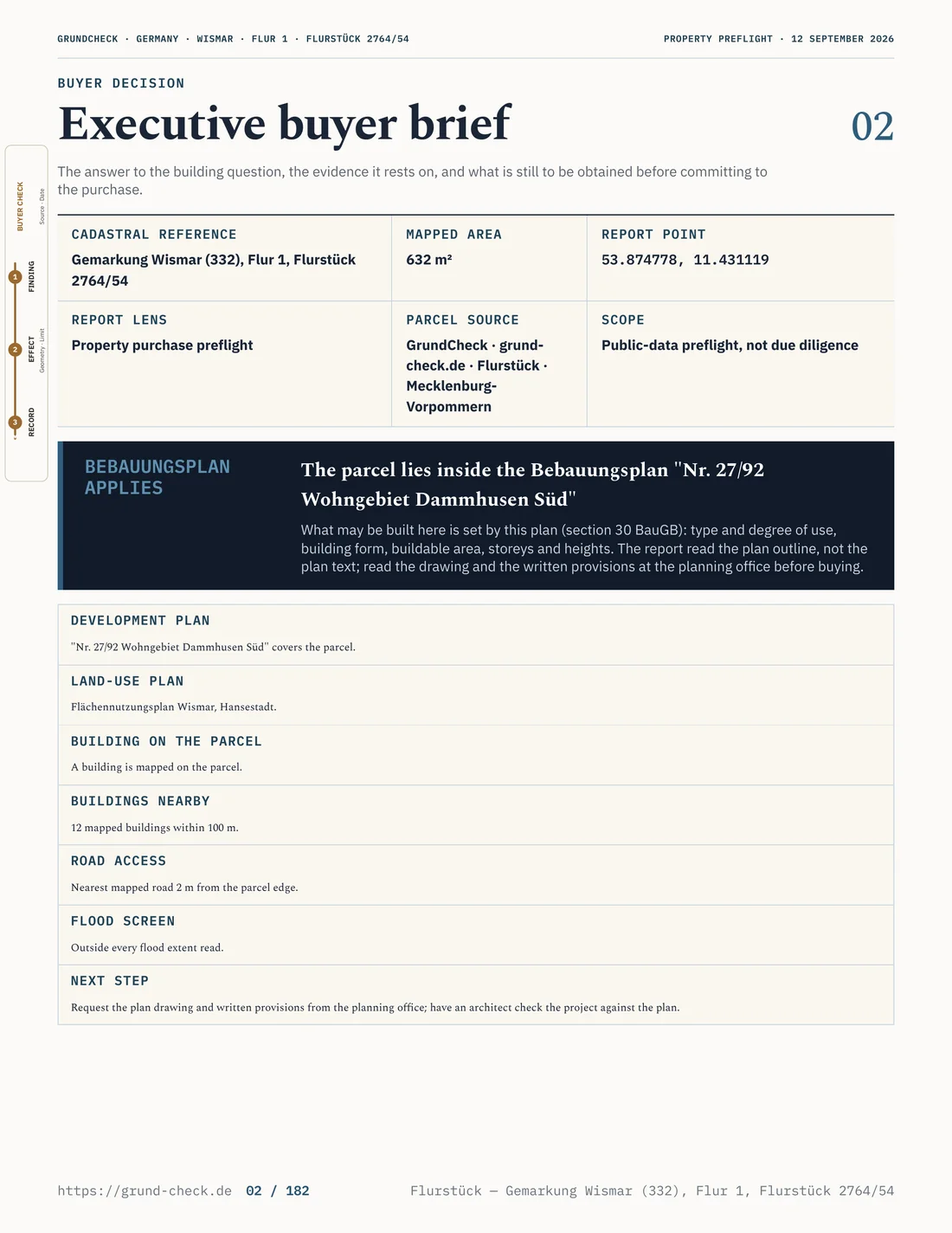
Send one e-mail to the Bauamt of the Gemeinde, quoting the three parcel identifiers, and ask whether a legally effective Bebauungsplan (binding local development plan) covers the parcel; if not, whether the municipality treats it as inside the built-up area under § 34 BauGB or as Außenbereich under § 35 BauGB; whether a plan change, a Veränderungssperre under § 14 BauGB or a Satzung is in preparation; and what the Flächennutzungsplan shows.
This answer identifies the planning regime that applies to the parcel, so request it early. The buildability guide explains how to read the reply, and the outer-area guide covers what to do if the answer is § 35.
Do not start the sequence blind. A GrundCheck preflight report resolves an address or a listing to the official parcel and sets out the planning and risk context around it, so the first letters go to the right offices with the right numbers on them. Check a parcel.
How to write to an authority so an answer comes back
German offices answer precise questions and ignore open ones. A message asking whether a plot is suitable for a house produces either silence or a paragraph of general law. A message listing four numbered questions about one identified parcel produces four answers.
The pattern that works: subject line with the parcel identifiers, one short opening sentence saying you are considering a purchase and need written information, then numbered questions, then a request for a dated written reply and a case reference. Keep it to one screen. Do not attach a listing or photographs, and do not ask the office to interpret your building plans, because that is what a Vorbescheid is for and a free enquiry cannot bind anyone.
Two habits save weeks. Send everything to one office at a time rather than copying four in the hope that somebody responds, because a message addressed to everybody is a message nobody owns. And when a reply is vague, answer it the same day with a single follow-up question quoting the original case number, while the file is still on the desk.
The questions that go to the seller, not to an office
Some facts exist nowhere in public records and only the seller can supply them. Ask in writing, so the answers form part of the picture the contract is built on.
- How long the parcel has been owned, and how it was used before that. Old workshop, filling point, farm yard and orchard all carry different soil histories.
- Whether anything was ever demolished, filled or buried on the plot, and whether fill material was brought in.
- Whether a building application, a Vorbescheid or an enquiry has ever been made and what the answer was. Ask for every earlier decision or enquiry, including refusals, and check whether its facts and legal context are still current.
- Whether any charge, contribution or municipal notice has arrived in the last ten years.
- Who mows, fences and uses the plot today, and on what basis. A tenancy, a hunting lease or an agricultural lease can survive the sale.
Silence in response to any of these is itself information. Put the questions and the answers in the file, because a seller who states something in writing before the deed cannot easily deny knowing it afterwards.
Week two: the two registers
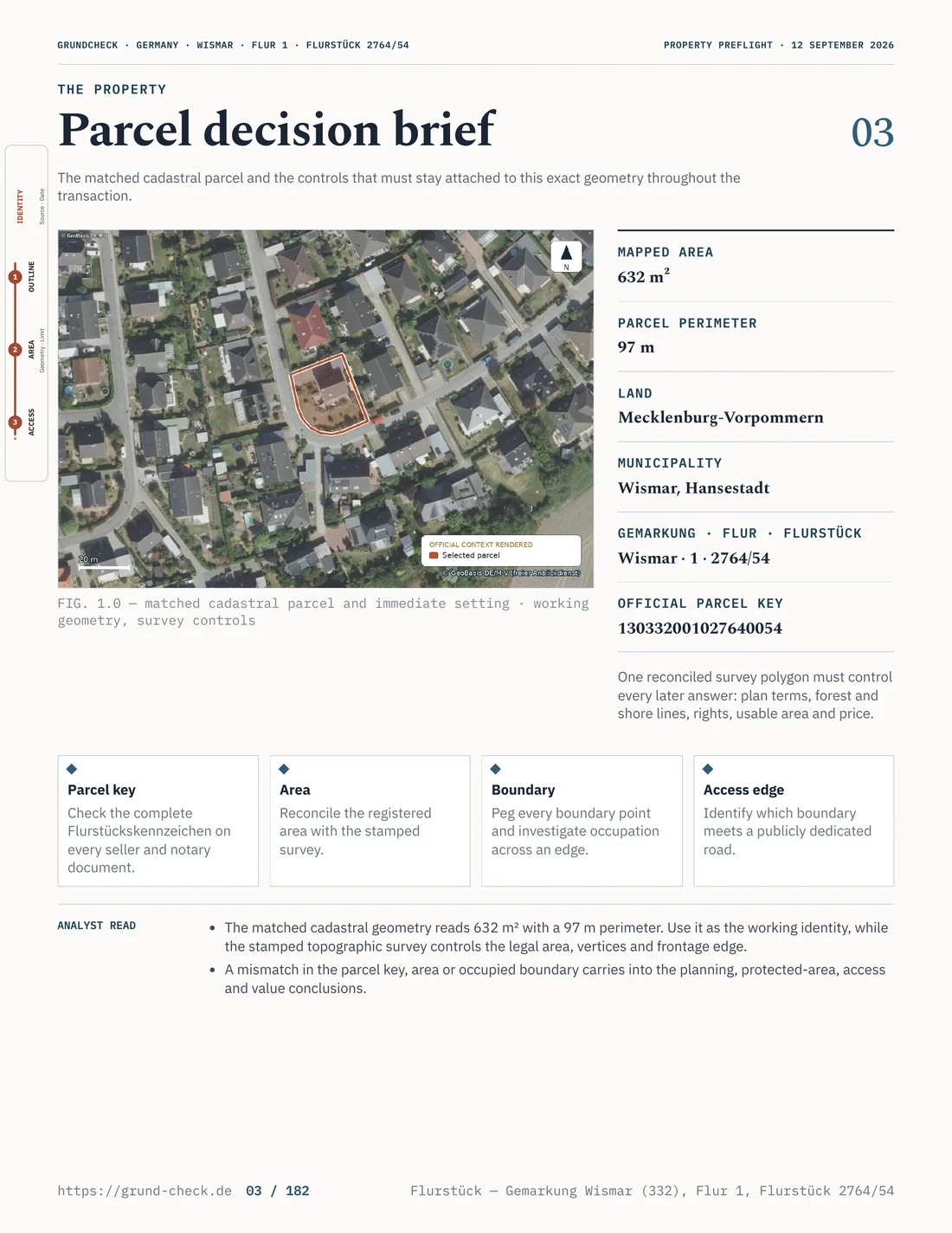
Ask the seller for a Grundbuch extract no older than four weeks. The register is not public: § 12 GBO requires a legitimate interest, so in practice the seller supplies it, consents to your obtaining it, or the notary requests it once instructed. A plain printout is 10 € and a certified one 20 € under the GNotKG schedule of charges.
Read all four parts. The Bestandsverzeichnis should carry the same Gemarkung, Flur and Flurstück you found on the map, because § 2 GBO makes the register borrow its parcel description from the cadastre. Abteilung I must name exactly the person selling to you. Abteilung II holds the burdens that limit what you may build. Abteilung III holds the debts secured on the land, and each one needs a written plan for how it disappears at closing. The register and cadastre guide works through the details.
Week two: the register nobody mentions
Public-law obligations on a plot do not sit in the Grundbuch. They sit in the Baulastenverzeichnis kept by the untere Bauaufsichtsbehörde at the Landkreis, under § 84 of the applicable state building code, and they bind every future owner. A setback given away to a neighbour, an access secured for someone else, a parking obligation: all of it lives there and none of it shows in a land register extract.
Ask the Landkreis for an extract, or for written confirmation that nothing is entered. The state only reintroduced the instrument in 2016, so older arrangements may instead appear in Abteilung II as limited personal easements. Both registers get checked, never one. The Baulasten guide explains what the entries mean in practice.
Source: GNotKG schedule of charges, items 17000 and 17001; checked August 2026
Week three: access and utilities
Two questions, and neither is answered by the phrase in the listing. Is the access legally secured, meaning either the parcel fronts a public road or a right of way is registered in your favour, not merely tolerated by a neighbour. And what exists for water, sewer, electricity, gas and internet: a main in the road, a written offer, a line to the boundary, or a working connection.
Write to the Gemeinde or the responsible Zweckverband and to the grid operator. Ask for prices and lead times, not for reassurance. On a typical plot the standard electricity connection runs between 2,000 € and 4,000 € including VAT, and the water and sewer contribution is set by by-law per square metre. The utilities guide has the figures and the wording that gets a usable answer.
Week three: what is in the ground and what lives on it
Four separate authorities, four separate questions, all free to ask.
- Contamination. The untere Bodenschutzbehörde at the Landkreis keeps the register of suspected sites. Under § 4 BBodSchG the owner of a contaminated plot can be required to clean it up regardless of who caused the problem.
- Flood. § 76 WHG defines flood areas and § 78 WHG bans new building in the designated ones apart from narrow exceptions. Maps come from the Landesamt für Umwelt.
- Nature. Protected biotopes under § 30 BNatSchG and species protection under § 44 BNatSchG can block clearance work on an otherwise ordinary plot, and cutting trees and scrub is prohibited from 1 March to 30 September under § 39 BNatSchG.
- Monuments. Protection follows the entry in the list, and works need permission under § 9 of the state monument act. Ground monuments are the surprise: a find must be reported at once and left untouched for a week.
Week four: the money questions
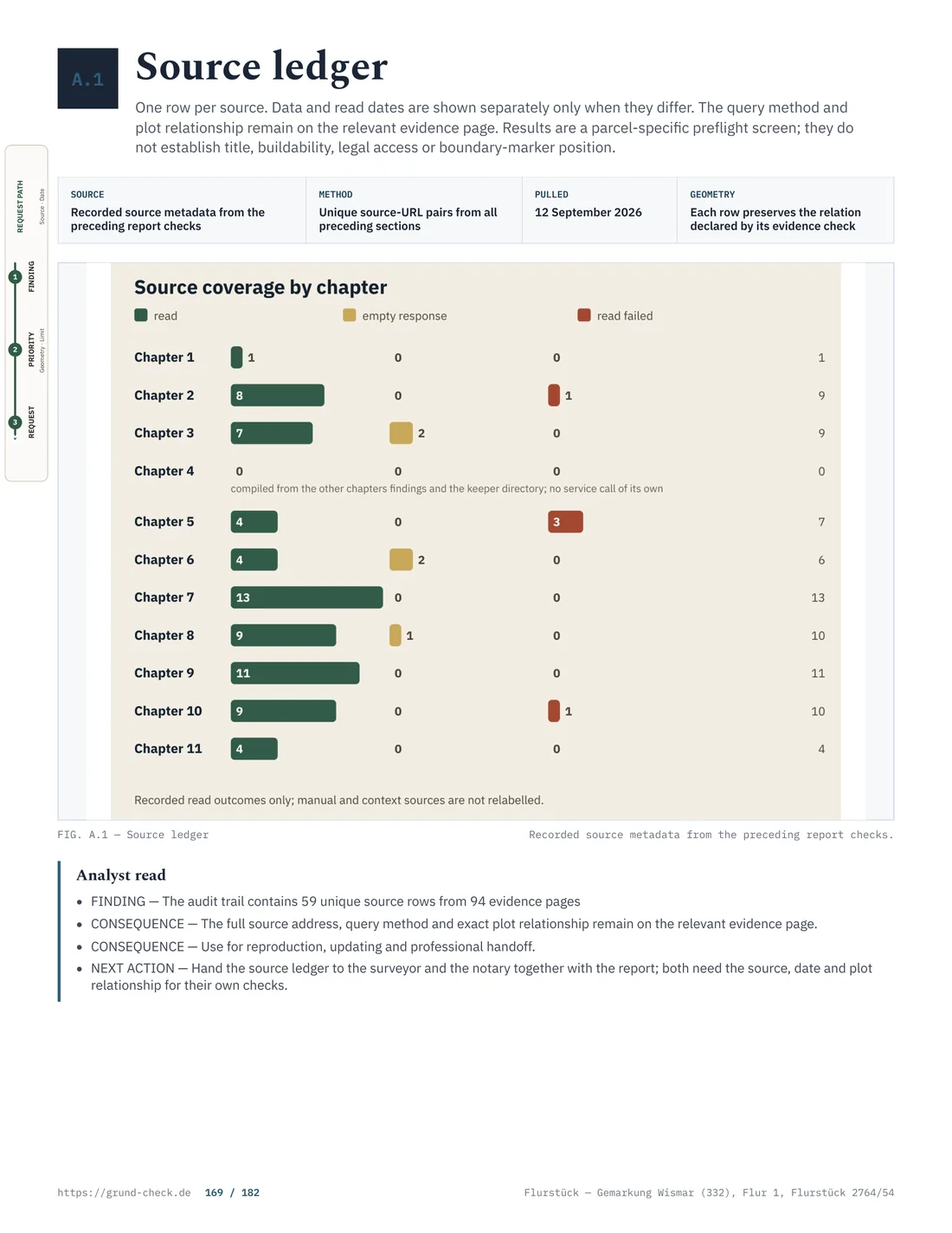
Three of them decide whether the purchase still works. What the transaction costs on top of the price: Brandenburg's 6.5 percent transfer tax under the state rate law plus roughly one to one and a half percent for notary and land registry. What the municipality may still bill: an Erschließungsbeitrag under § 127 and § 133 BauGB arises when the road is finally completed and falls on whoever owns the plot then. And what the plot costs every year: the Grundsteuer chain of value, rate and municipal Hebesatz, where Brandenburg rates in the worked example for 2025 ran from 150 to 610 percent, listed in the Hebesatz register.
Sanity-check the price itself against the official Bodenrichtwert for the location, free at state BORIS register. The Brandenburg average for a building plot for a house was 219 € per square metre in 2025, 318 € in a metropolitan ring and 111 € further out (market report 2025). The costs guide works the whole budget through.
The five answers that should stop a purchase
- The Gemeinde will not confirm the planning status in writing, or confirms Außenbereich for a plain house.
- The parcel has no legally secured access, only a track across land belonging to someone else.
- Abteilung II contains a burden the seller cannot explain and will not have deleted.
- The Bauamt or the environmental authority names a contamination suspicion and the seller refuses an investigation.
- The area or the boundary in the contract does not match the cadastre and nobody will pay for a survey.
None of these is automatically fatal. Each is a reason to stop paying for anything else until it is resolved in writing.
When an answer has not arrived, put it in the contract
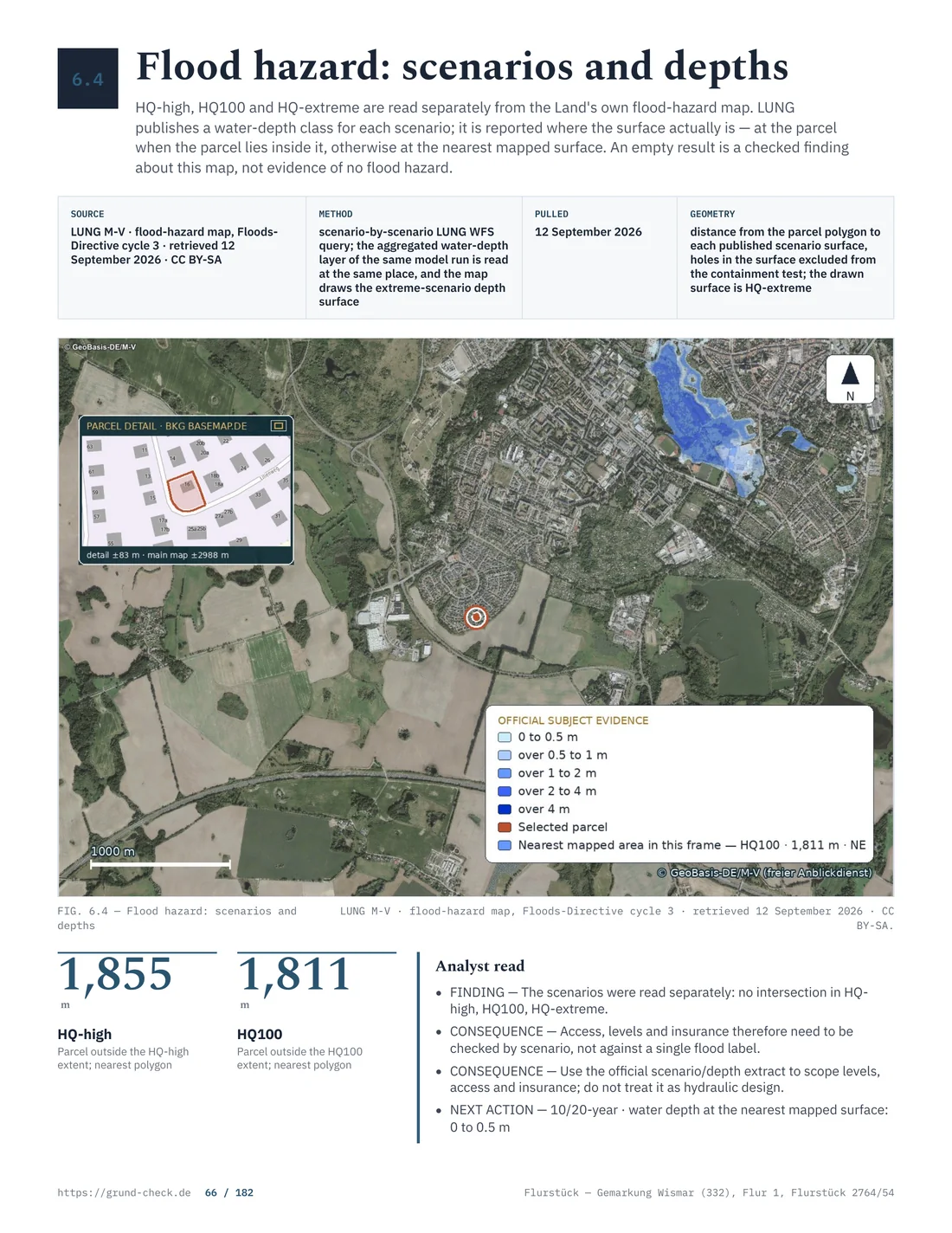
German purchase contracts can be conditional. The three constructions that work: purchase subject to a positive Vorbescheid within a stated period, a withdrawal right with a deadline if a named document is not produced, or a retention out of the purchase price held by the notary until a specific event. All three have to be in the notarised deed, because § 311b BGB means a side agreement on paper is worth nothing.
Read the clause dealing with the condition of the property and the exclusion of liability. A plot is normally sold with liability for defects excluded, and that exclusion holds unless the seller concealed something fraudulently, which § 444 BGB preserves. So a known risk that is not written into the contract is a risk you have accepted.
What the whole exercise costs
| Question | Who answers | Cost | Realistic wait |
|---|---|---|---|
| Parcel identity and map | state cadastral viewer, GEOBROKER | free | an hour |
| Planning regime and pending changes | Gemeinde, Bauamt | free | 1 to 3 weeks |
| Grundbuch extract | Grundbuchamt, via seller or notary | 10 € or 20 € | days |
| Baulasten extract | Landkreis, Bauaufsicht | small fee | 1 to 3 weeks |
| Contamination register | Landkreis, Bodenschutz | free or small fee | 2 to 4 weeks |
| Flood, biotopes, species | Landesamt für Umwelt, Landkreis | free | days to weeks |
| Monument and ground monument status | Landkreis, BLDAM | free | 2 to 4 weeks |
| Utility connections | Zweckverband, grid operator | free enquiry | 2 to 6 weeks |
| Binding planning answer | Landkreis, Vorbescheid | charged by time spent | 1 to 3 months |
Everything above the last line is free or costs less than fifty euros. That is the argument for doing all of it before spending anything on drawings, travel or advice.
Three mistakes with financial consequences
The first is trusting a word in the listing. Erschlossen, Bauland, Baugrundstück and voll erschlossen have no fixed legal meaning in an advertisement, and none of them binds anybody. Each of them corresponds to a question that an office answers for free in writing, and the gap between the word and the answer is routinely a five-figure sum. Treat every adjective in a listing as a question to be asked rather than a fact to be relied on.
The second is doing the checks in the wrong currency of effort. Buyers regularly pay an architect for a concept before the Gemeinde has said which planning regime applies, or commission a survey before knowing whether a house may stand there at all. The free answers come first precisely because they are the ones that can end the project. Paid work is worth doing once the free work has come back positive, and not before.
The third is letting the timetable be set by the seller. A viewing on Saturday, an offer on Monday and a notary date the following week leaves no room for a municipal reply that takes three weeks. If a seller will not wait for the answers, that is a fact about the plot as much as about the seller. The counter is simple and rarely refused: make the offer, agree the price, and put the outstanding answers into the deed as conditions with dates on them.
The one-page version
- Gemarkung, Flur, Flurstück fixed and used in every document.
- Written planning statement from the Gemeinde, dated.
- Grundbuch extract, all four parts, no older than four weeks.
- Baulasten extract from the Landkreis, or confirmation that none exists.
- Written answers on access, water, sewer, power and internet, with prices.
- Contamination, flood, nature and monument confirmations.
- Erschließungsbeitrag status and the municipal Hebesatz.
- Notary cost estimate and, where the deal depends on it, a Vorbescheid.
Eight items, one parcel, one document. Order a GrundCheck preflight report and start the sequence with the parcel identity, the planning context and the risk flags already in front of you. Check a parcel.
Where these rules are written
- Planning: § 30, § 34, § 35 and § 14 BauGB. Contributions: § 127, § 129, § 133 BauGB.
- Registers: § 2 and § 12 GBO; Baulasten § 84 of the applicable state building code; contract form § 311b and defects § 444 BGB.
- Environment: § 4 BBodSchG, § 76 and § 78 WHG, § 30, § 39 and § 44 BNatSchG, BbgDSchG.
- Money: state transfer tax rate, GNotKG charges, Hebesatz register, BORIS, market report 2025.
- Free geodata in Brandenburg: state cadastral viewer, GEOBROKER, applicable state geodata-use ordinance.
Rules and figures were checked in August 2026. This is general information for buyers, not legal advice on your parcel. Read next: the notary and closing process and buying from abroad.
State-law checks
Add the relevant state building, surveying, soil, water and monument registers to the national land-register and planning checks.