
State
Buying land in Brandenburg: forests, water and building law
Brandenburg combines woodland, water and municipal responsibilities with BbgBO rules. Before buying, obtain parcel, plan, Baulast and protection information.
On this page
Why Brandenburg needs a layered purchase check
A plot in Brandenburg may sit in a small Brandenburg town, the Berlin commuter belt or deep in the Außenbereich. Those settings change the purchase risk. Alongside federal planning law, the Brandenburgische Bauordnung, or BbgBO, must be read with the contaminated-land and soil register, forest, water and monument law.
The municipality controls the content of a Bebauungsplan (binding local development plan), while the Landkreis or kreisfreie Stadt supplies many plot-specific specialist answers. The central planning portal is an entry point, not a written decision for the Flurstück (cadastral parcel). Federal law sets the national frame; state law supplies the BbgBO; the municipality applies the plan and local by-law. Save every answer with Gemarkung, Flurstück and retrieval date.
Sort the Brandenburg parcel before the notary. A GrundCheck property check keeps the plan, register and authority answer attached to one plot.
- Setbacks under § 6 Abs. 5 BbgBO
- The Vorbescheid lasts seven years, with an exception
- ALKIS from the LGB
- Bauanzeigeverfahren under § 62 BbgBO
- Water, forest and nature
Source: BbgBO; Geoportal Brandenburg/LGB; BORIS Brandenburg; ALBOKAT; checked August 2026
Setbacks under § 6 Abs. 5 BbgBO
Brandenburg generally requires 0.4 H and at least 3 m. In commercial and industrial areas, 0.2 H and at least 3 m can be sufficient. For buildings in Gebäudeklassen 1 and 2 with no more than three above-ground storeys, 3 m in front of the external walls is sufficient.
The checked rule does not confirm a separate general core-area factor or a single general narrow-side privilege. A local building by-law under § 87 BbgBO can set different setbacks. The Brandenburg building code in the state-law portal is the controlling source. Put building position, wall height and the by-law on the same site plan.
Baulasten under § 84 BbgBO
§ 84 BbgBO provides for the Baulastenverzeichnis, the register of public-law building obligations. An owner assumes a Baulast (public-law building obligation) by declaration to the Bauaufsichtsbehörde; it takes effect on entry and binds legal successors. Inspection is available where there is a legitimate interest.
The register matters because a public-law obligation may not appear in an ordinary Grundbuch extract. Access, setbacks or parking for another project may be secured there. Brandenburg has the register, so no substitute mechanism is needed. Read the BbgBO Baulast provision with the authority's extract and the easements and building obligations guide.
The Vorbescheid lasts seven years, with an exception
A Brandenburg Vorbescheid lasts seven years. § 75 BbgBO governs this special case: where the questions concern included administrative decisions, the period is three years. No general extension option is confirmed.
The issue date, questions, plans and any included decision must match the actual parcel. A general statement about buildability is not a substitute for a decision tied to the right land. The Brandenburg rule on the Vorbescheid belongs in the file, alongside the building-permit and pre-application guide.
ALBOKAT and soil protection
The Altlasten- und Bodenschutzkataster, or ALBOKAT, has covered contaminated-land and soil-protection subjects since 2024. Requests go to the territorial lower soil-protection authority of the Landkreis or kreisfreie Stadt, not automatically to the building authority or cadastral office.
General public access is not confirmed by the checked data. Former industry, landfills, fill and intensive agriculture justify a plot-specific request. The Landesamt für Umwelt ALBOKAT information is the specialist entry point. The contaminated-site guide helps frame the enquiry.
ALKIS from the LGB
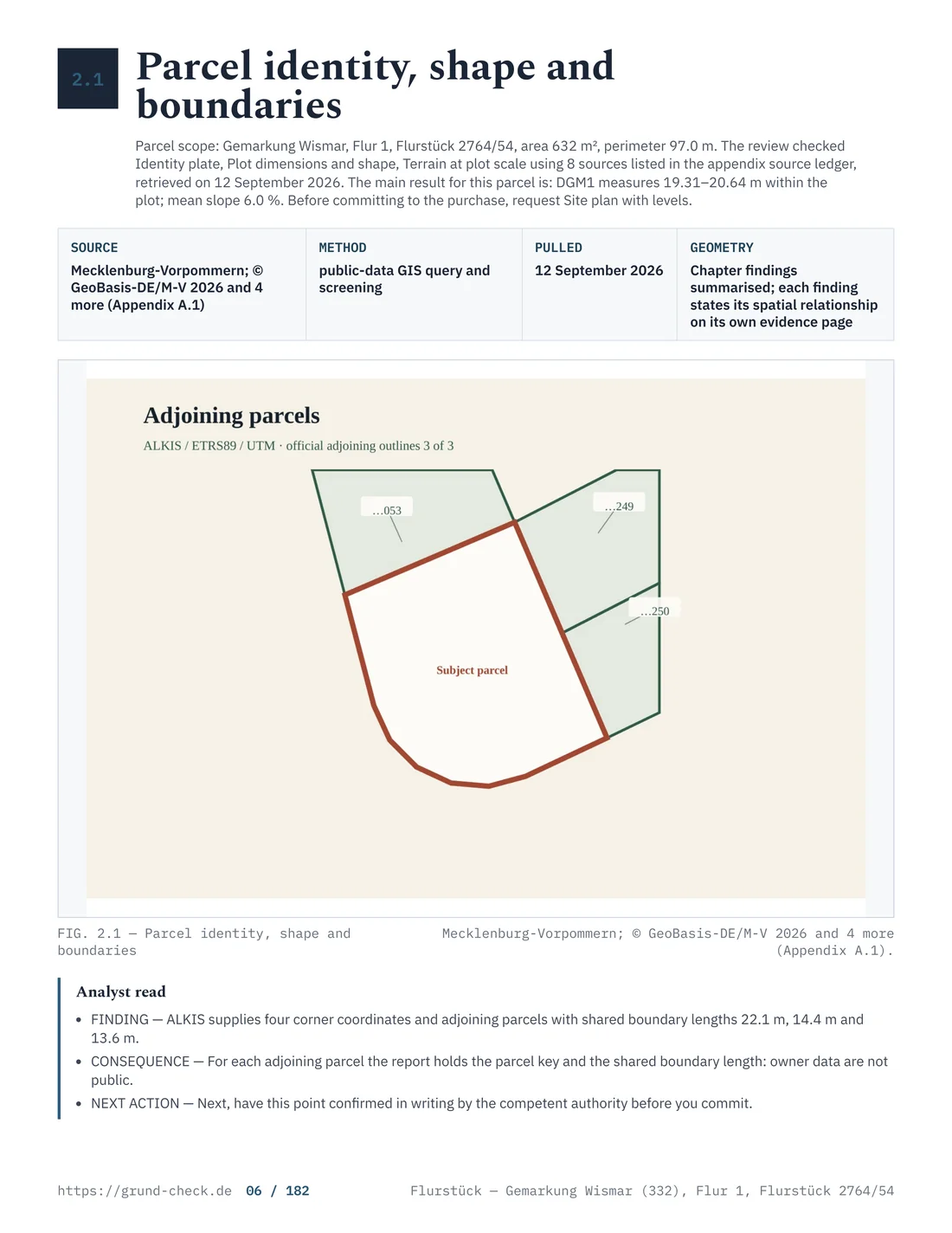
The WFS of the Amtliches Liegenschaftskataster-Informationssystem, ALKIS Brandenburg, supplies official cadastral information in NAS format. Ownership and address data are not part of this service. The product page describes the service as free under its licence conditions.
A free map service does not answer ownership, Baulast or buildability. It can help check boundaries and the Flurstück designation, while legal answers must be obtained separately. The LGB Brandenburg ALKIS-WFS is the official entry point. The land-register and ALKIS guide explains the limits.
BORIS and the Brandenburg land statistic
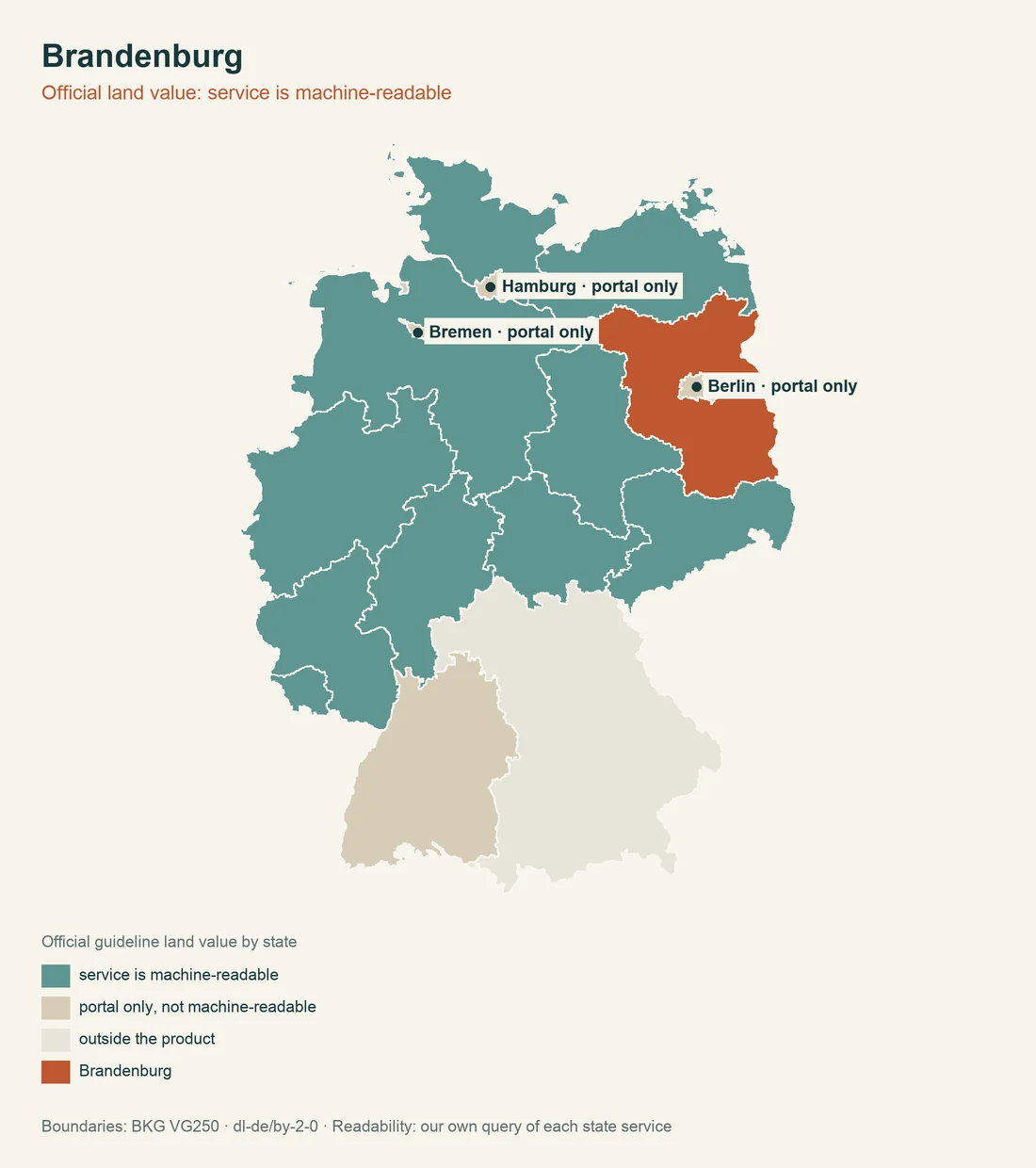
For baureifes Land, the 2024 Kaufwertstatistik gives an average of 176.80 EUR per m². It is a purchase-value statistic, not a Bodenrichtwert and not a promise for one Flurstück.
The Gutachterausschüsse publish current and historic Bodenrichtwerte through BORIS Land Brandenburg free of charge. The BORIS Brandenburg portal and the statistical land-value report answer different questions. The land-value guide explains the comparison.
Bauanzeigeverfahren under § 62 BbgBO
§ 62 BbgBO provides the Bauanzeigeverfahren. It is confirmed for residential buildings in Gebäudeklassen 1 and 2 where a legally effective Bebauungsplan under § 30 Abs. 1 or 2 BauGB applies, the project does not depart from its provisions and access is secured. Building may begin after one month from receipt of the Bauanzeige if the Bauaufsicht has not prohibited it or released it earlier.
This is not a free pass for every house. Use, building class, plan and access must fit together. The BbgBO Bauanzeige rule should be discussed with the municipality and building authority.
Garden sheds, garages and fences
§ 61 Abs. 2 Nr. 1, Nr. 4 and Nr. 7 BbgBO lists verfahrensfreie Vorhaben. Buildings without rooms for people, toilets or combustion appliances can be permit-free up to 75 m³ of gross volume when outside the Außenbereich; garages, stables and sales or exhibition buildings are excluded. Garages and covered parking can have a mean wall height up to 3 m and a gross floor area of 50 m² under the statutory conditions.
Walls and fences up to 2 m are permit-free outside the Außenbereich. No general height ceiling is confirmed for open, socket-free fences in the Außenbereich. The § 61 BbgBO text belongs in the existing-structures check.
Water, forest and nature
§ 77a BbgWG supplements § 38 WHG. In the Außenbereich, the Gewässerrandstreifen is generally 5 m from the bank line. No general state-wide Innenbereich width is confirmed; the 5 m rule is tied to the Außenbereich. Read the Brandenburg water-law text with the local water information.
Forest conversion generally needs permission under § 8 LWaldG Brandenburg. Cleared or heavily thinned woodland over 0.5 ha must be reforested within 36 months; extensions can apply in hardship or natural-regeneration cases. The Brandenburg forest-law access belongs in a woodland purchase file.
Under § 26 BbgNatSchAG, the Land can hold a nature-conservation pre-emption right for Nationalparks, Naturschutzgebiete and similar areas. The LfU nature pre-emption information should be checked where a protected area is involved.
Monuments and Brandenburg finds
Under §§ 3, 16 and 17 BbgDSchG, lower monument authorities work with the Brandenburgisches Landesamt für Denkmalpflege und Archäologisches Landesmuseum, or BLDAM. Built and archaeological monuments are protected declaratorily; the protection does not depend on a list entry alone.
§ 12 BbgDSchG contains the Schatzregal for certain ownerless or no-longer-attributable movable monuments and archaeological monuments. The BLDAM monument list and the Brandenburg monument-protection law should be checked for the Flurstück. A map alone does not replace the lower authority's position.
Neighbours, hunting and agricultural land
Under §§ 28–30 and 37 BbgNRG, a plot owner can require the neighbour to provide a fence under the statutory local and boundary conditions; § 30 contains exceptions. Fruit trees over 2 m generally require 2 m from the boundary. Other trees over 2 m generally require 4 m, doubled beside agricultural land. Shrubs and hedges over 2 m require at least one third of their height.
The BbgNRG text belongs in a file for a planted plot or boundary fence. An Eigenjagdbezirk, private hunting district, has a default minimum of 150 ha under § 7 Abs. 1 BbgJagdG; on application the lower hunting authority can reduce it to 75 ha under the statutory conditions. A sale of agricultural land under 2 ha does not require approval under § 1 AGGrdstVG. The Brandenburg land-transaction rule belongs in the documents.
Ordnance and historic mining
The Kampfmittelbeseitigungsdienst (KMBD) Brandenburg handles applications to check plots for possible ordnance contamination and removes chance finds. A uniform cost status for every plot enquiry is not confirmed. Use the Brandenburg ordnance-service information before earthworks.
The Landesamt für Bergbau, Geologie und Rohstoffe Brandenburg handles historic-mining hazards. Records in the Altbergbauarchiv are inspected after a written request. The LBGR historic-mining information belongs in the file where old workings or mining references exist.
- Planning lawMunicipality or building authority
- Parcel and mapGeoportal Brandenburg/LGB
- Soil, value and hazardsSpecialist portal and competent authority
Source: BbgBO; Geoportal Brandenburg/LGB; BORIS Brandenburg; ALBOKAT; checked August 2026
Tax, roads and the state table
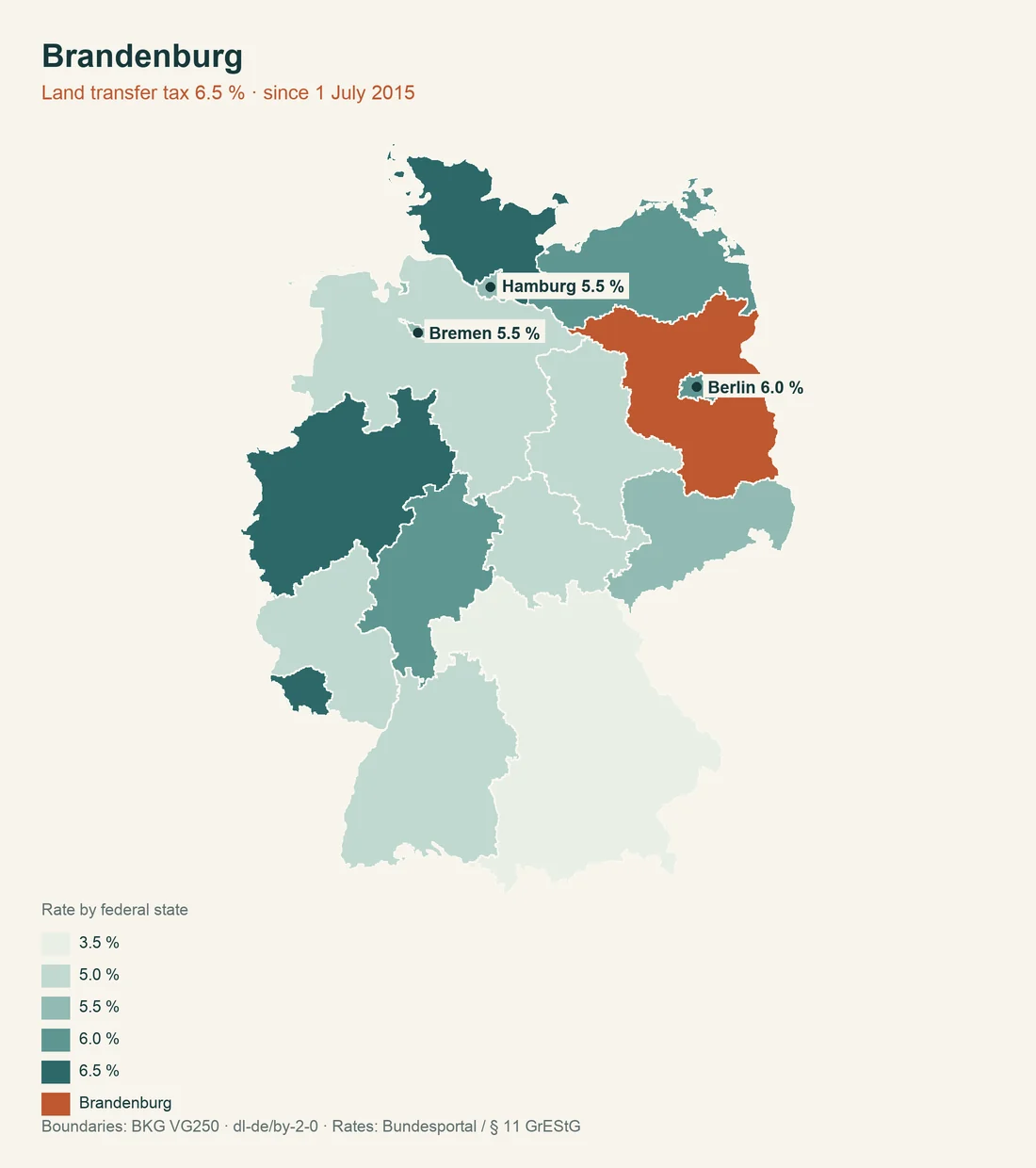
Brandenburg real-estate transfer tax is 6,5 percent for transactions involving land in Brandenburg realised from 1 July 2015. Brandenburg uses the federal property-tax model, not a separate state model. Road-improvement contributions under § 8 Abs. 1 and § 20 Abs. 3 to 4 KAG Brandenburg are abolished for public roads, paths and squares; this remains separate from the federal Erschließungsbeitrag.
The Brandenburg transfer-tax rate rule, Brandenburg property-tax information and KAG road-contribution rule answer different cost questions.
What differs in your state
Setbacks are the quickest cross-state screening point, but Brandenburg's § 6 Abs. 5 BbgBO and any § 87 BbgBO by-law control the actual plan. Use the table as orientation, not as a substitute for the cadastral drawing.
| State | Value | Legal basis | Source |
|---|---|---|---|
| Baden-Württemberg | Standard rule: Generally 0.4 H, at least 2.5 m. Core areas: In core areas, 0.2 H applies, at least 2.5 m. Commercial areas: In commercial areas, 0.125 H applies, at least 2.5 m. Narrow sides: For walls up to 5 m wide, the depth must not be less than 2 m. | § 5 Abs. 7 LBO | Source Baden-Württemberg |
| Bavaria | Standard case: 0.4 H, at least 3 m. The building setback is 0.4 H, at least 3 m. Commercial and industrial areas: 0.2 H at least 3 m. In commercial and industrial areas it is 0.2 H, at least 3 m. Large cities with over 250,000 inhabitants: 1 H; on up to two external walls 0.5 H Art. 6 Abs. 5a contains this special rule outside certain areas if the surrounding area is characterized accordingly. | Art. 6 Abs. 5 BayBO | Source Bavaria |
| Berlin | As a rule: 0.4 H at least 3 m building setbacks must be kept clear in front of external walls and roofs; basically 0.4 H, at least 3 m. Commercial and industrial areas: 0.2 H at least 3 m. The special statutory scale applies to certain commercial or industrial areas. | § 6 Abs. 5 BauO Bln | Source Berlin |
| Brandenburg | Standard case: 0.4 H, at least 3 m. The depth of the building setback is 0.4 H, at least 3 m. Commercial and industrial areas: 0.2 H at least 3 m. In commercial and industrial areas, 0.2 H is sufficient, at least 3 m. Building classes 1 and 2 with a maximum of three floors above ground: 3 m In front of the outer walls, a depth of 3 m is sufficient. | § 6 Abs. 5 BbgBO | Source Brandenburg |
| Bremen | § 6 Abs. 6 Satz 1 BremLBO – Standard case: 0.4 H at least 3 m The depth of the building setback is 0.4 H, at least 3 meters. § 6 Abs. 6 Satz 2 BremLBO – Commercial and industrial areas: 0.2 H, at least 3 m. In commercial and industrial areas, a depth of 0.2 H, at least 3 meters, is sufficient. § 6 Abs. 6 Satz 3 BremLBO – small buildings: 3 m In front of external walls of buildings in building classes 1 and 2 with a maximum of three floors above ground, 3 meters is sufficient. § 6 Abs. 6 Satz 4 BremLBO – neighbour-protecting effect: 0.75 Only three quarters of the required depth, but at least 2.50 meters, have a neighbour-protecting effect. | § 6 Abs. 6 BremLBO | Source Bremen |
| Hamburg | Standard case: 0.4 H at least 2.5 m § 6 Abs. 5 Satz 1 HBauO: Depth of the building setback 0.4 H, at least 2.50 m. Commercial and industrial areas: 0.2 H at least 2.5 m § 6 Abs. 5 Satz 2 HBauO: 0.2 H, at least 2.50 m; the standard rule (0.4 H) applies again at borders to other building areas. Bebauungsplan with different regulations: as set in the Bebauungsplan § 6 Abs. 5 Satz 3 HBauO: If a Bebauungsplan sets other distances, these take precedence. Garages and outbuildings without their own building setback: wall height up to 3 m, length up to 9 m per property line § 6 Abs. 8 HBauO allows garages, building-independent solar systems, retaining walls/enclosures and heat pumps without their own building setback, a maximum of 15 m in total per property. | § 6 HBauO | Source Hamburg |
| Hesse | Standard rule: 0.4 H at least 2.5 m. The depth is generally 0.4 H; according to the current version, at least 2.50 m applies. Commercial and industrial areas: 0.2 H at least 2.5 m The reduced depth only applies in the legally specified areas and not to areas of other use. Narrow sides and border developments: Special rules according to § 6 Abs. 6 und 11 HBO Separate requirements apply to certain subordinate components and border garages; Bebauungsplan and local statutes remain to be checked additionally. | § 6 Abs. 5 HBO | Source Hesse |
| Lower Saxony | As a rule: The distance is 0.5 H, at least 3 m. Commercial and industrial areas: In commercial and industrial areas, 0.25 H applies, at least 3 m. Narrow sides: special legal rules For border development and narrow sides, § 5 contains further special rules; they cannot be reduced to a single general factor. | § 5 Abs. 2 NBauO | Source Lower Saxony |
| Mecklenburg-Western Pomerania | Building classes 1 to 3: 3 m Fixed building setback depth of 3 m in front of the external walls, regardless of the building height (§ 6 Abs. 5 Nr. 1). Building class 4: 4 m Fixed building setback depth of 4 m (§ 6 Abs. 5 Nr. 2). Building class 5: 5 m Fixed building setback depth of 5 m (§ 6 Abs. 5 Nr. 3). Commercial and industrial areas as well as antenna systems in the Außenbereich: 0.2 H at least 3 m 0.2 H, at least 3 m (§ 6 Abs. 5 Nr. 4). Otherwise (fallback rule outside the building class circumstances): 0.4 H at least 3 m 0.4 H, at least 3 m (§ 6 Abs. 5 Nr. 5). | § 6 Abs. 5 LBauO M-V (Änderungsgesetz vom 26. Mai 2026, GVOBl. M-V 2026 Nr. 16 S. 524) | Source Mecklenburg-Western Pomerania |
| North Rhine-Westphalia | Standard rule: 0.4 H, at least 3 m. The depth is 0.4 H, at least 3 m. Commercial and industrial areas: 0.2 H at least 3 m. In commercial and industrial areas, 0.2 H is sufficient, at least 3 m. Core areas: 0.25 H at least 3 m In core areas 0.25 H applies, at least 3 m; Special rules apply to certain public areas. | § 6 Abs. 5 BauO NRW 2018 | Source North Rhine-Westphalia |
| Rhineland-Palatinate | Standard case: 0.4 H at least 3 m. The depth of the building setback is generally 0.4 H, at least 3 m. Special cases: Border garages and subordinate buildings § 8 Abs. 9 LBauO contains special requirements for systems without their own building setback; Location, wall height and boundary length must be checked individually. | § 8 LBauO Rheinland-Pfalz | Source Rhineland-Palatinate |
| Saarland | Normal case (§ 7 Abs. 5 Satz 1 und 5 LBO): 0.4 H, in all cases at least 3 m Residential buildings in building classes 1 and 2 with a maximum of three floors above ground (§ 7 Abs. 5 Satz 2 LBO): 3 m is sufficient as the depth of the building setback Commercial and industrial areas (§ 7 Abs. 5 Satz 3 LBO): 0.2 H, at least 3 m Core areas and non-recreational special areas (§ 7 Abs. 5 Satz 4 LBO): depth less than 0.4H may be permitted, but at least 3 m; not a fixed factor in the law Wind turbines (§ 7 Abs. 8 LBO): 0.25 H in the Außenbereich or in special areas for wind energy, otherwise 0.4 H Antennas including masts in the Außenbereich (§ 7 Abs. 9 LBO): 0.2 H Walls without openings in commercial and industrial areas (§ 8 Abs. 1 LBO): 1.50 m or 2.50 m depending on fire resistance and building materials, not opposite property boundaries | § 7 Abs. 5 LBO | Source Saarland |
| Saxony | Standard rule: 0.4 H at least 3 m. The depth is generally 0.4 H, at least 3 m. | § 6 Abs. 5 SächsBO | Source Saxony |
| Saxony-Anhalt | Standard case: 0.4 H at least 3 m § 6 Abs. 5 Satz 1 BauO LSA: The depth is 0.4 H, at least 3 m. Commercial and industrial areas: 0.2 H at least 3 m § 6 Abs. 5 Satz 2 BauO LSA: In commercial and industrial areas 0.2 H is sufficient, at least 3 m. Residential buildings, building classes 1 and 2: 3 m In front of the outer walls of certain residential buildings of building classes 1 and 2, a depth of 3 m is sufficient according to § 6 Abs. 5 Satz 3. | § 6 Abs. 5 BauO LSA | Source Saxony-Anhalt |
| Schleswig-Holstein | Standard case: § 6 Abs. 5 LBO determines 0.4 H, at least 3 m. Commercial and industrial areas: In commercial and industrial areas, the legal requirements are 0.2 H, at least 3 m. Residential buildings, building classes 1 and 2: Special regulations For residential buildings of building classes 1 and 2, § 6 contains further special rules. Narrow-side privilege: yes § 6 contains a special legal regulation for certain narrow pages; the specific application is property-specific. | § 6 Absatz 5 LBO SH (Bekanntmachung der geltenden Fassung vom 5. Juli 2024, GVOBl. Schl.-H. 2024 Nr. 8, S. 504/522) | Source Schleswig-Holstein |
| Thuringia | Standard case: 0.4 H The depth of the building setback is generally 0.4 H, at least 3 m. Commercial, industrial and comparable special areas: 0.2 H In commercial and industrial areas as well as comparable special areas, the special depth of 0.2 H applies, at least 3 m, provided the legal requirement is met. | § 6 Abs. 5 ThürBO (Fassung vom 2. Juli 2024, GVBl. 2024, 298, Gültig ab 19.07.2024) | Source Thuringia |
Start with the Flurstück, planning portal, access and Baulastenverzeichnis. Then request ALBOKAT, ALKIS, monument, water, forest and ordnance information. If building law remains open, put a Vorbescheid, Bauanzeige or clear contract condition in the purchase file. The access and infrastructure guide and notary and closing guide help with the next documents.
For comparisons, use the 16-state road-contribution comparison and the 16-state monument-protection comparison. The boundaries and land-survey guide helps when a new boundary or division is planned.
Bundle Brandenburg authority answers before signing. A GrundCheck property check ties the Flurstück, plan and open risks together.
Sources and checking date
Checked on 7 August 2026. The information is general and does not replace a written answer from the municipality, Landkreis, Bauaufsicht or specialist authority. Read next: land register and ALKIS, Bodenrichtwert and land value, contamination and monuments and archaeology.