
State
Buying land in Bremen: the city-state checks
A Bremen plot needs more than a building-plan check: identify the municipality, then verify BremLBO, Baulasten, soil, water, ordnance and neighbour law.
On this page
The city-state changes who answers the question
Buying land in Bremen requires a different approach from checking a territorial state divided into rural districts. The Land consists of the municipalities of Bremen and Bremerhaven. State law, local land-use planning and different administrative routes therefore meet within a small area.
The first item in the purchase file is the exact municipality. A plot in Bremen city is not handled by the same local office as a plot in Bremerhaven for planning purposes. The state publishes its laws through the Bremen law portal; the plot-specific answer remains a matter for the competent municipality or specialist authority.
The state GeoPortal Bremen geodata platform is a useful starting point, but it does not replace the original decision for the parcel. Plan, cadastre, Baulast (public-law building obligation) and specialist-law restrictions should be saved separately.
- Setbacks under the BremLBO
- Cadastre data is open, formal extracts cost money
- Soil, contamination and the unavailable average land value
- Ordnance and mining supervision
- Taxes, fees and agricultural land
Source: BremLBO; GeoPortal Bremen; BORIS Bremen; Altlastenkataster Bremen; checked August 2026
Setbacks under the BremLBO
The Bremische Landesbauordnung (BremLBO), Bremen's state building code, applies in the version in force since 1 July 2024. For setback depth, § 6 Abs. 6 BremLBO gives the usual rule as 0.4 H, at least 3 m. In commercial and industrial areas, 0.2 H also with a minimum of 3 m is sufficient.
For buildings in Gebäudeklassen 1 and 2 with no more than three above-ground storeys, the same provision gives 3 m in front of the external walls. Only three quarters of the required depth has neighbour-protective effect, but never less than 2.50 m. The checked version of the BremLBO does not state a separate core-area factor or a narrow-side privilege.
That figure belongs on the site plan, not merely in a note copied from the listing. Building height, zone, building form and local by-law can change practical buildability. Read the Bremische Landesbauordnung together with the building-permit and pre-application guide.
A Baulast is not a Grundbuch entry
Bremen's building supervision authority keeps a Baulastenverzeichnis, the register of public-law building obligations. Under § 82 BremLBO, the obligation takes effect through registration and also binds legal successors. The declaration must be made in writing; electronic form is excluded.
This matters especially on narrow city plots. Access, parking, setbacks or another obligation may secure the building solution without appearing in the corresponding place in the Grundbuch, the land register. Before notarisation, request a plot-specific Baulastenverzeichnis extract under the BremLBO.
A Grundbuch check is still necessary. The Grundbuch and ALKIS comparison helps keep ownership, parcel identity and actual use from being treated as one document.
Cadastre data is open, formal extracts cost money
Since 9 June 2024, Liegenschaftskataster datasets have been freely available through GeoPortal Bremen and MetaVer. That does not mean every formal extract is free. Ordered cadastral products remain subject to fees.
The cadastral-extract service portal distinguishes the products. For a purchase check, a parcel certificate, property certificate and, where applicable, owner data are not interchangeable. Name the requested content expressly in the application.
The online map also does not answer a Baulast, contaminated-site or monument question. Keep a printout with retrieval date and parcel number as working material; a legal decision requires the competent office to answer the specific facts.
Land-use planning in two municipalities
The Bremen land-use planning information system lists procedure data for Bebauungsplan (binding local development plan), Flächennutzungsplan and project-related plans in Bremen city. Finding a plan does not automatically answer whether the proposed building is permitted.
For a Bremerhaven plot, follow up with the local planning office there. In both municipalities, the plan drawing, text provisions, infrastructure and actual parcel boundary must fit together. Resolve any difference between the listing and the plan status in writing before buying.
For the first assessment, use the zoning and buildability guide and the access and infrastructure checklist. State building law regulates procedures and setbacks, not the specific designation of every zone.
Soil, contamination and the unavailable average land value
The soil information system of the highest soil-protection and contaminated-site authority is publicly accessible. A plot-specific disclosure under § 10 BremBodSchG is nevertheless fee-based; processing normally takes four weeks and costs at least 77 euros per plot.
Link the Bremen plot-specific contaminated-site disclosure to former use, excavation and planned infiltration. A general map is not a complete negative certificate.
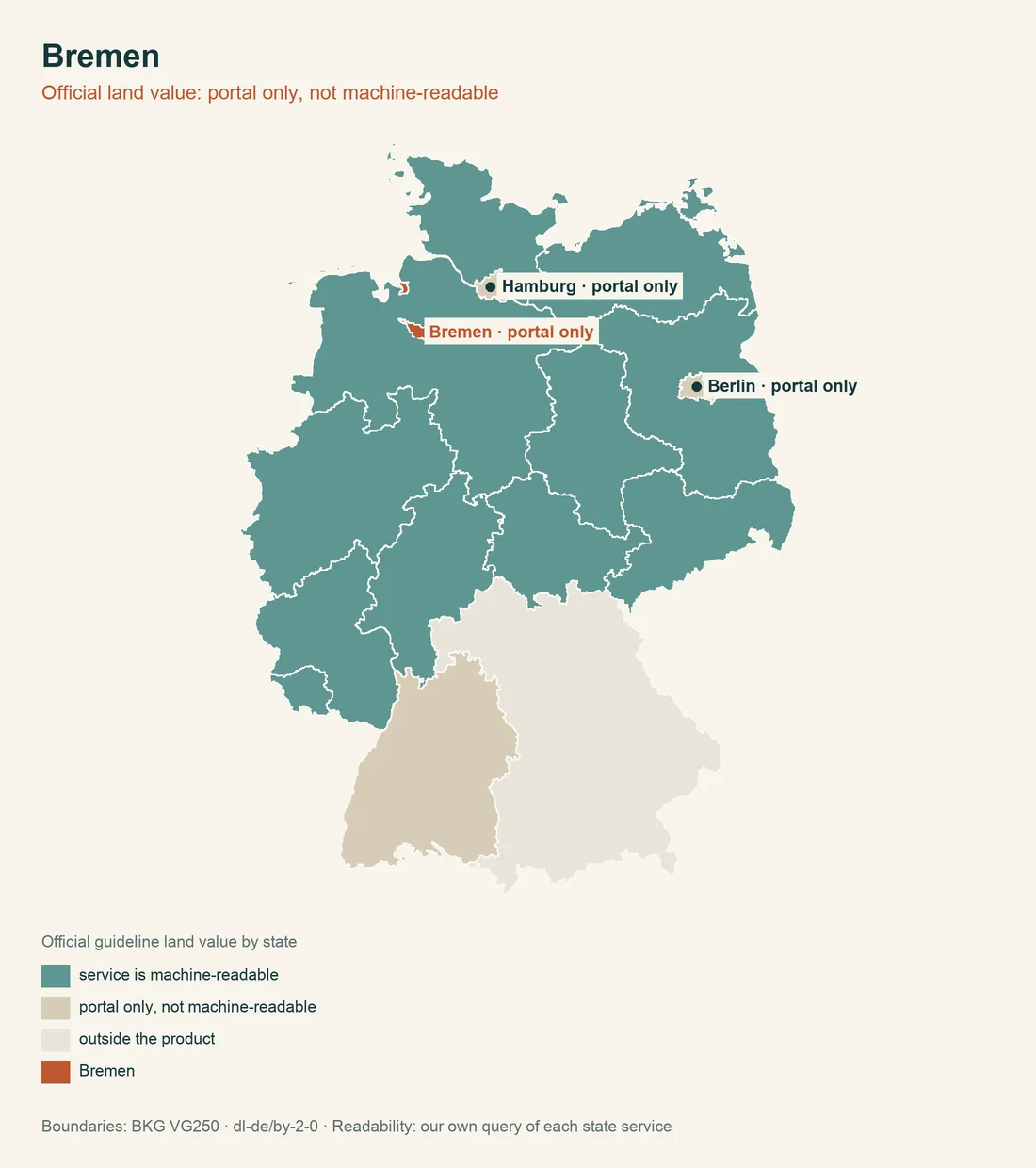
The checked Bremen statistics do not publish an official state average for building-ready land. The value of 131.69 EUR per m² covers building land overall in 2022 and must not be presented as the price of building-ready land. The Bremen Gutachterausschuss provides Bodenrichtwerte through BORIS.NI online without charge; a map extract up to DIN A3 costs 50 euros.
Water margins and nature
Bremen is shaped by urban waters, ditches and tidal areas. § 21 BremWG gives 5 m within built-up localities. In the Außenbereich, the margin is 10 m; 5 m is stated for drainage and irrigation ditches in the Außenbereich.
These widths are not a blanket answer for every waterfront plot. Water type, location and the planned measure decide the result. The Bremisches Wassergesetz rules belong in the file alongside the site plan and drainage concept.
A nature-conservation pre-emption right under § 32 BremNatG can create an additional contract question for legally defined areas. Ask for the parcel-specific position under the Bremen nature-conservation rules.
Ordnance and mining supervision
Where ground is to be disturbed in a suspected area, a survey must be carried out first. § 8 of Bremen's Kampfmittelgesetz allocates the cost: surveying and exposing the object fall to the obligated party, while removal and transport of the ordnance are borne by the Land.
The Bremen police ordnance-clearance service is the competent contact. State the parcel and planned depth of excavation; an unremarkable map impression does not replace a specialist answer.
Bremen has no separate mining authority. Mining supervision is carried out by Landesbergamt Clausthal-Zellerfeld as the intermediate mining authority for Bremen. This is a Bremen jurisdictional feature even though the specialist office is in Lower Saxony.
Monuments and neighbours
For Bremen, the Landesamt für Denkmalpflege and Landesarchäologie are the monument specialist authorities; in Bremerhaven, the Magistrat performs this task. Under §§ 4, 5 BremDSchG, do not rule out built or archaeological monuments solely from a property map.
Protection of a built monument arises constitutively through an administrative decision. Archaeological monuments are recorded declaratorily; registration informs but does not replace specialist review. Consult the Bremen monument list and preservation office before demolition, earthworks or alteration. § 19 BremDSchG also contains a treasure trove rule for certain ownerless or long-hidden movable cultural monuments.
Bremen has no separate state neighbour-law statute. For trees, hedges, overhang and fences, state-specific metre values therefore do not apply automatically. The relevant rules include the BGB, in particular § 906, plus the local situation. Compare the Bürgerliches Gesetzbuch neighbour-law rule with by-laws and the physical site.
Taxes, fees and agricultural land
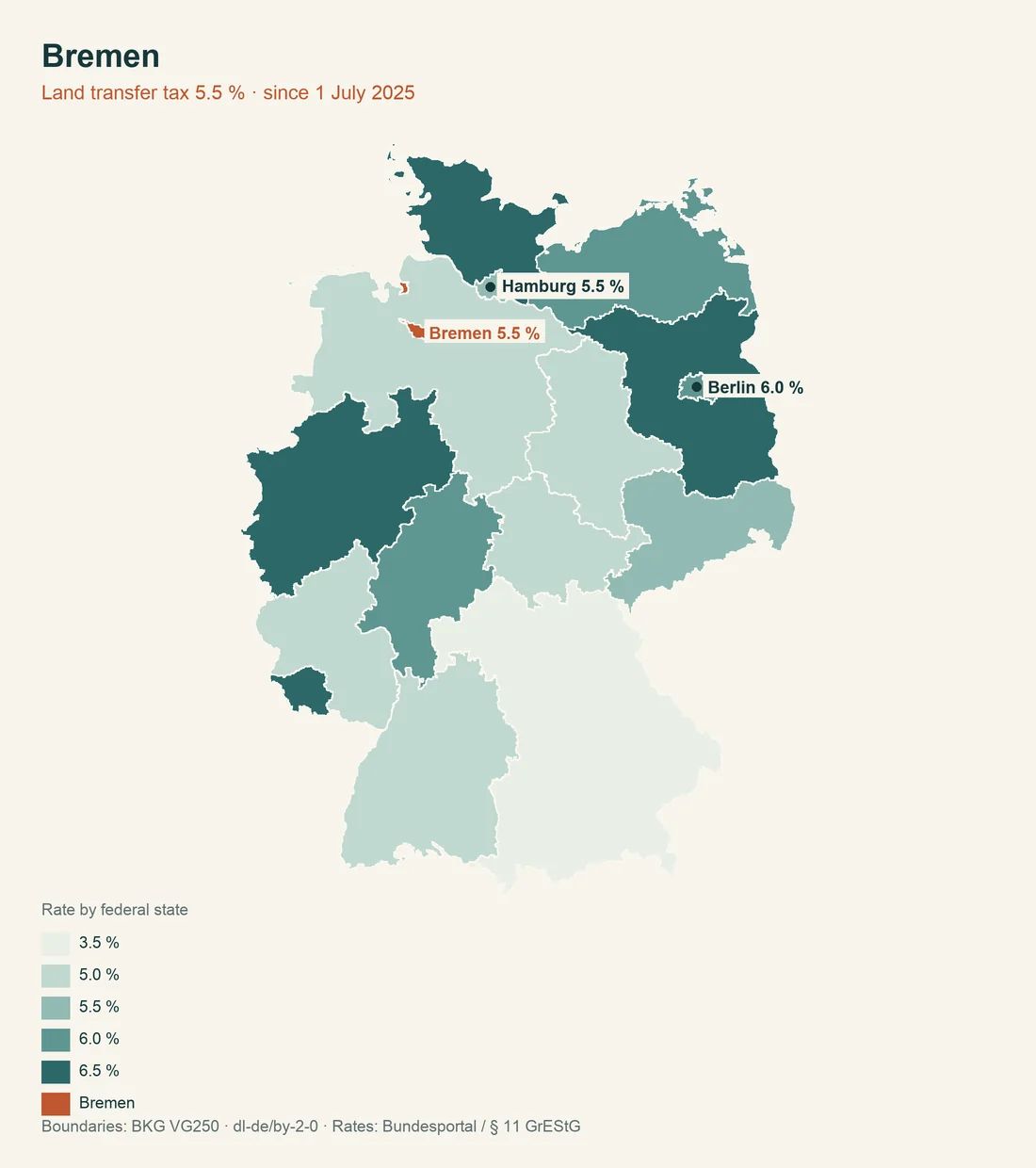
Bremen's real-estate transfer tax rate is 5.5 % for transactions from 1 July 2025. Earlier transactions were subject to 5 %. The Bremen real-estate transfer tax service explains which date controls.
Bremen uses the federal model for Grundsteuer and departs from the assessment figures through the BremGrStMG. Building administration fees follow the BauKostV. The amount depends on the actual official act, not on a flat figure in a listing.
For agricultural or forestry land transactions, Bremen has a 0.25 ha exemption threshold under § 1 GrdstVFreiGrG BR. This is a state-law feature and must not be confused with purchase-price, property-tax or Bodenrichtwert checks.
Preliminary decision, exemption and ancillary structures
A Vorbescheid under § 75 BremLBO is valid for three years. On an application in text form, the period can be extended once by two years. For a plot with an uncertain building envelope, the decision is useful only if the site plan, use and precise question match the property being bought.
§ 62 BremLBO regulates Genehmigungsfreistellung for homes, certain other installations, garages, parking spaces and ancillary structures. Building may generally begin one month after the required documents reach the municipality, unless the municipality first requires a permit procedure or authorises an earlier start.
§ 61 BremLBO gives 2 m for certain permit-free fences within the built-up area; the checked basis does not confirm a general fence height for the Außenbereich. For outbuildings, ask for the specific classification instead of relying on an assumed standard value.
- Planning lawMunicipality or building authority
- Parcel and mapGeoPortal Bremen
- Soil, value and hazardsSpecialist portal and competent authority
Source: BremLBO; GeoPortal Bremen; BORIS Bremen; Altlastenkataster Bremen; checked August 2026
A Bremen purchase sequence
Start with municipality, parcel, plan status and actual access. Then work through Bebauungsplan, setbacks, Baulast, contamination, ordnance, water, monument and mining supervision with the responsible office for each subject.
Every answer should be stored with authority, date, parcel and the question asked. Mark unresolved facts as unresolved. That restraint matters for the contaminated-site disclosure, the building-ready land price and the absence of a separate Bremen neighbour-law statute.
Useful background includes the contamination guide, the Baulasten checklist, the land-value guide and the costs and taxes guide. For built and archaeological monuments, use the monument and archaeology guide; for permit-free projects, the building-permit guide. The land-register and ALKIS guide helps compare the states' cadastral access points.
Documents for the bank and notary
The financing file should bring together the official parcel designation, plan status and written answers. The Bremen building-fee ordinance helps classify an administrative invoice, but says nothing about surveyor, valuer or investigation costs.
For a plot with woodland or open-space content, also check the Bremen Forest Act. An agricultural connection raises the exemption-threshold question, not automatically a building-law use.
For Bodenrichtwerte, distinguish online information from a map extract. The Gutachterausschuss online map extract is market and location information; it confirms neither infrastructure nor building rights.
| State | Value | Legal basis | Source |
|---|---|---|---|
| Baden-Württemberg | Building-ready land 2024: 362.06 EUR/m². Official average purchase value for building-ready land in Baden-Württemberg; not a Bodenrichtwert. | § 1 LStatG BW | Source Baden-Württemberg |
| Bavaria | Building-ready land 2024: 381 EUR/m². The Bavarian State Office for Statistics reports this average purchase value for 2024; regional differences are substantial. | Art. 1 Bayerisches Statistikgesetz | Source Bavaria |
| Berlin | Building-ready land 2024: 705.19 EUR/m². State-wide average from the official purchase-value statistics; not a Bodenrichtwert. | § 2 Statistikgesetz Berlin-Brandenburg | Source Berlin |
| Brandenburg | Building-ready land 2024: 176.8 EUR/m². State-wide average from the official purchase-value statistics; not a Bodenrichtwert. | Statistischer Bericht M I 6 – j/24, Tabelle 5 | Source Brandenburg |
| Bremen | All building land 2022: 131.69 EUR/m². Published value for all building-land categories combined, explicitly not building-ready land. Building-plot market size 2025/2024: 71 and 19 sales. Counts of plots sold, not prices. | Kaufwertstatistik für Bauland; Grundstücksmarktbericht Bremen 2026 | Source Bremen |
| Hamburg | Building-ready land 2024: 1026.71 EUR/m². State-wide average purchase value; not a Bodenrichtwert. | Statistisches Amt für Hamburg und Schleswig-Holstein | Source Hamburg |
| Hesse | Building-ready land, Hesse overall, 2024: 246.36 EUR/m². Derived from the official totals of 1,639 thousand m² and EUR 403,791 thousand in purchase consideration; an average purchase value, not a price index. | Statistischer Bericht M I 6 - j/24, Hessisches Statistisches Landesamt | Source Hesse |
| Lower Saxony | Building-ready land 2024: 148.01 EUR/m². State-wide average from official statistics; not a Bodenrichtwert. | § 1 NStatG | Source Lower Saxony |
| Mecklenburg-Western Pomerania | Building-ready land 2024: 115.3 EUR/m². State-wide average purchase value; not a Bodenrichtwert. | Amtliche Kaufwertstatistik für Bauland, Statistisches Amt Mecklenburg-Vorpommern | Source Mecklenburg-Western Pomerania |
| North Rhine-Westphalia | Building-ready land 2024: 272.59 EUR/m². IT.NRW reports this area-weighted average purchase value for 2024; it is purchase-value statistics, not a Bodenrichtwert. | § 3 Statistikgesetz NRW | Source North Rhine-Westphalia |
| Rhineland-Palatinate | Building-ready land, Rhineland-Palatinate overall, 2024: 175 EUR/m². The State Statistical Office reports this average from 2,310 sales in 2024; an average purchase value, not a price index. | Kaufwerte für Bauland 2024, Statistisches Landesamt Rheinland-Pfalz | Source Rhineland-Palatinate |
| Saarland | Building-ready land 2025: 135.02 EUR/m². State-wide average purchase value. All building land 2025: 112.21 EUR/m². All building-land categories combined; a comparison figure, not a Bodenrichtwert. | Statistik der Kaufwerte für Bauland (§ 195 BauGB i.V.m. Agrarstatistikgesetz/Landesstatistikrecht) | Source Saarland |
| Saxony | Building-ready land 2024: 155.0 EUR/m². State-wide average purchase value; not a Bodenrichtwert. | Sächsisches Statistikgesetz | Source Saxony |
| Saxony-Anhalt | Building-ready land, Saxony-Anhalt, 2024: 65.42 EUR/m². The State Statistical Office reports this state-wide average; the corresponding figure for all undeveloped plots is 29.33 EUR/m². | Statistik der Kaufwerte für Bauland; Statistisches Landesamt Sachsen-Anhalt | Source Saxony-Anhalt |
| Schleswig-Holstein | Building-ready land 2024: 137.13 EUR/m². The statistics report this average purchase value for Schleswig-Holstein as a whole. | Statistik der Kaufwerte für Bauland | Source Schleswig-Holstein |
| Thuringia | Building-ready land 2025: 74.09 EUR/m². State-wide average for Thuringia overall; not the price class below 5 EUR/m². | Amtliche Kaufwertestatistik für Bauland, Thüringer Landesamt für Statistik / Regionaldatenbank Deutschland | Source Thuringia |
A table supports the purchase file, but it does not replace the original document. The point is to show which figure comes from state law, where an answer is missing and where the municipality or specialist authority must decide.
Sort the risks before the notary appointment. The property review keeps open answers and documents together.
For a densely built plot, photograph existing buildings, walls, access and drainage and file the images with the site plan. The agricultural and forestry land-transaction threshold rule concerns only that type of transaction. It answers nothing about access, the building envelope or neighbouring planting. In a city-state, these layers are easily mixed because paths, plots and buildings sit close together. A short list of confirmed, open and irrelevant points is more useful to the notary than a general reference to a portal.
Complete the purchase file. The parcel check orders the last open points.
Before the notary appointment, compare the list once more with the current draft contract. For partial areas, access and planned ancillary structures, identify exactly which parcel the authority response covers. A missing answer is not replaced by a general seller assurance. This keeps clear whether a Bremen feature has been resolved or a city municipality decision is still missing.
An existing building is not assessed from its appearance alone. Permits, use and actual condition must match the current parcel. If they do not, ask the building supervision authority in writing before buying.
Record the retrieval date visibly on every document and again before each later decision.
Source status and limits
Information checked on 7 August 2026. Law, plan status and administrative practice can change. A map, listing or general answer does not replace a parcel-specific review.
Read next: access and infrastructure, contaminated sites and Baulasten and restrictions.
Before you commit to a plot in either city municipality, it helps to see how the same question is answered elsewhere: monument protection compared by state, permit-free building limits by state, the state geoportals side by side.
GrundCheck editorial team