
Legal review
Grundbuch and ALKIS: what each proves
Which register answers which question about a German parcel, how to get hold of both, and what to do when the contract and the map disagree.
On this page
Two registers, two different promises
The cadastral record and the land register answer different questions. Federal law governs the register's legal effects, state law supplies cadastral administration, and the municipality controls the planning context. The Liegenschaftskataster, held by the state as ALKIS, records the parcel number, shape, area and mapped buildings. The Grundbuch records ownership and legal burdens. Treating either record as a substitute for the other leaves ownership, burdens or geometry unchecked.
The two records are linked by one statutory rule. § 2 GBO says parcels are designated in the land register according to the official register kept by the state, meaning the cadastre. So the Grundbuch does not measure anything. It borrows the description from ALKIS and then makes statements about rights.
That single sentence explains the practical rule that follows. The land register's guarantee runs to rights, not to square metres. § 891 BGB presumes that a right entered in the register exists and that a deleted right does not, and § 892 BGB protects a buyer who relies in good faith on the register when acquiring a right in the land. Neither provision makes the area figure or the boundary line binding. If the register says 1,000 square metres and the survey says 920, the register does not give you the missing 80.
ALKIS data, and the fact that it is free
Access and reuse terms vary by state. In Brandenburg, digital geobasis data has been available without charge and for free reuse since 21 June 2019. The BbgGeoNutzV sets the terms, the Brandenburg surveying authority runs the service, and around six hundred products are downloadable through GEOBROKER. For a quick look, the Brandenburg cadastral viewer and Geoportal Brandenburg show the cadastral map and parcel numbers in a browser.
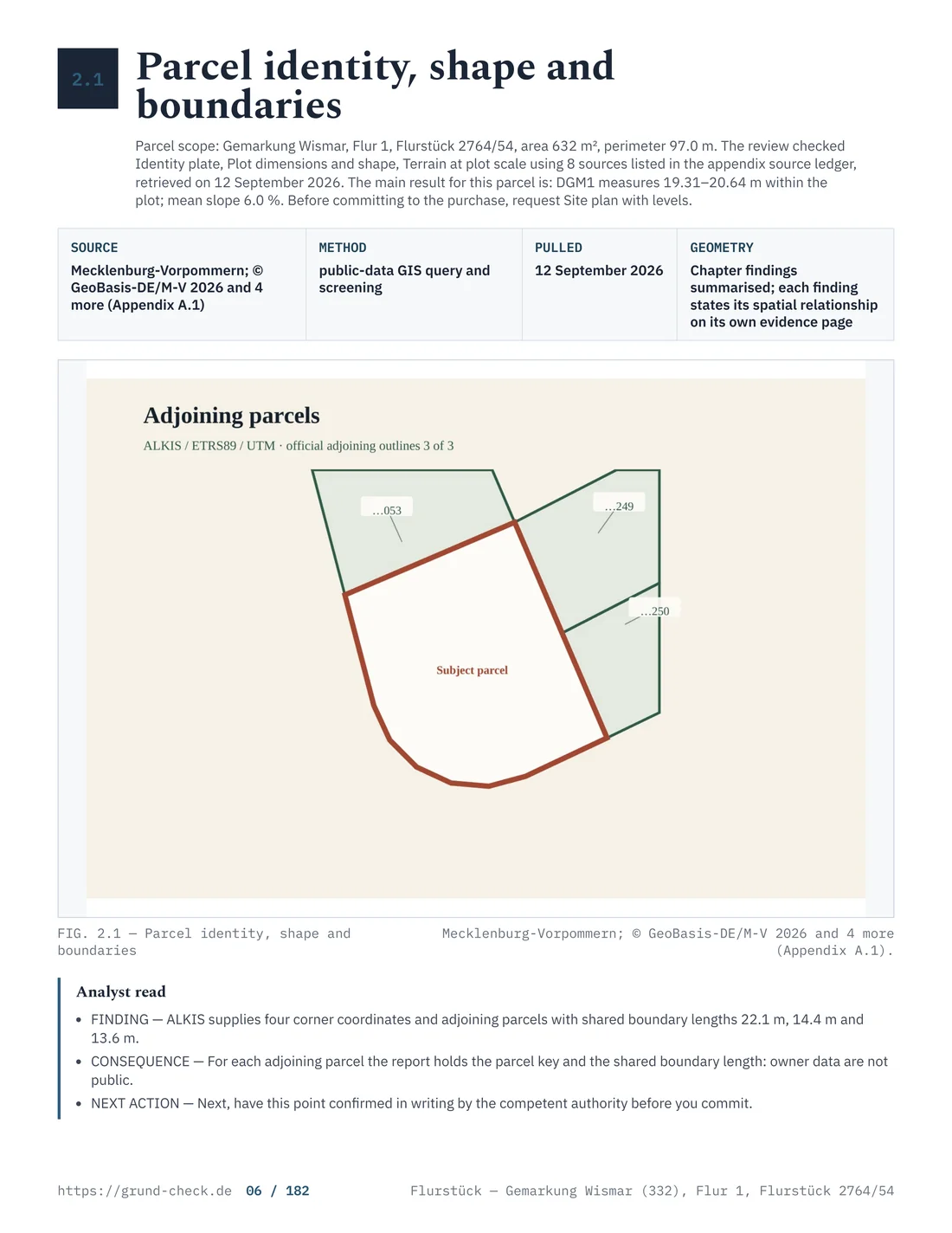
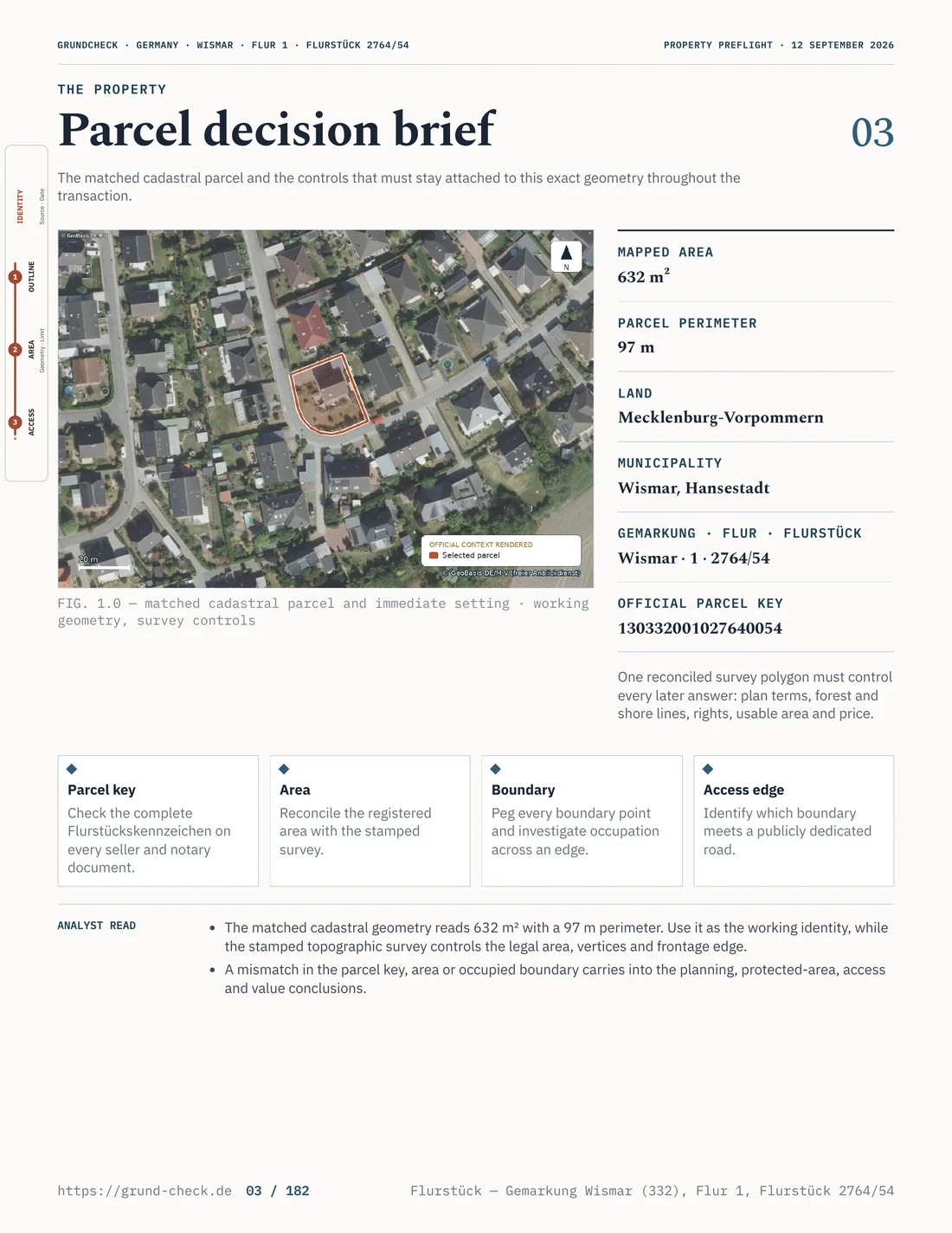
What you are looking for is the parcel identity in the form the whole system uses: Gemarkung, Flur and Flurstück (cadastral parcel), for example Gemarkung Bernau, Flur 12, Flurstück 7/3. Every letter you write to an authority should carry those three items. An address is not an identifier, and half the delays in a purchase come from correspondence about the wrong piece of land.
Paper products and bespoke extracts still cost money, and a formal Flurstücksnachweis or Liegenschaftskarte with an official stamp is a chargeable service from the cadastre authority. The free download is enough for due diligence. The stamped version is what a bank or an authority sometimes wants in the file.
Start with the parcel, not the paperwork. A GrundCheck preflight report resolves an address or a listing to the official parcel identity and shows the planning and risk context around it, which is the reference every one of these documents is filed under. Check a parcel.
What the Grundbuch actually contains
A Grundbuchblatt has four parts, and buyers who only ask about "the three sections" miss the one that connects the two registers.
- Bestandsverzeichnis. The parcels on this sheet, described by Gemarkung, Flur, Flurstück, land use and area, all taken from the cadastre. Also the rights that belong to this parcel over other land, such as a right of way in your favour.
- Abteilung I. The owner or owners, their shares, and the legal ground on which they acquired.
- Abteilung II. Burdens and restrictions other than money charges: easements, rights of way, utility line rights, usufruct, rights of residence, pre-emption rights, insolvency notes, restrictions on disposal, and any Auflassungsvormerkung.
- Abteilung III. Money charges: Grundschuld, Hypothek, Rentenschuld, with the amount, the creditor and the interest rate entered.
Read Abteilung II first and slowly. A single line of shorthand there can mean that a utility company may dig across the middle of your building plot, or that the neighbour drives over your access. The register entry itself is usually a one-line summary; the substance sits in the Bewilligung, the underlying deed, and you are entitled to ask for it. An easement under § 1018 BGB binds every future owner, so its exact wording matters more than the summary line.
- Notarial deed§ 311b BGB
- Auflassung§ 925 BGB
- Priority notice§ 883 BGB
- Tax clearance§ 22 GrEStG
- Registration of ownership§ 873 BGB
Source: BGB §§ 873, 883, 925 and 311b; GrEStG § 22; checked August 2026
Order of entry decides who wins
Rank is not a formality. § 17 GBO makes the registry deal with applications in the order they arrive, and § 879 BGB gives rights in the same section priority by the order of their entry. In a purchase this becomes concrete in one place: the Auflassungsvormerkung, the priority notice under § 883 BGB. Once it is entered for the buyer, later disposals by the seller are ineffective against the buyer's claim. It is the reason no sensible notary lets the purchase price move before the notice is registered.
Ownership passes on registration, not on signature
Three provisions run the transfer. § 311b BGB requires the contract to be notarised. § 925 BGB requires the Auflassung, the agreement on the transfer, declared before the notary. § 873 BGB makes the transfer effective only on entry in the land register. On top of all that, § 22 GrEStG bars the registry from entering the new owner until the tax office has issued its clearance certificate.
So the gap between signing and owning is normal, and it is measured in weeks. What protects you across it is the priority notice, not the contract.
Getting the extracts, in the right order
Start with the free map, because it is instant and it gives you the parcel identity. Then apply for the register extract with that identity in hand.
The Grundbuch is not public. § 12 GBO allows inspection only to somebody who shows a legitimate interest, and mere curiosity about a plot on the market does not qualify. In practice a buyer gets the extract in one of three ways: the seller supplies a current one, the seller gives written consent for the buyer to obtain it, or the notary requests it once instructed. The registry office is the Grundbuchamt at the local Amtsgericht.
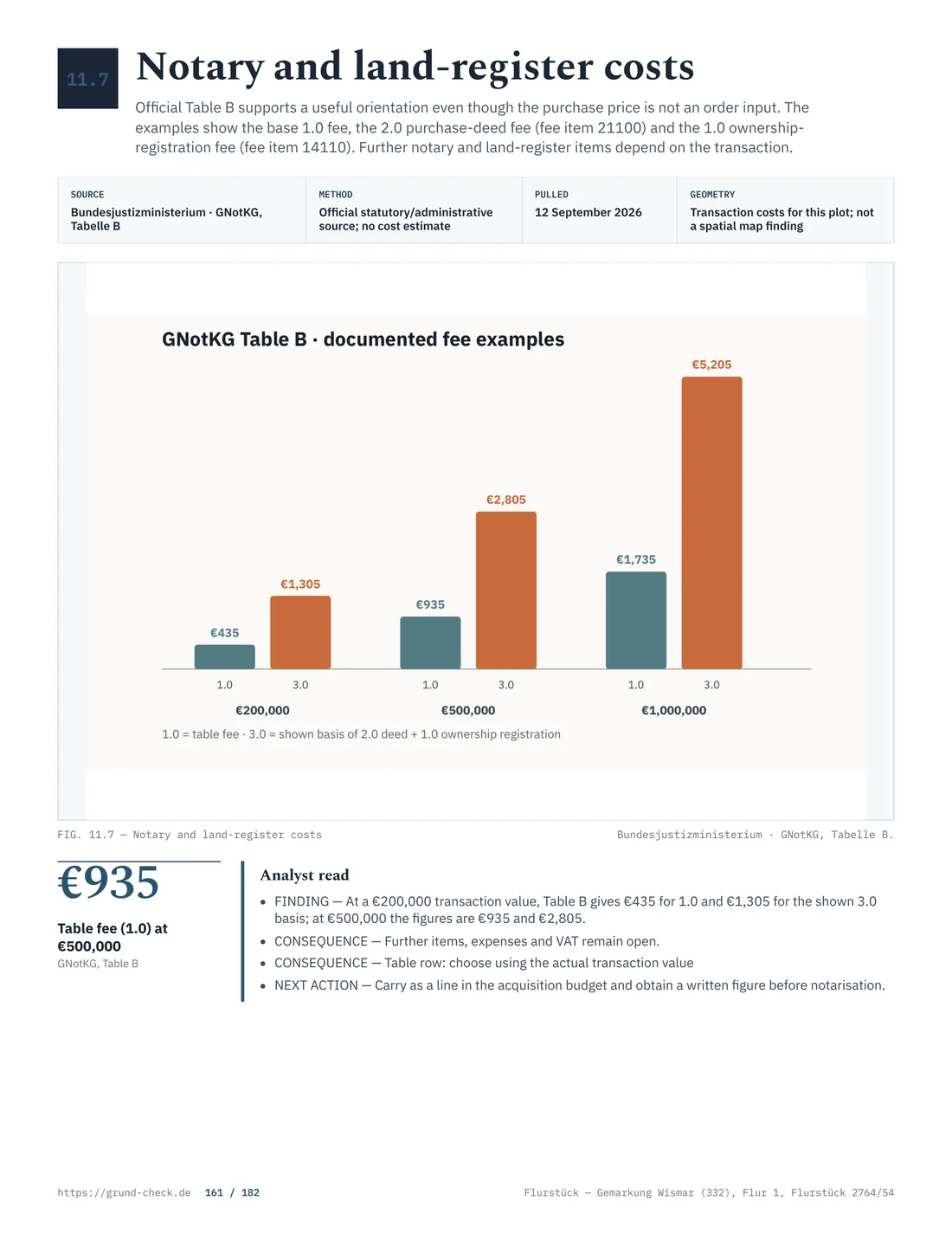
The fees are fixed and small. A plain printout is 10 €, an official certified printout 20 €, both set as fixed amounts in the GNotKG schedule of charges. Order the certified one if a bank will see it. Whatever you receive, check the date on it. An extract from last spring proves nothing about a charge registered last month.
How to request usable documents
Ask the seller for a current extract in a message that identifies the parcel by Gemarkung, Flur and Flurstück and requests the following five items. Access to the Grundbuch is restricted, so the seller or the instructed notary may have to obtain the extract:
- a current Grundbuch extract for Gemarkung, Flur and Flurstück, not older than four weeks;
- the underlying deeds for the entries in Abteilung II, or written consent for the notary to obtain them;
- for every charge in Abteilung III, the creditor, the current balance and whether a release has been requested;
- an extract from the Baulastenverzeichnis of the Landkreis, or confirmation that none exists;
- the cadastral parcel record, and any survey report if the plot has been divided or re-measured.
Add one sentence that changes the tone of the reply: state that your notary needs these before a draft contract can be prepared. That is true, it is neutral, and it moves the request from curiosity to process. If the seller will not consent to the extract, the notary can still obtain it once instructed, but a refusal at this stage is worth thinking about.
Charges in Abteilung III, and how they disappear
A mortgage on the seller's parcel is normal and is not a reason to walk away. It is a reason to insist on the mechanics. A Grundschuld entered for the seller's bank does not vanish because the seller says the loan is repaid. It stays on the sheet until it is formally deleted, and it binds the parcel, not the person.
The standard solution runs through the notary. The seller's bank issues a release, the notary holds it under conditions, part of the purchase price is directed to that bank to clear the balance, and the deletion is applied for together with the transfer. Everything is agreed in the contract before signing, so the money never moves without the release in hand.
Three points to check. The registered amount of a Grundschuld is often far higher than the debt actually outstanding, so the entry alone tells you nothing about what has to be paid. Interest and ancillary charges are usually registered as well and belong in the calculation. And where a charge is to be taken over rather than cleared, that must be priced into the purchase and written down, because a taken-over charge follows you.
Matching the two documents, step by step
- Take Gemarkung, Flur and Flurstück from the cadastre and confirm the same three items appear in the Bestandsverzeichnis of the register and in the draft contract. All three, not just the parcel number.
- Compare the area. Small differences of a few square metres are normal after re-surveys. A difference of tens of square metres, or a different shape, is a stop signal.
- Check that the seller in the contract is exactly the person in Abteilung I. Married names, inheritances and company reorganisations are where this fails.
- Read every entry in Abteilung II and ask the notary for the underlying deed of any you do not understand.
- Read Abteilung III and agree in the contract how each charge will be cleared or taken over, with the release documents named.
- Only then compare the picture against the planning documents, the Baulastenverzeichnis and the utility answers.
Where the two registers disagree, resolve it before signing, not after. Once you own a parcel with a boundary problem, you are the person paying to fix it.
Source: GNotKG schedule of charges, items 17000 and 17001; checked August 2026
When the date on the extract is the real risk
A Grundbuch extract is a snapshot. Applications can arrive between ordering the extract and the notary appointment without yet appearing as completed entries. The notary therefore checks the current position and the ranking of rights before the purchase price falls due. An old printout is a starting point, not a promise about the day of notarisation. The same is true of ALKIS: after a survey or division, the area, parcel number and geometry can change. A saved map image without a date is weaker evidence than a current parcel record. Keep every discrepancy with the authority, surveyor or notary in writing and in the purchase file. The Grundbuch answers ownership and charges; ALKIS answers identity and geometry; the Baulastenverzeichnis, municipality and specialist authorities answer the questions outside both registers.
Which question does each document answer?
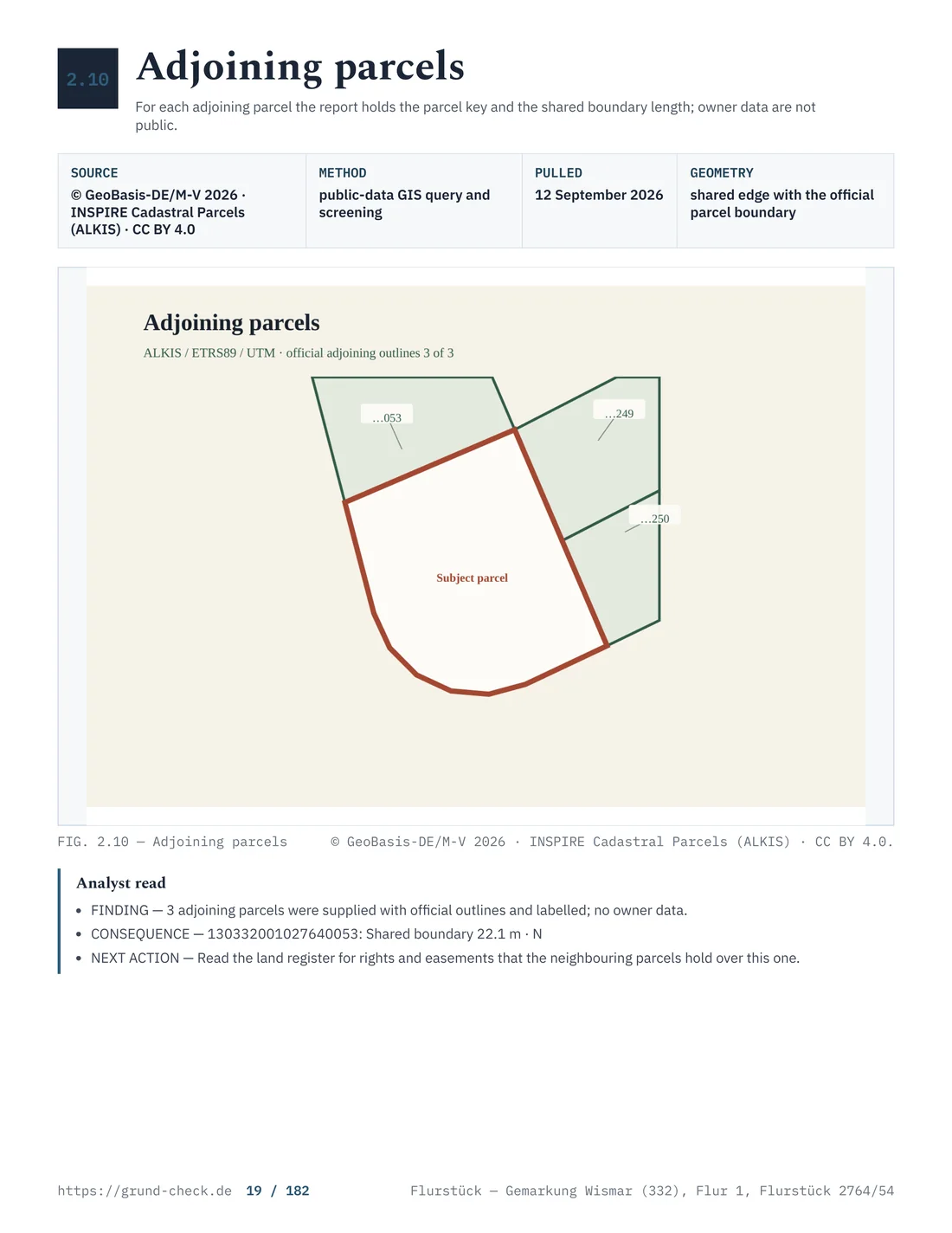
Use the document that answers the question. ALKIS and the official geoportal show where the parcel lies and what shape it has. A parcel record confirms its official size and identity. Abteilung I of the Grundbuch answers who owns it; Abteilung II answers which rights and restrictions exist; Abteilung III answers which debts are secured. A precise boundary requires a Grenzfeststellung by a surveyor, while public-law duties require the Baulastenverzeichnis and buildability requires the municipality or building authority. No single extract replaces the others, and the answer is only reliable when Gemarkung, Flur and Flurstück match across the file.
When the boundary itself is in doubt
Cadastral geometry is good but it is not a survey of your fence. Boundary marks on the ground can be missing, moved or simply wrong, and a building or hedge that has stood for thirty years does not create a boundary. A Grenzfeststellung by a publicly appointed surveyor establishes the legal line from the cadastral evidence and sets the markers. the applicable state's surveying act governs the cadastre and this procedure, and the fees come from the surveying fee ordinance, revised with effect from 1 January 2026.
Have it done before signing when the plot is unmarked, when it is being split off from a larger one, when a structure sits close to the line, or when the neighbour describes the boundary differently from the map. A parcel that is being divided cannot be conveyed until the new parcel exists in the cadastre with its own number, which is a surveyor's job and a lead time, not a formality on the day.
If the register itself is wrong, § 894 BGB gives a claim to have it corrected. That is a legal process, and it is far cheaper to discover the need for it before the purchase than after.
What neither register will tell you
Several matters that affect buildability appear in neither system and need separate enquiries.
- Baulasten. Public-law obligations on the plot, such as a setback taken over for a neighbour or a secured access, live in the Baulastenverzeichnis kept by the Landkreis under § 84 of the applicable state building code, not in the Grundbuch. They bind every future owner. The state only reintroduced the instrument in 2016, so older arrangements may instead sit in Abteilung II as limited personal easements. Check both.
- Planning status. Whether the parcel is covered by a Bebauungsplan (binding local development plan), sits inside the built-up area or lies in the Außenbereich is held by the municipality. The buildability guide works through it.
- Pre-emption rights of the municipality under §§ 24 to 28 BauGB. The notary asks for a negative certificate, and the transfer waits for it.
- Contamination, flood risk, protected species and monuments. Separate authorities, separate registers, and the duty to remediate can reach an owner who caused nothing.
- Utility connections. Neither register says whether a water main runs in the road. The utility connection check is a separate exercise.
| Question | Which system answers it | Where to get it | Cost |
|---|---|---|---|
| Where is the parcel and what shape is it? | ALKIS | state cadastral viewer, GEOBROKER | free |
| How large is it officially? | ALKIS, copied into the register | Flurstücksnachweis | free to download |
| Who owns it? | Grundbuch, Abteilung I | Grundbuchamt, via the notary | 10 € or 20 € |
| What rights burden it? | Grundbuch, Abteilung II | same extract, plus the underlying deeds | 10 € or 20 € |
| What debts are secured on it? | Grundbuch, Abteilung III | same extract | 10 € or 20 € |
| Where exactly does the boundary run? | Neither, on its own | Grenzfeststellung by a surveyor | per the fee ordinance |
| What public-law duties bind the plot? | Neither | Baulastenverzeichnis, Landkreis | small fee |
| May I build a house on it? | Neither | Gemeinde and Bauaufsicht | free enquiry, or a Vorbescheid |
What to have before the notary appointment
- A current Grundbuch extract, dated within the last few weeks, with all four parts.
- The underlying deed for every entry in Abteilung II you cannot read at a glance.
- A written plan for every entry in Abteilung III: deletion, assumption, or payment out of the purchase price.
- The cadastral map and parcel record, with Gemarkung, Flur and Flurstück matching the contract exactly.
- An extract from the Baulastenverzeichnis at the Landkreis.
- Where the boundary is unmarked or disputed, a surveyor's confirmation or a quotation for one.
- The municipality's negative certificate on pre-emption, which the notary will normally obtain.
One parcel, one document, before you instruct anyone. Order a GrundCheck preflight report and take a single reference for the parcel to your notary, your surveyor and your bank. Check a parcel.
Where state law changes the process
Property and register checks operate on several levels. Federal law supplies the common framework through the BGB, GBO and BauGB, while state law adds surveying rules, building obligations and procedural details. The municipality may add its own by-laws and local charges. Check which state authority and which municipal rule applies to the parcel, especially where the documents requested, the boundary procedure or a local contribution differs from the federal baseline.
Where these rules are written
- Land register: § 2, § 12, § 13 and § 17 GBO.
- Effect of entries: § 891, § 892 and § 894 BGB; rank § 879 BGB; priority notice § 883 BGB; easements § 1018 BGB.
- Transfer: § 311b, § 873 and § 925 BGB, with tax clearance under § 22 GrEStG.
- Extract fees: GNotKG schedule of charges, numbers 17000 and 17001.
- Cadastre and surveying: applicable state surveying act, state surveying fee ordinance, applicable state geodata-use ordinance, LGB.
- Baulasten: § 84 of the applicable state building code. Municipal pre-emption: §§ 24 ff. and § 28 BauGB.
Rules and figures were checked in August 2026. This is general information for buyers, not legal advice on your parcel. Read next: boundaries and survey, Baulasten and building obligations, costs and taxes and the full due diligence checklist.