
Closing process
German land purchase: notary and closing
How a German land purchase actually closes: the deed, the priority notice, the payment instruction, and the point at which the parcel becomes yours.
On this page
The notary is not your lawyer
A German notary is a neutral office holder. The same person acts for buyer and seller, must explain the deed to both and may not take either side. That impartiality is the reason the system works without each party hiring a solicitor, and also the reason a notary will not tell you whether the price is fair or whether the plot is a good idea.
What the notary must do is set out in § 17 BeurkG: establish what the parties actually want, explain the legal consequences, and record the declarations clearly. The notary also runs the machinery afterwards, which is the part buyers underestimate. Applications, tax reports, municipal certificates and the release of mortgages all pass through the same desk.
Notarial procedure is federal law: the BeurkG sets the notary's duties throughout Germany.
The two-week rule, and why it protects you
§ 17 Abs. 2a BeurkG says the intended text of the deed should as a rule be given to a consumer two weeks before the appointment. It is not a formality invented by cautious notaries. It exists so that a private buyer has time to read a contract drafted by the other side, take advice and ask for changes.
Use the fortnight. Read the draft against your own notes on the parcel, and send corrections in writing rather than raising them at the table. If an agent or seller pushes for an appointment inside the two weeks, ask why. The period can be shortened, but the reason has to be recorded in the deed, and pressure to sign quickly is worth a pause on its own.
Before the appointment
The notary needs the parties identified with passports, the parcel identified by Gemarkung, Flur and Flurstück (official cadastral parcel), the agreed price and payment terms, and any conditions you want. Identification is not optional courtesy: § 10 GwG obliges the notary to identify the parties and, where the buyer acts for someone else, to establish the beneficial owner. Expect questions about where the money comes from.
Send the notary anything that has to appear in the deed. A retention for an unfinished check, a right to withdraw, an agreed division of the agent's commission, an inventory of moveable items sold separately: all of it belongs in the draft, not in an e-mail.
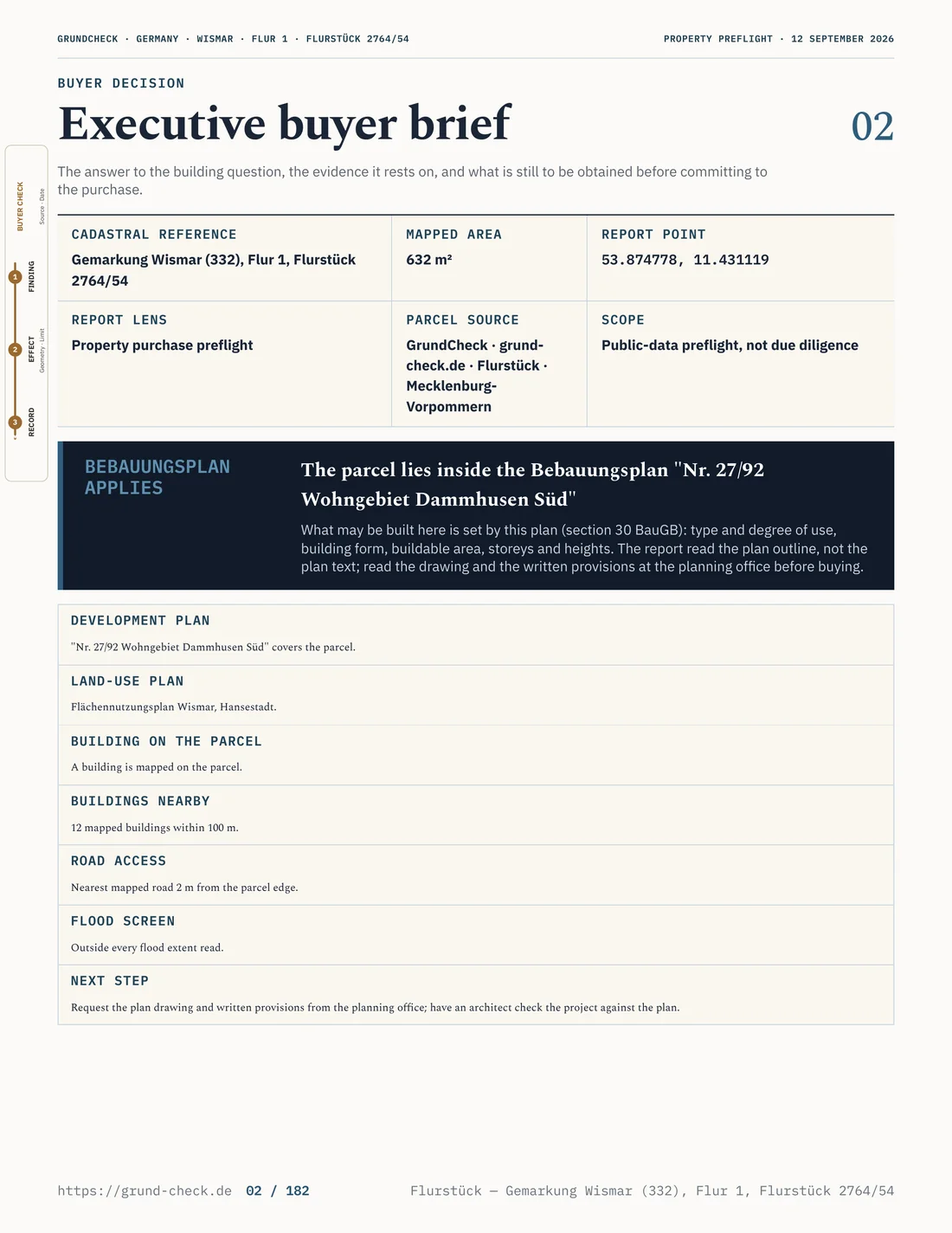
Read the draft with the parcel in front of you. A GrundCheck preflight report gives the parcel identity, the planning context and the risk flags in one document, which is what turns a contract review into a real check. Check a parcel.
The appointment itself
The deed is read aloud in full. § 13 BeurkG requires it, and a contract of twenty pages takes the time it takes. Interrupt whenever something is unclear; that is the purpose of the reading, and a question at that moment is free.
If your German is not good enough to follow, § 16 BeurkG requires the notary either to translate personally or to bring in an interpreter, and you may ask for a written translation as well. Arrange it in advance. An interpreter found on the morning of the appointment is expensive and rarely familiar with property vocabulary.
What the deed contains, and the three clauses that matter
Beyond the parties, the parcel and the price, three passages decide your exposure.
- Defects. Land is normally sold with liability for defects excluded. The exclusion is effective, with one limit: § 444 BGB keeps the seller liable for anything fraudulently concealed. Known risks belong in the deed as express statements, not as reassurances.
- Condition and withdrawal. Anything the purchase depends on, a planning answer or a document not yet produced, has to be written as a condition or a withdrawal right with a date.
- Costs and possession. Who pays which fee, and from when charges, insurance and property tax pass to the buyer, which is normally the day of full payment rather than the day of registration.
Everything agreed must be in the deed, because § 311b BGB requires notarial form for the whole contract. A promise left out is not merely unenforceable; it can put the validity of the contract in question.
Auflassung and the priority notice
Two separate legal steps hide inside one appointment. The contract creates the obligation to transfer. The Auflassung under § 925 BGB is the agreement that ownership passes, declared before the notary. Ownership itself only moves on entry in the land register, under § 873 BGB.
Between signature and entry sits the Auflassungsvormerkung, a priority notice under § 883 BGB. Once registered, later disposals by the seller are ineffective against your claim, and its rank is fixed by the order of application under § 17 GBO. This is the single most important protection in the transaction, and it is the reason the price is never paid on the day of signing.
When the money actually moves
The notary issues a payment instruction once a list of conditions is met: the priority notice is registered, the municipality has issued its negative certificate on pre-emption, and the releases for any mortgage in Abteilung III are in the notary's hands. Only then does the buyer transfer, usually directly to the seller and to the seller's bank in the proportions the releases require.
The certificate is a municipal decision: the municipality applies the federal pre-emption rule to the parcel.
A notary escrow account is the alternative, used where the structure is complicated. It costs an extra fee and is not the default, because the conditional instruction achieves the same protection more cheaply. Never pay ahead of the instruction, whatever the reason offered.
Cancelling, and what it costs
Before the deed is signed, either party may withdraw the instructions given to the notary. That does not necessarily end the matter without cost. If the notary has already advised the parties, sent out a draft or otherwise prepared the deed, fees and expenses may be payable under No. 21300 ff. KV GNotKG for the work completed. The amount depends on the stage reached and the transaction value. Separate costs may also remain for other work already commissioned, such as a survey, valuation or financing.
A binding preliminary contract is legally possible. If it already commits either party to acquire or transfer the property later, it too must be notarised under § 311b(1) BGB. That formality is one reason such contracts are uncommon. An informal reservation, including a reservation agreement with an estate agent, does not normally bind the seller to sell the property; a reservation fee imposed through standard terms may also be invalid.
After signing, walking away is expensive. The contract binds, the seller can enforce, and the buyer who simply stops is exposed to the submission to immediate enforcement and to a damages claim. The only clean exits are the ones written into the deed: a condition that fails, a withdrawal right whose deadline passes without the promised document, or a mutual cancellation, which itself needs notarial form and its own fee. This is the strongest single argument for spending the two-week reading period properly.
Tax clearance, and the wait nobody warns about
The notary reports the deed to the tax office. An assessment follows, payable one month after the notice under § 15 GrEStG, and only once it is paid does the office issue the Unbedenklichkeitsbescheinigung. Until that certificate exists, § 22 GrEStG forbids the registry from entering the new owner.
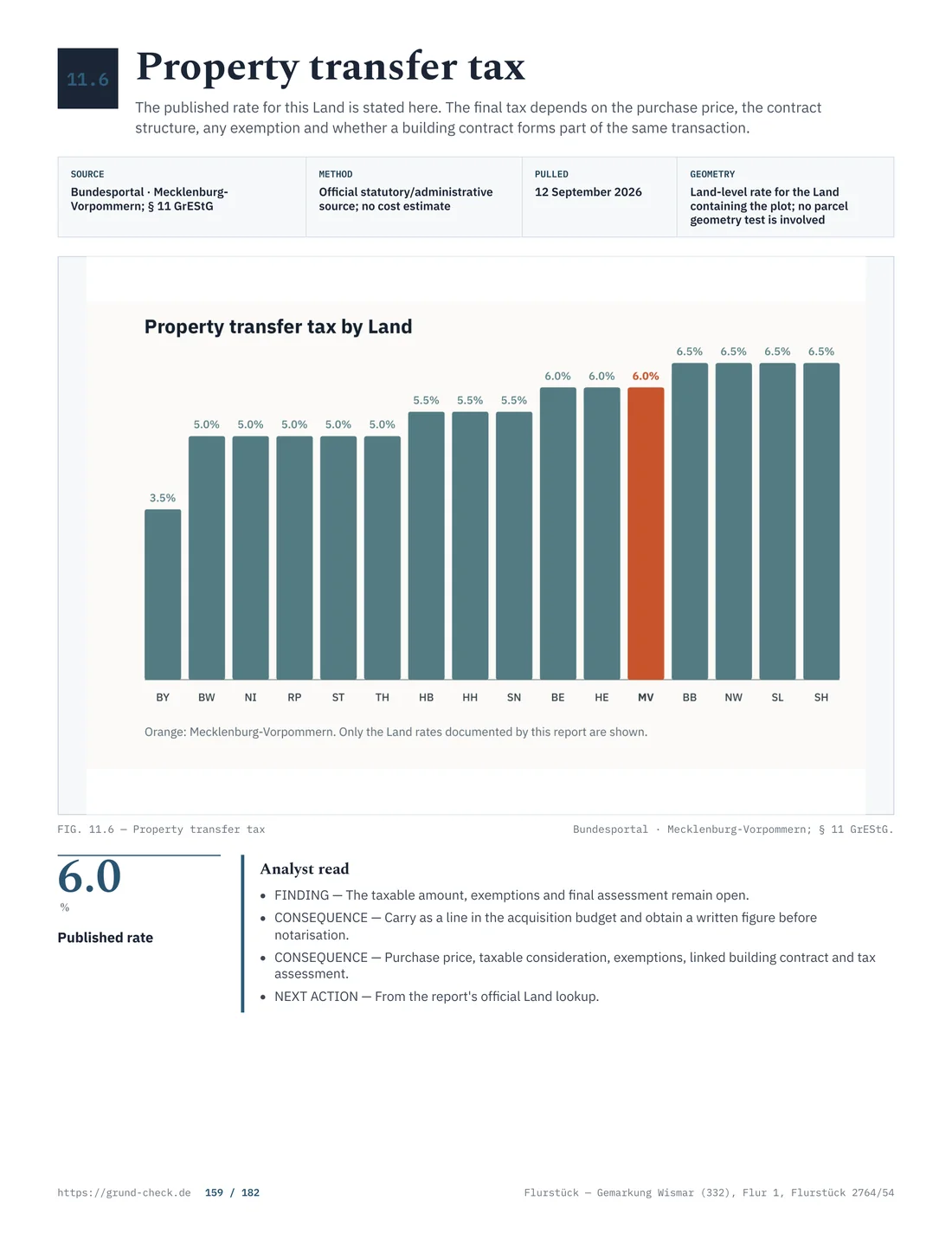
The transfer-tax rate is set by state law; the applicable Land determines which rate applies to the parcel.
So the sequence is fixed: sign, notice registered, conditions cleared, price paid, tax paid, then registration. Six to twelve weeks is normal across Germany and longer is not unusual. You have the priority notice throughout, which is what makes the wait tolerable.
The closing sequence on one page
| Step | Who does it | What it waits for | Typical time |
|---|---|---|---|
| Draft deed sent to the buyer | notary | agreed terms, parcel data | two weeks before signing |
| Appointment, deed read and signed | notary and both parties | identification, interpreter if needed | 1 to 2 hours |
| Priority notice applied for | notary | nothing further | days |
| Sale reported to the tax office | notary | nothing further | days |
| Negative certificate on pre-emption | municipality | the municipal decision period | 2 to 8 weeks |
| Releases for existing mortgages | the seller's bank | payoff figures | 2 to 6 weeks |
| Payment instruction issued | notary | all of the above | on completion of conditions |
| Purchase price transferred | buyer | the instruction | within the stated period |
| Transfer tax assessed and paid | tax office, buyer | the notary's report | 4 to 8 weeks |
| Owner registered | Grundbuchamt | the tax clearance certificate | weeks after payment |
No row in that chain can be jumped. If a required document is missing, the next step waits until it arrives. Check the status of the municipal certificate and the seller's bank documents in particular.
- Receive the draftNormally two weeks before signing
- Notarial signingRead aloud and signed
- Priority notice and releasesSecure rank and clear charges
- Payment instructionOnly after contractual conditions
- Tax and ownershipClearance, then registration
Source: BeurkG §§ 13 and 17(2a); BGB §§ 873, 883 and 925; GrEStG §§ 15 and 22; checked August 2026
What happens if somebody does not perform
If the purchase deed contains a submission to immediate enforcement for the price, the buyer agrees that, if the money is not paid when due, the seller may enforce against the buyer's assets without first winning a court case. Read the particular clause in the draft and ask the notary to explain it. Financing should be confirmed before the appointment rather than after it.
The reverse case is weaker than buyers expect. If the seller has second thoughts, the buyer's remedy is a claim to performance, protected by the priority notice, which is strong but slow. If a condition in the deed fails, the withdrawal right operates as drafted and the notice is deleted. Neither situation is improved by having paid early, which is the practical argument for following the payment instruction exactly.
Buying from a developer, an estate or a struggling seller
Three situations change the shape of the closing. A developer selling a plot out of a larger site is often selling land that does not yet exist as a separate parcel, so the survey and the new parcel number have to be completed before the transfer can be registered, and the deed carries a provisional description. Ask for the surveyor's timetable in writing and tie a payment step to it.
An estate sale needs the certificate of inheritance or a notarised will with the probate order, and every heir must sign or be represented. One heir who cannot be reached stops the transaction completely. Where the seller is in financial difficulty, insist that the entire price runs through the notary's conditions and the mortgage releases, because a payment made outside that structure can be attacked later by an insolvency administrator.
What it costs
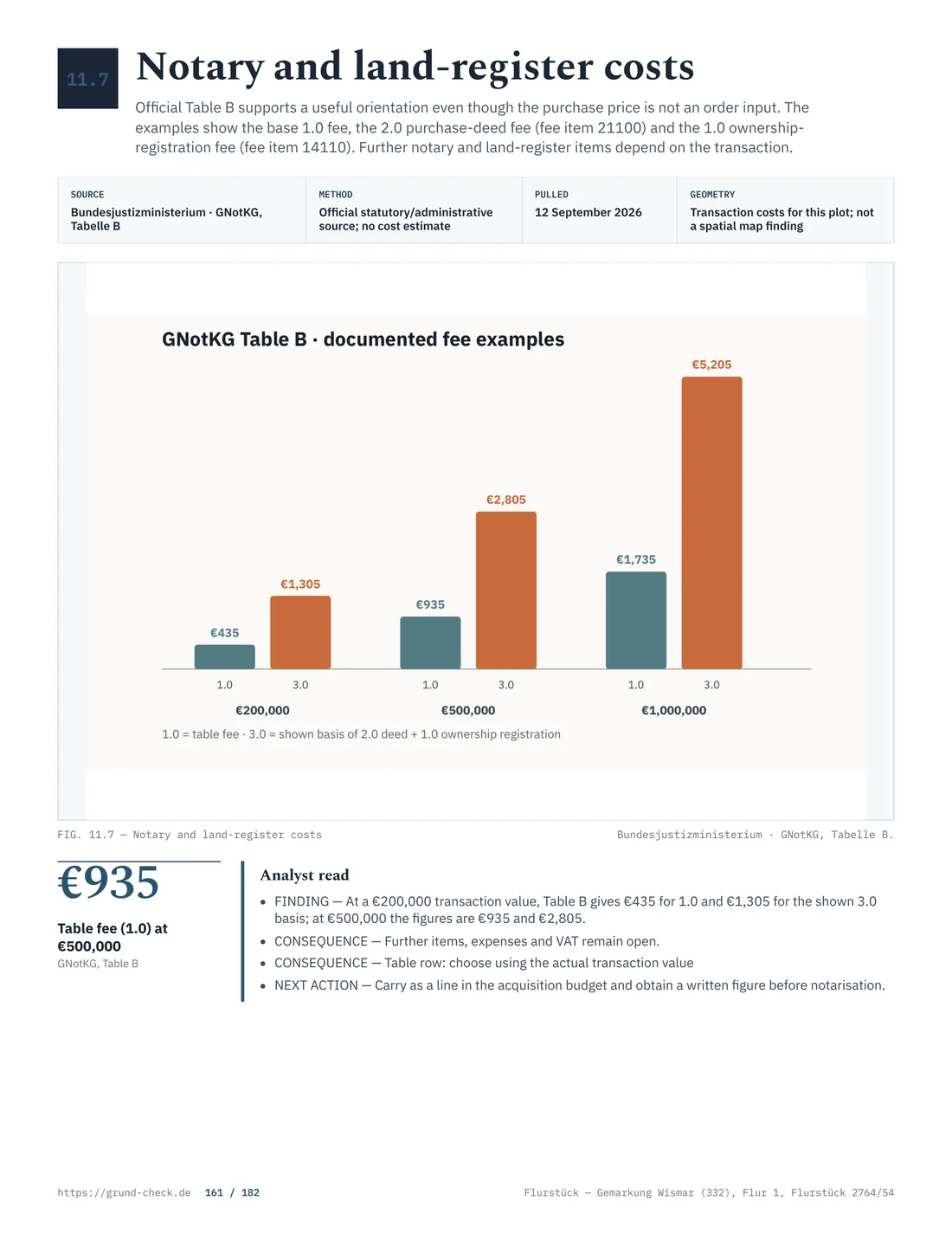
Notary fees are statutory and identical everywhere. A Geschäftswert, normally the purchase price, is read off Tabelle B of the GNotKG and each act in the schedule of charges is a multiple of it. On a 150,000 € purchase the base fee is 354 €: the deed is charged at twice that, the priority notice at half, the registration of the new owner at one. Those three come to 1,239 €, and the realistic total with execution fees and 19 percent VAT on the notary's share lands near 1,500 €. Court fees carry no VAT.
Registering a mortgage is separate and roughly doubles the registry line, because the Grundschuld is charged on the loan amount rather than the purchase price. Two smaller items appear on most bills and surprise people: the fee for the notary's supervision of the payment conditions, and the deletion of the seller's old mortgage, which is normally the seller's cost but is sometimes shifted by the contract. Ask for the estimate to list every position separately, and check that the deletion is not quietly on your side. The full budget, including the transfer-tax rate applicable in the state where the property lies, is set out in the costs guide.
Source: GNotKG Table B and schedule of charges; worked example in this article; checked August 2026
The changes a notary will make, and the ones they will not
A draft deed is not fixed. The notary drafts it, but the content is what the parties agree, and a buyer who asks for a change in writing during the two-week period usually gets it if the seller consents. Requests that go through routinely: adding a condition tied to a planning answer, naming a date by which a document must be produced, itemising moveable items sold separately, adjusting the date from which charges pass to the buyer, and recording a specific statement by the seller about the condition of the land.
That last one is worth understanding. Where the seller has told you something material, that the plot has never been built on, that no fill was brought in, that the access has always been used without objection, ask for it as an express statement in the deed. A statement in the deed is a different thing from a reassurance at a viewing, and it survives the general exclusion of liability for defects.
What a notary will not do is negotiate for you, advise on whether the price is sensible, verify the physical condition of the plot, or check the planning status on your behalf. The office is neutral and its duty is to record what the parties want accurately and to warn about legal consequences. Anything that requires taking your side belongs to a lawyer, and anything that requires knowing the parcel belongs to the due diligence you did before the draft arrived.
What the notary does not check
The notary does not negotiate for the buyer, assess whether the price is reasonable, inspect the physical condition of the land or confirm its planning status. The office is neutral. Its role is to record the parties' intentions correctly and explain the legal consequences.
The parcel therefore needs specialist review before the draft deed. That includes the Bebauungsplan (legally binding local development plan), any preliminary decision and any public-law building obligations. The notary can make unresolved points visible in the contract, but cannot replace technical or financial due diligence.
Before you sign: the file that should already exist
- The draft deed, received at least two weeks earlier and read.
- A Grundbuch extract no older than four weeks, with a plan for every entry in Abteilung II and III.
- The written planning statement from the Gemeinde, and any Vorbescheid the purchase depends on.
- The Baulasten extract from the Landkreis.
- Written answers on access and utility connections.
- The notary's cost estimate, and financing confirmed in writing.
- Where needed, an interpreter booked and a translation of the draft ordered.
Do the parcel work before the draft arrives. Order a GrundCheck preflight report and walk into the two-week reading period knowing what the contract has to cover. Check a parcel.
Where these rules are written
- Notarial procedure: § 13, § 16 and § 17 BeurkG; identification duties § 10 GwG.
- Contract and transfer: § 311b, § 873, § 883, § 925 and § 444 BGB; rank § 17 GBO.
- Tax: § 15 and § 22 GrEStG, state transfer-tax rate law.
- Fees: GNotKG Tabelle B and the schedule of charges.
- Municipal pre-emption, which the notary clears: §§ 24 ff. BauGB.
Rules and figures were checked in August 2026. This is general information for buyers, not legal advice on your transaction. Read next: the due diligence checklist, register and cadastre and buying from abroad.