
State
Buying land in Bavaria: the permit and register traps
Bavaria has its own rules on setbacks, permit exemptions, land-register security, water, forest conversion and property tax. Check them before the notary appointment.
On this page
What makes a Bavarian purchase different
In Bavaria, federal law sets the national frame; state law supplies the BayBO rules; the municipality applies the plan and its local by-law. Record that distinction in the request log, because a state rule cannot answer a question reserved for the municipality.
Buying land in Bavaria means checking federal planning law together with the Bayerische Bauordnung, the state's building code, and several state-law rules. The practical trouble spots are the setbacks under Art. 6 BayBO, the absence of a Baulastenverzeichnis and the Bavarian area-based property-tax model. Genehmigungsfreistellung, water margins, Waldumwandlung and nature-conservation pre-emption rights can change the project as well.
The municipality may add a local by-law under Art. 81 BayBO and may require a full approval procedure during a permit exemption. A listing or a development plan alone is therefore not enough. Start the file with the exact Flurstück (cadastral parcel), the cadastral parcel, and the municipality's current information. The property due-diligence checklist gives the general order.
Resolve Bavarian issues before the offer. A GrundCheck property check links the plan, cadastre and protection questions to the actual parcel.
- Setbacks under Art. 6 BayBO
- Contamination and plot-specific authority answers
- Vorbescheid under Art. 71 BayBO
- Permit-free ancillary structures
- Water, forest and nature pre-emption
Source: BayBO; BayernAtlas; BORIS Bayern; Altlastenkataster Bayern; checked August 2026
Setbacks under Art. 6 BayBO
The ordinary setback is 0.4 H and at least 3 m. In commercial and industrial areas it is 0.2 H, at least 3 m. Art. 6 Abs. 5a adds a special rule for cities with more than 250,000 inhabitants: outside certain areas, 1 H can apply, with 0.5 H at up to two external walls where the surrounding area has the required character.
Do not assume a general Schmalseitenprivileg, a narrow-side privilege. The building, area and actual plot must be tested against the current rule. The official Art. 6 BayBO text belongs in the purchase file. Sketch the building and its setbacks before treating a small Bavarian plot as buildable. The building-permit and pre-application guide covers the general procedure.
Bavaria has no Baulastenverzeichnis
Bavaria is the only German territorial state without a Baulastenverzeichnis under a state building-law Baulast (public-law building obligation) regime. Art. 6 Abs. 2 BayBO can require legal or factual security when setbacks extend onto another plot, but that does not create a public-law Baulast entry.
The usual private-law route is a Grunddienstbarkeit, an easement recorded in the Grundbuch. It benefits a plot or entitled person rather than the building authority, so it is not equivalent to a Baulast. Read the land register, the underlying consent and the building-law requirements together. The Bayerische Bauordnung is the starting source, and the easements and building obligations guide explains what to look for.
Contamination and plot-specific authority answers
The Altlastenkataster Bayern is supported by the Bayerisches Landesamt für Umwelt. Plot-specific information comes from the responsible Kreisverwaltungsbehörde. Art. 3 BayBodSchG is the state-law basis.
There is no confirmed general public online view of all owner-related or plot-specific detail. The Kreisverwaltungsbehörde decides the particular access and case review. A missing public map entry is therefore not a clean bill of health. Request the information with Gemarkung and Flurstück. The LfU Bavaria contaminated-land information is the first official entry point; consult LfU register, LfU soil information, LfU contaminated-land guidance, LfU authority information, LfU case guidance, LfU plot enquiry guidance, LfU soil register page, while the contamination guide covers soil, fill and contract questions.
ALKIS, BayernAtlas and the Grundbuch
The Bayerische Vermessungsverwaltung supplies ALKIS through geodata services, BayernAtlas and specialist offices. Art. 11 VermKatG is the state-law basis. The Bavarian cadastral-information service describes the official products.
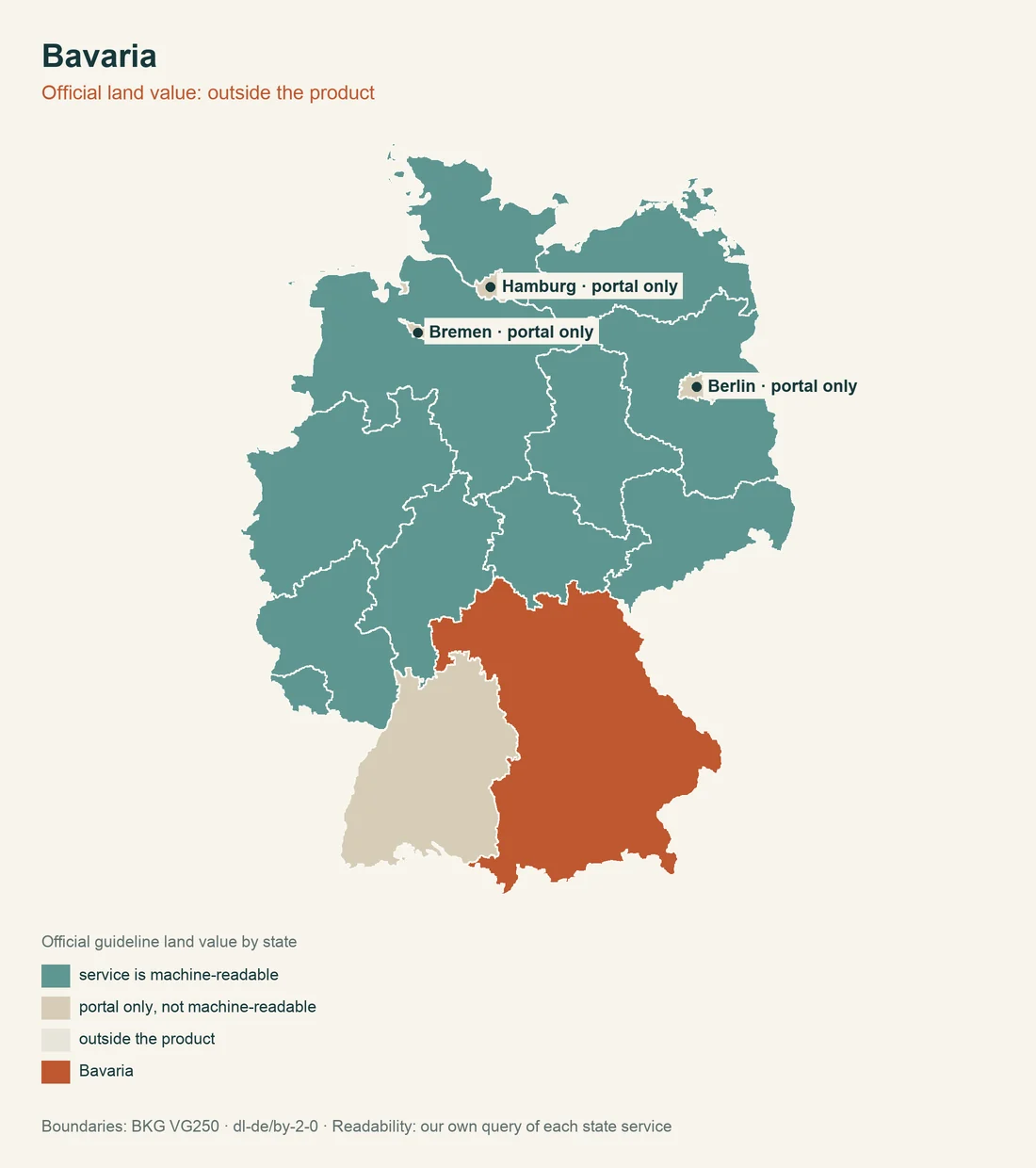
Whether a particular ALKIS product is free online cannot be confirmed in general. The answer depends on the product, and ownership data are not generally confirmed as free. Ownership proof, boundary information and a geodata service are different documents. The Geoportal Bayern brings together ALKIS, planning and land-value services; save every map with its parcel number and retrieval date. The land-register and ALKIS guide explains the distinction.
Vorbescheid under Art. 71 BayBO
A Bavarian Vorbescheid, preliminary building decision, lasts four years unless it sets another period. Under Art. 71 BayBO, a written application can extend the period by up to four years at a time. A Bauvoranfrage should describe the intended building, size, position, access and precise planning question rather than simply ask whether the land is buildable.
Read the official Art. 71 BayBO rule with the actual decision. Put the issue date, period, extension and plans in the purchase file. A decision for another project does not answer the buyer's own question.
Genehmigungsfreistellung under Art. 58
Buildings that are not Sonderbauten can qualify for Genehmigungsfreistellung where they follow the Bebauungsplan (binding local development plan), meet its requirements, have secured access and satisfy the other statutory conditions. The municipality may require a full approval procedure. The municipal period stated in the source is one month.
Permit exemption does not release the owner from the BayBO, local by-law or neighbour-law requirements. The builder remains responsible for the conditions. The details are in Art. 58 BayBO. On land in the Außenbereich or with uncertain access, do not treat the exemption as a safe shortcut. The zoning and buildability guide provides the general test.
Permit-free ancillary structures
Art. 57 BayBO lists verfahrensfreie Vorhaben. Garages and covered parking can be permit-free outside the Außenbereich up to 50 m² of floor area. Buildings without rooms for people can fall within the list up to 75 m³ in the Innenbereich and 20 m³ in the Außenbereich. Use, combustion appliances, rooms and location remain decisive.
For walls and fences, Art. 57 Abs. 2 Nr. 5 does not confirm a general maximum height. That does not make every design free: the Bebauungsplan, local building by-law, setbacks and Außenbereich law can restrict it. The official Art. 57 BayBO PDF should be checked before planning. The building-permit guide does not replace a plot-specific answer.
Land value and the Bavarian average
The Bayerisches Landesamt für Statistik reports an average 2024 purchase value for baureifes Land of 381 EUR per m². Regional differences are substantial. This is an average purchase-value statistic, not a Bodenrichtwert for the particular plot.
Compare location, use, servicing, shape and local market level separately. The Bavarian purchase-value statistics should be read with the Bodenrichtwert service in the Geoportal. The Bodenrichtwert and land-value guide explains why the two figures answer different questions.
Water, forest and nature pre-emption
Art. 21 BayWG gives a 10 m Gewässerrandstreifen, watercourse margin, for state-owned land at waters of first and second order. For other covered waters, the source includes a 5 m variant; no single Innenbereich width for every water type is confirmed. The water-margin rule must therefore be applied to the particular water and measure.
Art. 16 Abs. 1 Satz 1 Nr. 3 BayNatSchG remains relevant to further protected margins. Agricultural and horticultural use, fertiliser and plant-protection products can be affected in the 10 m case. Conversion of woodland generally needs permission under Art. 9 and 15 BayWaldG; cleared or damage-affected woodland must be replanted within three years.
Under Art. 39 BayNatSchG, the Freistaat, district, county, municipality and municipal associations can hold nature-conservation pre-emption rights, including for water bodies or protected areas. Official starting points include the Bayerisches Waldgesetz, Art. 39 BayNatSchG and the Geoportal Bayern services.
Fees, tax and road charges
Building fees follow the Kostenverzeichnis zum Kostengesetz, tariff no. 2.I. Art. 5 KG and § 1 KVz are the stated bases, while the actual administrative act determines the fee The § 1 KVz basis should be checked against the fee notice.
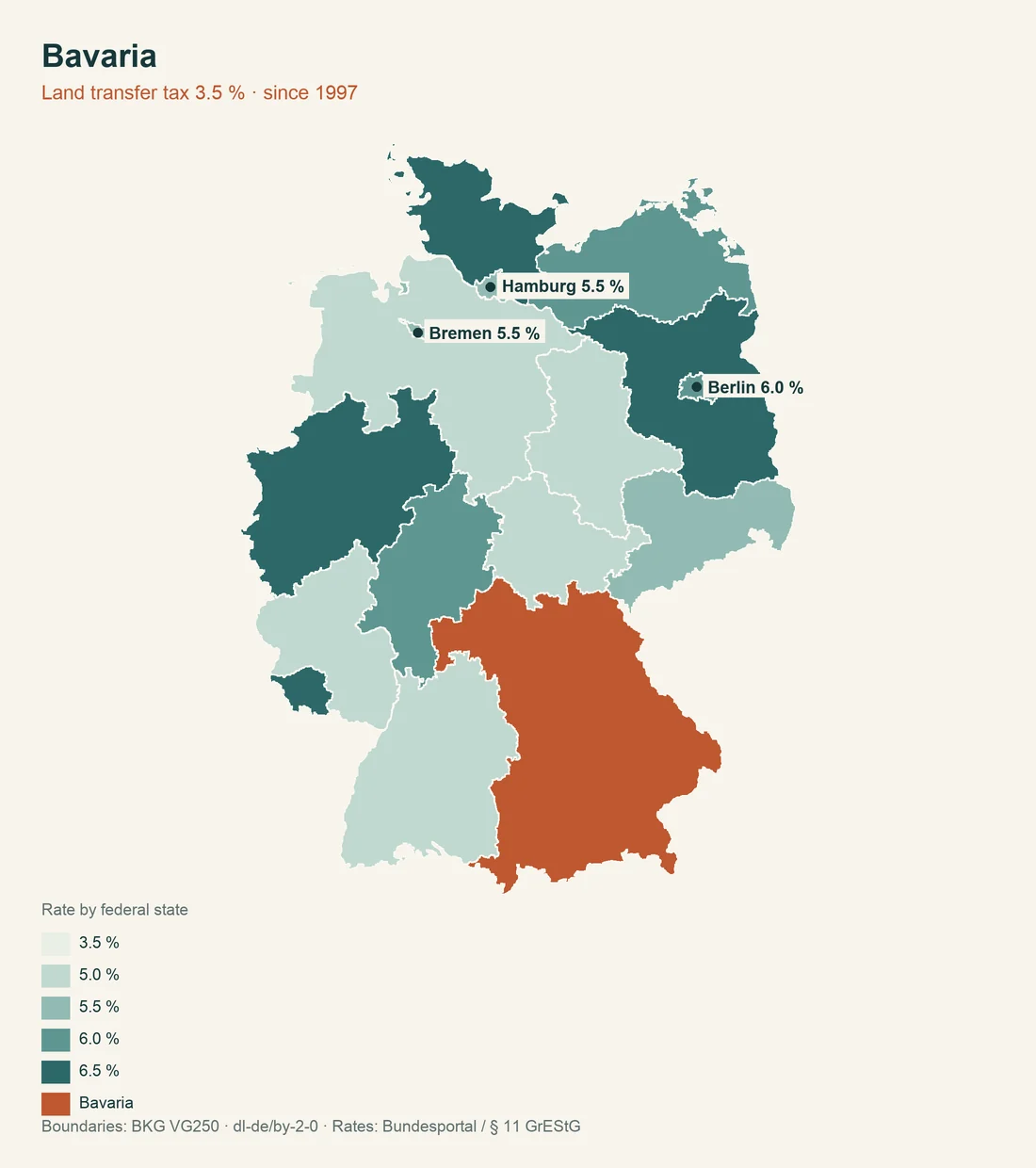
Real-estate transfer tax is 3.5 percent in Bavaria under § 11 Abs. 1 GrEStG; Bavaria has no separate state rate statute. Grundsteuer follows the Bavarian Flächenmodell under Art. 1 and 3 BayGrStG: the assessment uses equivalence amounts for land, residential space and other usable space, while the municipality sets the Hebesatz. The Bayerisches Grundsteuergesetz is the source.
No Straßenausbaubeiträge are levied for improvement or renewal measures on the local roads named in Art. 5 BayKAG. Art. 19 Abs. 7 BayKAG covers transitional cases. Erschließungsbeiträge under §§ 127 ff. BauGB remain separate. The separate § 127 ff. BauGB route must be checked independently. The Art. 5 BayKAG text, cost schedule and costs and taxes guide belong in the file.
- Planning lawMunicipality or building authority
- Parcel and mapBayernAtlas
- Soil, value and hazardsSpecialist portal and competent authority
Source: BayBO; BayernAtlas; BORIS Bayern; Altlastenkataster Bayern; checked August 2026
What differs in your state
Setbacks provide the fastest cross-state comparison, but the table is only a screening tool. For Bavaria, the actual Art. 6 BayBO calculation, municipal by-law and building position control.
| State | Value | Legal basis | Source |
|---|---|---|---|
| Baden-Württemberg | Standard rule: Generally 0.4 H, at least 2.5 m. Core areas: In core areas, 0.2 H applies, at least 2.5 m. Commercial areas: In commercial areas, 0.125 H applies, at least 2.5 m. Narrow sides: For walls up to 5 m wide, the depth must not be less than 2 m. | § 5 Abs. 7 LBO | Source Baden-Württemberg |
| Bavaria | Standard case: 0.4 H, at least 3 m. The building setback is 0.4 H, at least 3 m. Commercial and industrial areas: 0.2 H at least 3 m. In commercial and industrial areas it is 0.2 H, at least 3 m. Large cities with over 250,000 inhabitants: 1 H; on up to two external walls 0.5 H Art. 6 Abs. 5a contains this special rule outside certain areas if the surrounding area is characterized accordingly. | Art. 6 Abs. 5 BayBO | Source Bavaria |
| Berlin | As a rule: 0.4 H at least 3 m building setbacks must be kept clear in front of external walls and roofs; basically 0.4 H, at least 3 m. Commercial and industrial areas: 0.2 H at least 3 m. The special statutory scale applies to certain commercial or industrial areas. | § 6 Abs. 5 BauO Bln | Source Berlin |
| Brandenburg | Standard case: 0.4 H, at least 3 m. The depth of the building setback is 0.4 H, at least 3 m. Commercial and industrial areas: 0.2 H at least 3 m. In commercial and industrial areas, 0.2 H is sufficient, at least 3 m. Building classes 1 and 2 with a maximum of three floors above ground: 3 m In front of the outer walls, a depth of 3 m is sufficient. | § 6 Abs. 5 BbgBO | Source Brandenburg |
| Bremen | § 6 Abs. 6 Satz 1 BremLBO – Standard case: 0.4 H at least 3 m The depth of the building setback is 0.4 H, at least 3 meters. § 6 Abs. 6 Satz 2 BremLBO – Commercial and industrial areas: 0.2 H, at least 3 m. In commercial and industrial areas, a depth of 0.2 H, at least 3 meters, is sufficient. § 6 Abs. 6 Satz 3 BremLBO – small buildings: 3 m In front of external walls of buildings in building classes 1 and 2 with a maximum of three floors above ground, 3 meters is sufficient. § 6 Abs. 6 Satz 4 BremLBO – neighbour-protecting effect: 0.75 Only three quarters of the required depth, but at least 2.50 meters, have a neighbour-protecting effect. | § 6 Abs. 6 BremLBO | Source Bremen |
| Hamburg | Standard case: 0.4 H at least 2.5 m § 6 Abs. 5 Satz 1 HBauO: Depth of the building setback 0.4 H, at least 2.50 m. Commercial and industrial areas: 0.2 H at least 2.5 m § 6 Abs. 5 Satz 2 HBauO: 0.2 H, at least 2.50 m; the standard rule (0.4 H) applies again at borders to other building areas. Bebauungsplan with different regulations: as set in the Bebauungsplan § 6 Abs. 5 Satz 3 HBauO: If a Bebauungsplan sets other distances, these take precedence. Garages and outbuildings without their own building setback: wall height up to 3 m, length up to 9 m per property line § 6 Abs. 8 HBauO allows garages, building-independent solar systems, retaining walls/enclosures and heat pumps without their own building setback, a maximum of 15 m in total per property. | § 6 HBauO | Source Hamburg |
| Hesse | Standard rule: 0.4 H at least 2.5 m. The depth is generally 0.4 H; according to the current version, at least 2.50 m applies. Commercial and industrial areas: 0.2 H at least 2.5 m The reduced depth only applies in the legally specified areas and not to areas of other use. Narrow sides and border developments: Special rules according to § 6 Abs. 6 und 11 HBO Separate requirements apply to certain subordinate components and border garages; Bebauungsplan and local statutes remain to be checked additionally. | § 6 Abs. 5 HBO | Source Hesse |
| Lower Saxony | As a rule: The distance is 0.5 H, at least 3 m. Commercial and industrial areas: In commercial and industrial areas, 0.25 H applies, at least 3 m. Narrow sides: special legal rules For border development and narrow sides, § 5 contains further special rules; they cannot be reduced to a single general factor. | § 5 Abs. 2 NBauO | Source Lower Saxony |
| Mecklenburg-Western Pomerania | Building classes 1 to 3: 3 m Fixed building setback depth of 3 m in front of the external walls, regardless of the building height (§ 6 Abs. 5 Nr. 1). Building class 4: 4 m Fixed building setback depth of 4 m (§ 6 Abs. 5 Nr. 2). Building class 5: 5 m Fixed building setback depth of 5 m (§ 6 Abs. 5 Nr. 3). Commercial and industrial areas as well as antenna systems in the Außenbereich: 0.2 H at least 3 m 0.2 H, at least 3 m (§ 6 Abs. 5 Nr. 4). Otherwise (fallback rule outside the building class circumstances): 0.4 H at least 3 m 0.4 H, at least 3 m (§ 6 Abs. 5 Nr. 5). | § 6 Abs. 5 LBauO M-V (Änderungsgesetz vom 26. Mai 2026, GVOBl. M-V 2026 Nr. 16 S. 524) | Source Mecklenburg-Western Pomerania |
| North Rhine-Westphalia | Standard rule: 0.4 H, at least 3 m. The depth is 0.4 H, at least 3 m. Commercial and industrial areas: 0.2 H at least 3 m. In commercial and industrial areas, 0.2 H is sufficient, at least 3 m. Core areas: 0.25 H at least 3 m In core areas 0.25 H applies, at least 3 m; Special rules apply to certain public areas. | § 6 Abs. 5 BauO NRW 2018 | Source North Rhine-Westphalia |
| Rhineland-Palatinate | Standard case: 0.4 H at least 3 m. The depth of the building setback is generally 0.4 H, at least 3 m. Special cases: Border garages and subordinate buildings § 8 Abs. 9 LBauO contains special requirements for systems without their own building setback; Location, wall height and boundary length must be checked individually. | § 8 LBauO Rheinland-Pfalz | Source Rhineland-Palatinate |
| Saarland | Normal case (§ 7 Abs. 5 Satz 1 und 5 LBO): 0.4 H, in all cases at least 3 m Residential buildings in building classes 1 and 2 with a maximum of three floors above ground (§ 7 Abs. 5 Satz 2 LBO): 3 m is sufficient as the depth of the building setback Commercial and industrial areas (§ 7 Abs. 5 Satz 3 LBO): 0.2 H, at least 3 m Core areas and non-recreational special areas (§ 7 Abs. 5 Satz 4 LBO): depth less than 0.4H may be permitted, but at least 3 m; not a fixed factor in the law Wind turbines (§ 7 Abs. 8 LBO): 0.25 H in the Außenbereich or in special areas for wind energy, otherwise 0.4 H Antennas including masts in the Außenbereich (§ 7 Abs. 9 LBO): 0.2 H Walls without openings in commercial and industrial areas (§ 8 Abs. 1 LBO): 1.50 m or 2.50 m depending on fire resistance and building materials, not opposite property boundaries | § 7 Abs. 5 LBO | Source Saarland |
| Saxony | Standard rule: 0.4 H at least 3 m. The depth is generally 0.4 H, at least 3 m. | § 6 Abs. 5 SächsBO | Source Saxony |
| Saxony-Anhalt | Standard case: 0.4 H at least 3 m § 6 Abs. 5 Satz 1 BauO LSA: The depth is 0.4 H, at least 3 m. Commercial and industrial areas: 0.2 H at least 3 m § 6 Abs. 5 Satz 2 BauO LSA: In commercial and industrial areas 0.2 H is sufficient, at least 3 m. Residential buildings, building classes 1 and 2: 3 m In front of the outer walls of certain residential buildings of building classes 1 and 2, a depth of 3 m is sufficient according to § 6 Abs. 5 Satz 3. | § 6 Abs. 5 BauO LSA | Source Saxony-Anhalt |
| Schleswig-Holstein | Standard case: § 6 Abs. 5 LBO determines 0.4 H, at least 3 m. Commercial and industrial areas: In commercial and industrial areas, the legal requirements are 0.2 H, at least 3 m. Residential buildings, building classes 1 and 2: Special regulations For residential buildings of building classes 1 and 2, § 6 contains further special rules. Narrow-side privilege: yes § 6 contains a special legal regulation for certain narrow pages; the specific application is property-specific. | § 6 Absatz 5 LBO SH (Bekanntmachung der geltenden Fassung vom 5. Juli 2024, GVOBl. Schl.-H. 2024 Nr. 8, S. 504/522) | Source Schleswig-Holstein |
| Thuringia | Standard case: 0.4 H The depth of the building setback is generally 0.4 H, at least 3 m. Commercial, industrial and comparable special areas: 0.2 H In commercial and industrial areas as well as comparable special areas, the special depth of 0.2 H applies, at least 3 m, provided the legal requirement is met. | § 6 Abs. 5 ThürBO (Fassung vom 2. Juli 2024, GVBl. 2024, 298, Gültig ab 19.07.2024) | Source Thuringia |
Purchase sequence and comparisons
Federal plan routes under § 30 BauGB, § 34 BauGB and § 35 BauGB remain distinct from the Bavarian building-code checks.
Start with Flurstück, Bebauungsplan, access and the possible building position. Then check the Grundbuch and easements, ALKIS, contamination, water and protection maps, forest and monument issues, and nature pre-emption rights. Every answer should carry the parcel, authority, date and question.
For comparison, use the 16-state setback comparison and the 16-state building-obligation comparison. The access and infrastructure guide and notary and closing guide cover the next decisions.
Complete the Bavarian purchase file. A GrundCheck parcel check keeps the missing Baulastenverzeichnis from becoming a missing risk.
Sources and checking date
Checked on 6 August 2026. The information is general and does not replace an answer from the municipality, Kreisverwaltungsbehörde, Vermessungsverwaltung or specialist office. Read next: land register and ALKIS, easements and building obligations, monuments and archaeology and flood and nature screening.