
State
Buying land in North Rhine-Westphalia: registers and fees
North Rhine-Westphalia has its own rules for setbacks, Baulasten, contaminated sites and building approval procedures. These checks belong before purchase.
On this page
What differs when buying land in North Rhine-Westphalia
Anyone buying land in North Rhine-Westphalia must check the BauO NRW 2018, the North Rhine-Westphalia building code, and other state rules alongside federal planning law. North Rhine-Westphalia has a Baulastenverzeichnis, a register of public-law building obligations, specific setbacks and its own fee ordinance. Information also comes from the district, independent city and municipality.
The first question is not simply whether a Bebauungsplan (legally binding local development plan) exists. Before the notary appointment, the file should show whether the intended use is limited by setbacks, a Baulast (public-law building obligation), contaminated sites, a protection rule or unsecured servicing. The property due-diligence checklist provides a fixed order for collecting the documents.
State law does not replace a parcel-specific review. A municipal by-law may permit or require different setback dimensions under § 6 Abs. 5 BauO NRW 2018. The competent building control authority therefore remains the office for the specific plot.
Sort the risks before buying. A property analysis connects planning law, the cadastre and identifiable protection interests. Check the property.
- Setbacks under § 6 BauO NRW 2018
- Contaminated sites: the lower soil protection authority
- Preliminary decision under § 77 BauO NRW 2018
- Separate the building-land price from the Bodenrichtwert
- Fees, real estate transfer tax and property tax
Source: BauO NRW 2018; GEOportal.NRW; BORIS-NRW; Altlastenkataster NRW; checked August 2026
Setbacks under § 6 BauO NRW 2018
As a rule, the setback depth is 0.4 H, at least 3 m. In commercial and industrial areas, 0.2 H is sufficient, also with a minimum of 3 m. For core areas, § 6 Abs. 5 gives a factor of 0.25 H and at least 3 m; specific public areas have special rules.
This matters for a tightly shaped building plot. The setback generally lies on the building plot and may limit the position of a house, garage or extension. The factors are not blanket permission: height, area category and local by-law must be considered together.
The BauO NRW 2018 is the relevant state source. A site plan showing the possible building position should accompany a purchase offer. Especially with subdivisions or building on the boundary, the setback must not be copied from the sales brochure.
Baulastenverzeichnis, not merely a land-register check
North Rhine-Westphalia maintains a Baulastenverzeichnis. Under § 85 BauO NRW 2018, Baulasten take effect on entry and also bind legal successors. The building control authority keeps the register; people with a legitimate interest may request inspection and an extract.
A Baulast can restrict the use of one plot for the benefit of a building permit on another plot. Purchase decisions therefore concern rights entered in the Grundbuch, the land register, as well as public-law obligations. An empty land-register extract does not answer this question.
Before notarisation, the request should be made to the locally competent building office and the exact parcel reference checked. The state-law basis is set out in § 85 BauO NRW 2018. The guide to public-law building obligations explains the distinction.
Contaminated sites: the lower soil protection authority
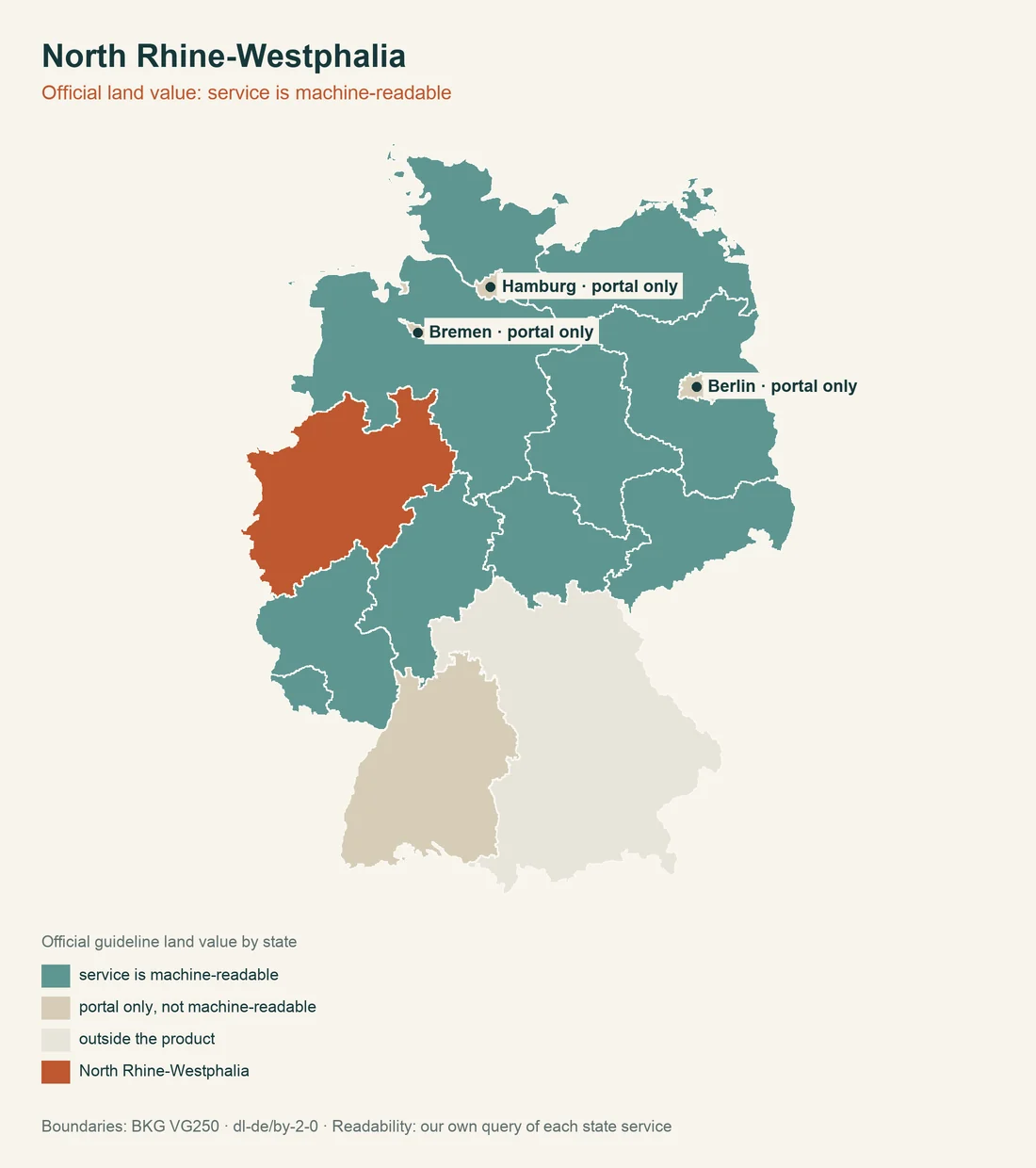
Districts and independent cities maintain parcel-related information in the contaminated-site register in North Rhine-Westphalia. The Landesamt für Natur, Umwelt und Klima, the state office for nature, environment and climate, provides specialist information. The legal basis is § 8 LBodSchG NRW.
General public online access to all parcel records is not confirmed. Specific access depends on the competent lower soil protection authority and a case-by-case review. A failure to obtain information should not be treated as a negative certificate for the land.
The specialist information on contaminated sites helps with classification. For the specific parcel, a request stating the cadastral district and parcel number is sensible. The guide to contaminated sites and soil contamination covers further evidence from surveys and the purchase contract.
ALKIS and official property information
ALKIS data is provided through the surveying and cadastral administration and its services. Section 2 VermKatG NRW supplies the state-law basis. Geobasis NRW describes ALKIS as official cadastral information.
Whether a particular ALKIS product is available online free of charge cannot be confirmed in general. It depends on the product and, in particular, on whether owner data is involved. For a purchase review, ALKIS, the land register and surveying documents must not be treated as interchangeable.
A cadastral plan does not automatically prove legal buildability. Planning law, Baulasten and servicing require separate checks. The comparison of public-law building obligations across Germany places these instruments in context.
Preliminary decision under § 77 BauO NRW 2018
A Bauvorbescheid, or preliminary decision, can settle individual questions with binding effect before the complete building application. Under § 77 Abs. 1 BauO NRW 2018, it is valid for three years from issue. On application, the period can be extended by up to one year at a time.
For a buyer, the Bauvoranfrage should contain concrete questions about use, building type, floor area, position and servicing. A broad question about buildability leaves more unresolved. The decision answers only the requested points and must be read with the plot, plan and exact wording of the question.
The provision on the preliminary decision belongs in the purchase file. The guide to building permits and preliminary applications covers the nationwide procedure; three years and an extension of up to one year per application are the NRW-specific points.
Permit exemption and procedure-free ancillary structures
The state building code contains rules on permit exemption and procedure-free projects. The label in a sales brochure is not enough for a particular project. The Bebauungsplan, servicing, use, setbacks and local by-law may determine the route.
A procedure-free structure is not automatically lawful in substance. Building law, planning law, neighbour law and protection rules still apply without a building permit. The municipality or building control authority may therefore remain relevant even where a procedure-free category appears to apply.
The official building code should be read in its current version. Existing garden sheds, garages and extensions belong in the existing-conditions review. For planning classification, see zoning and buildability.
Separate the building-land price from the Bodenrichtwert
IT.NRW reports a weighted average purchase value for serviced building land in North Rhine-Westphalia of 272.59 euros per m² in 2024. This is a purchase-value statistic, not a Bodenrichtwert, the official land value for a zone. It therefore does not state the price that can be demanded for a particular parcel.
For the individual location, use, servicing, shape and local price level matter. The state-wide average must not be treated as a valuation in the purchase contract. The statistic provides context but does not replace a property valuation.
The IT.NRW purchase-value statistics should be compared with the Bodenrichtwert portal. The guide to Bodenrichtwert and land value explains why the two figures answer different questions.
Water, nature, forest and heritage protection
A property in North Rhine-Westphalia may be affected by watercourse strips, nature and landscape protection, forest law or heritage protection. In the outer area, the watercourse strip is 5 m; this follows from § 38 WHG, on which § 90a LWG NRW builds. Section 90a Abs. 1 LWG NRW does not state a state-wide width for plots inside built-up areas; the local designation supplies the answer.
Under § 39 LFoG NRW, clearing forest generally requires approval. Heritage protection is governed by the DSchG NRW; the competent Untere Denkmalbehörde, lower heritage authority, remains important for the specific property. Even land without a visible built monument may require review because of its surroundings or archaeological finds.
Official starting points include the Geoportal NRW, the North Rhine-Westphalia heritage protection law and the state legislation portal. Map findings and authority responses about nature and forests should be recorded separately.
Fees, real estate transfer tax and property tax
Building fees follow the AVwGebO NRW, Allgemeiner Gebührentarif, general fee tariff, Tarifstelle 2. Section 2 GebG NRW supplies the statutory basis. The actual fee depends on the official act, construction costs and local procedure. A fixed amount in a broker's brochure does not securely establish the later authority fee.
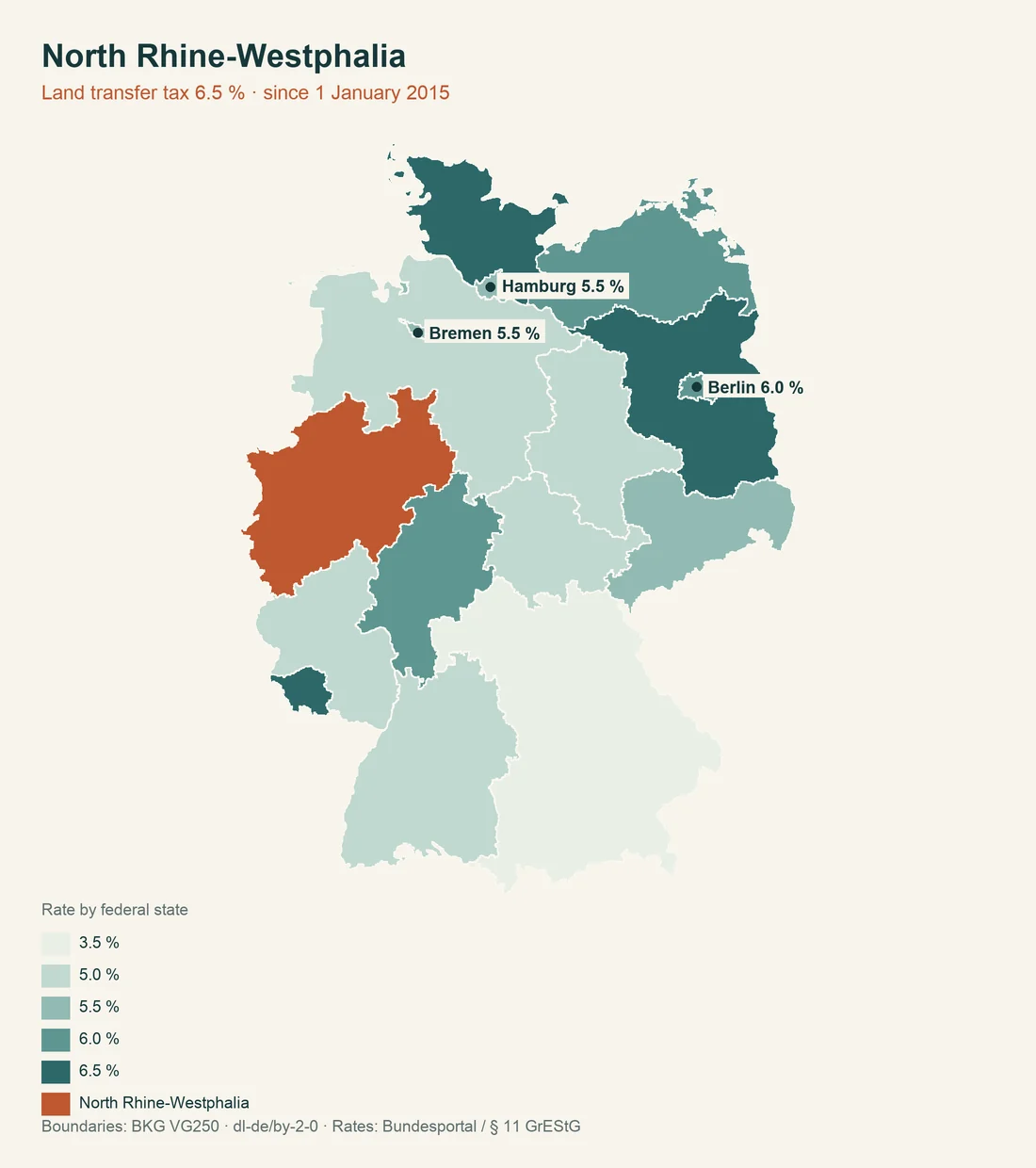
North Rhine-Westphalia applies a real estate transfer tax rate of 6.5 percent under § 11 Abs. 1 GrEStG. Property tax follows the federal model; the municipality sets the multiplier. Section 25 GrStG is therefore relevant to the municipal burden alongside the land and building data.
Sources are the General Administrative Fees Ordinance, the Real Estate Transfer Tax Act and the Property Tax Act. Further purchase costs are covered in costs, taxes and fees.
Order of checks before the notary appointment
The sensible sequence begins with the parcel, Bebauungsplan and servicing. Next come the Baulastenverzeichnis, contaminated-site register, ALKIS, heritage protection, nature and water indications, and the comparison with the land register. If building law remains open, the purchase contract should depend on a clearly identified preliminary decision.
Every request should state the date, authority, parcel and precise question. A map view is an indication, not a complete negative certificate. A positive answer to one question does not replace a review of the whole project.
Bring the documents together before notarisation. The access and infrastructure check and the notary process checklist belong in the same file. Check the property.
- Planning lawMunicipality or building authority
- Parcel and mapGEOportal.NRW
- Soil, value and hazardsSpecialist portal and competent authority
Source: BauO NRW 2018; GEOportal.NRW; BORIS-NRW; Altlastenkataster NRW; checked August 2026
North Rhine-Westphalia compared with other states
The differences become clearer when state-law points are placed side by side. The comparison of road improvement contributions across Germany classifies state contribution duties, while the comparison of heritage protection across Germany shows which protection rules must be checked alongside building law. For North Rhine-Westphalia, the local building authority remains decisive because by-laws and the actual parcel affect application.
| Check point | North Rhine-Westphalia | Consequence for purchase |
|---|---|---|
| Setback | General rule 0.4 H, at least 3 m; commercial and industrial 0.2 H, at least 3 m; core areas 0.25 H, at least 3 m | Check building position and by-law |
| Baulast | Baulastenverzeichnis under § 85 BauO NRW 2018 | Request information from building control |
| Preliminary decision | Three years; extension of up to one year each time | Check date and extension application |
| Building-land statistic | 272.59 euros per m² for serviced building land in 2024 | Do not confuse with Bodenrichtwert |
| Contaminated sites | Information from the lower soil protection authority | Do not assume complete public online access |
The file should also distinguish which authority keeps which information. Building control answers the Baulast question, the lower soil protection authority handles the parcel-related contaminated-site request and the surveying administration handles cadastral information. One portal search cannot replace all three levels.
For a plot with an older building, the review should not stop at the planned new construction. An existing garage, hall or fence may raise its own permit or by-law question. Documents must be compared with the current parcel because an earlier subdivision or merger can change the meaning of older records.
For planning law, § 30 BauGB applies to a plot covered by a Bebauungsplan, § 34 BauGB to an unplanned built-up area and § 35 BauGB to the outer area. The state building code governs procedures and setbacks alongside that federal framework. The file should mark these levels separately.
In a subdivision, the setback under § 6 BauO NRW 2018 may create a new boundary for the division plan. A Baulast under § 85 BauO NRW 2018 may be needed where development works only through a public-law security. The building control authority decides whether that solution works for the specific application.
For official maps and legal sources, the building code, soil protection law, Baulasten law and fee law should be stored with the same retrieval date. This keeps it clear whether a statement applies across the state or depends on a municipal decision.
Servicing in North Rhine-Westphalia should not be treated solely as a cost question. Buildability requires secured servicing; an actually accessible road, water, wastewater and energy supply must be evidenced separately. A private road may require an easement, a Baulast or another public-law decision.
During price negotiations, unresolved authority questions can be written as clear conditions. These may include delivery of the Baulast extract, the soil protection response, a positive preliminary decision or confirmation of servicing. A statement in the sales brochure is weaker than a verifiable contract annex.
State-law values are also time-dependent. The preliminary-decision period runs from issue, the statistic concerns reporting year 2024 and fees follow the version applicable to the procedure. Every document should therefore be saved with its retrieval or issue date.
This is especially relevant to plots with several former uses. Purchase documents, authority responses and the actual existing condition should carry the same parcel number. Discrepancies belong in the file before signing.
A written answer tied to the parcel is more useful for later review than a general portal reference. It should be stored with the purchase contract and site plan.
Other state-law references include § 2 VermKatG NRW, § 25 GrStG and § 90a Abs. 1 LWG NRW.
Sources and limits of the information
The state-law facts were checked on 6 August 2026 against official sources. Rules can be supplemented by legislative amendments, local by-laws or new administrative practice. For a specific property, contact the competent office with the parcel number.
- BauO NRW 2018, especially §§ 6, 77 and 85.
- LBodSchG NRW, § 8 contaminated-site register.
- AVwGebO NRW, Tarifstelle 2.
Further reading: contaminated sites, public-law building obligations and Bodenrichtwert.