
Risks
Neighbour boundaries, plants and fences
How German federal and state neighbour law affects trees, boundaries, fences and open disputes in a land purchase.
On this page
Which legal sources work together
Neighbour law has two levels. Nationwide, the Bürgerliche Gesetzbuch, the German Civil Code describes an owner's powers in § 903 BGB and limits them through neighbouring rights and statutory duties to tolerate. § 906 BGB addresses effects such as noise, smells, smoke and similar intrusions. § 910 BGB concerns overhanging branches and roots, and § 911 BGB fallen fruit. Boundary structures are covered by § 921 BGB and § 922 BGB; the removal and injunction claim is in § 1004 BGB.
State law adds planting distances, exclusion periods, fences and shared structures. A number from another state cannot simply be carried over. The building code, Bebauungsplan (legally binding local development plan), Baumschutzsatzung or another by-law may also apply. The Nachbarrechtsgesetz governs claims between owners, while the municipality checks whether a structure or fence is permitted. Record both levels separately.
- Three states without a general neighbour statute
- Distance follows species and growth form
- Branches, roots and fruit across the boundary
- Fences between state law and municipal by-law
- What the purchase contract takes over from the neighbour
Source: BGB §§ 903, 910 and 1004 plus the neighbour-law acts of the states; checked August 2026
Three states without a general neighbour statute
Bremen, Hamburg and Mecklenburg-Western Pomerania do not have a general state codification of neighbour law that supplies a complete distance system for all typical planting and fencing questions. Federal law is the starting point there. In Bremen and Hamburg this particularly means checking effects, overhang, fruit and property protection under the BGB. In Mecklenburg-Western Pomerania, the justice information points to general rules and neighbourly guidance without confirming a uniform state distance for this overview.
These states still have building law, nature protection, local tree rules, development plans and private agreements. Case law may assess reasonableness. The purchase note should therefore describe the actual plant, use, local rule and BGB claims, not borrow a distance from another state.
The legal boundary is the measurement point
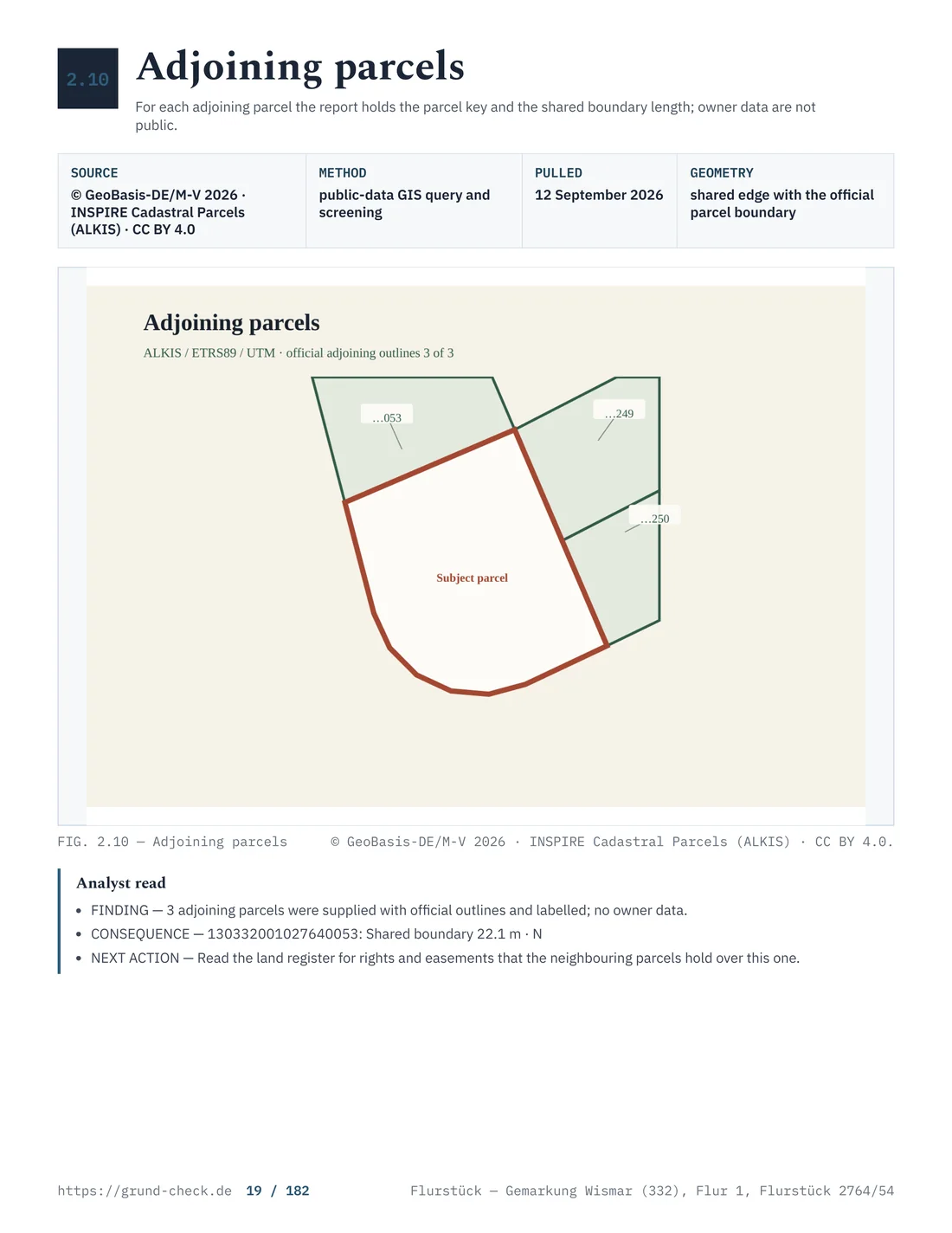
A plant's distance is measured to the property boundary. The legal boundary, not the centre of a fence post, visible hedge edge or line in the sales brochure, is decisive. An old fence may be offset, inaccurately built or classified differently by agreement. Before measuring, bring together the Flurstück (official cadastral parcel) number, cadastral map, boundary markers and existing survey documents. The Liegenschaftskataster is an indication; where the position is disputed, a boundary determination by an authorised surveyor provides a reliable basis.
On sloping land, the state rule determines how distance is defined and where on the plant measurement starts. A tree may be measured from the trunk base, trunk centre or outermost planting point. Record the method, date, direction and photographs. A laser value without a traceable start is less useful than a survey note tied to the Flurstück.
Distance follows species and growth form
State law usually classifies plants by species, expected height or growth form. A slow-growing fruit tree, hedge and large oak are not treated alike merely because they stand on the same boundary section. The rule may distinguish fruit tree, ornamental plant, shrub, hedge and other tree. For fruit plants, the rootstock matters because it influences later growth. Calling something a fruit tree in the purchase contract therefore replaces neither identification of the variety nor of the rootstock.
Record trunk circumference, height, crown shape, new growth, species, variety and rootstock. For a hedge, record continuous planting and regular height. Pruning does not automatically change classification. If identification is uncertain, obtain a written description of species and expected growth. The table is not a substitute for classifying the actual plant.
Sort out the boundary and plants before buying. A land analysis connects location documents, findings and open questions for the next review.
Old plantings and exclusion periods
A tree planted too close to the boundary does not automatically create an enforceable claim decades later. Neighbour statutes often use exclusion periods. Depending on the state and claim, they may begin with planting, discovery of the breach or the end of a permitted transitional rule. Saying that the tree has always been there does not answer the question. Negotiations, admissions, tolerance agreements and a change of owner may also affect the defence.
Collect planting year, former owners, photographs, invoices, correspondence and visible pruning. Ask whether the neighbour demanded removal, pruning or payment. Assess letters by content, receipt and response. If a period is running, establish its end and the preserving action. Removal may expire while later-branch or damage claims continue. Timing belongs in the price discussion.
Branches, roots and fruit across the boundary
Overhang and root growth are not assessed by the same action. § 910 BGB generally allows the affected owner to remove encroaching branches or roots under statutory conditions. For branches, a reasonable period to remedy the problem is normally required. The claim also depends on whether use of the property is impaired. An immediate cut without notice, without impairment or despite special protection rules can intensify the dispute.
Photograph the boundary point, growth direction, affected area and actual obstruction. A specialist should carry out the cut so that tree stability is not endangered without assessment. Nature protection law, a Baumschutzsatzung and protection periods may affect the practical work. Fallen fruit is treated differently under § 911 BGB from fruit still hanging on the tree. Ownership of land therefore does not automatically confer a right to harvest, fell or cut a neighbour's plants at the boundary.
Leaves, shade and other effects
Leaves, needles, seeds, blossom, shade and root pressure can interfere with use of a property. The legal assessment does not turn only on the fact that something comes from neighbouring land. § 906 BGB requires an assessment of the effect, its intensity and reasonableness. Customary effects are treated differently from exceptional burdens. Leaves beneath a mature tree therefore do not automatically require removal. A substantial, concrete burden may trigger a different review.
For a purchase, record cleaning effort, blocked drains, shading of rooms or solar installations, dampness and recurring damage over a longer period. One autumn day proves little. Dated pictures, invoices, shade measurements and a description of the affected use are more useful. Commercial or building use also requires checks on permits and technical consequences. A claim under § 1004 BGB requires a concrete impairment and the correct direction of the claim; general dissatisfaction with appearance is not enough.
- Public building lawBuilding setback and permit
- State neighbour lawPlanting distance, fences and time limits
- Municipal by-lawLocal design and protection rules
Source: BGB §§ 903, 910 and 1004 plus the neighbour-law acts of the states; checked August 2026
Fences between state law and municipal by-law
A fence does not automatically follow from every property boundary. State law may require an Einfriedung, a boundary enclosure, in defined circumstances, for example where a neighbour seeks protection from substantial interference or the properties lie in a built-up area. Other states regulate only type, position, distance or cost without creating a general duty for every boundary. The table identifies these differences where they are recorded in the state-specific rules.
The municipality must not be confused with the Nachbarrechtsgesetz. A Bebauungsplan or local by-law may regulate material, height, permeability, front-garden area or fence position. The state building code may also say whether an enclosure is exempt from approval. Exemption from approval does not remove a civil boundary, design rule or nature-protection requirement. Before buying, ask separately about by-law, development plan, existing fence, local custom and allocation of costs. A structure built by one owner can later cause disputes over ownership, maintenance and removal.
Wall, boundary wall and shared boundary structure
A wall may stand entirely on one plot, exactly on the boundary or as a Grenzwand, a wall at the boundary. Its position must be surveyed before assessment. The owner of a wall entirely on one plot can generally control it unless an easement, Baulast (public-law building obligation), agreement or public-law rule prevents this. A structure on the boundary may instead be a shared boundary facility. § 921 BGB presumes shared use only where a recognisable structure stands on the boundary and the local circumstances support it.
Use, maintenance and alteration of a shared facility are governed by § 922 BGB, agreement and the actual construction. Before replacement, establish ownership, cost responsibility, load-bearing function and whether access for the neighbouring plot must remain. For a Grenzwand, also check whether a neighbour may later build against it or use it structurally. Foundation photographs and building-file plans often resolve the issue better than the label in the purchase contract.
What the purchase contract takes over from the neighbour
When ownership changes, the relevant property position changes with it. A buyer takes over the actual situation with trees, hedges, overhang, walls and existing effects. That does not mean every seller statement automatically binds the buyer or every claim continues unchanged. The important matters are claim content, time, agreement, registration and whether tolerance was declared only personally. § 873 BGB shows the importance of agreement and land-register entry for property-related rights.
List neighbour agreements, minutes, cost arrangements, permits, settlement certificates and ongoing letters expressly in the contract file. A verbal promise that the neighbour will prune the tree later is not a safe solution. For known disputes, identify parties, Flurstück, location, demand, deadline, costs and attachments. Also state whether an existing fence or wall is sold with the property, maintained jointly or changed at the buyer's expense. Unresolved boundary conflicts do not belong in a side agreement after notarisation.
Review before the notarial appointment
Mark the affected boundary on a current site plan. Record species, growth form, trunk distance, hedge line, branches, roots, fence, wall and claimed effect. Classify each item as federal law, state law, building code, by-law, contract or observation. This prevents a design rule becoming a private removal claim.
Add the land-register extract, cadastral papers, correspondence, dated photographs, measurement sketches and open questions. Ask the municipality about the Bebauungsplan, fencing rules and Baumschutzsatzung, and check current state law. If the boundary is disputed, commission a survey. The notary does not decide species, boundary position or claim prospects.
The contract should name known attachments and reservations pending review clearly. § 311b BGB requires notarisation of a land purchase. It does not replace an open investigation. If the decision depends on a survey, agreement or authority response, clarify consequence, deadline, cost and withdrawal option with the parties before signing.
Make open neighbour questions visible before notarisation. A land analysis organises documents and flags missing confirmations.
Dispute file and mandatory conciliation
Start a chronological dispute file. Give each image a date, location, viewing direction and description. Record the instrument, starting point and sketch for measurements. Keep correspondence and delivery evidence. Separate impairment, notice period and execution for branches and roots; record frequency, extent and use for leaves or shade. Keep insults and general accusations out of the first demand.
Before filing a claim, check whether the state requires mandatory conciliation for the specific neighbour claim. § 15a ZPOEG allows the states to require a Gütestelle, a conciliation body, for defined neighbour claims, including overhang, fallen fruit, certain effects and claims under state statutes. The exact procedure, competent body and exceptions come from state law. A claim filed without the required certificate may be inadmissible. Keep the certificate of an unsuccessful attempt in the file.
Conciliation does not replace boundary surveying or expert tree assessment. A useful settlement describes the plant or structure, location, cutting or removal, access, costs, deadlines and consequences of non-performance. Before settling, establish whether the agreement binds only the current parties or is connected to the property. Where value, deadlines or ownership are material, obtain legal advice before making the declaration.
State overview for the purchase review
The table places recorded boundary distances, enclosure approaches and review notes side by side. Each numerical entry is tied to its plant category and legal basis; an unconfirmed figure is neither clearance nor a prohibition. For the property, check legal version, species, measurement line, deadline and local by-law. The first-column links provide state context.
| State | Value | Legal basis | Source |
|---|---|---|---|
| Baden-Württemberg | Smaller fruit trees: For pome and stone fruit trees on weak and medium-growing rootstocks, § 16 states 2 m; other types and special situations are regulated separately. Large trees: § 16 generally states 8 m for large species; special local rules may apply. Fences: no general obligation for every property The NRG regulates fences and boundary distances, but does not establish a general obligation for every property. | § 16 NRG | Source Baden-Württemberg |
| Bavaria | Plants up to 2 m high: 0.5 m. For trees, bushes, hedges, vines and hop vines, 0.50 m generally applies. Plants over 2 m high: 2 m If the height is over 2 m, the neighbour can generally request a boundary setback of 2 m; Art. 47 Abs. 2 contains special rules for forest as well as wine and hops. | Art. 47 AGBGB | Source Bavaria |
| Berlin | Large trees: 3 m For larger trees, the legal boundary setback according to the Nachbarrechtsgesetz applies. Small trees and bushes: 1.5 m The lower legal boundary setback applies to smaller trees; Special rules and exclusion periods must be observed. | §§ 27, 28 NachbG Bln | Source Berlin |
| Brandenburg | Obligation to fence: yes According to § 28, every property owner can demand fencing from neighbours under the legal local and boundary conditions; § 30 contains exceptions. Fruit trees over 2 m. Growth height: 2 m. For fruit trees, a distance of 2 m generally applies. Other trees over 2 m growth height: 4 m For other trees, a distance of 4 m generally applies; compared to agriculturally used areas, the distance doubles. Other bushes and hedges over 2 m: at least a third of the height. The distance is measured horizontally and at right angles to the border. | §§ 28–30 und 37 BbgNRG | Source Brandenburg |
| Bremen | State law: not proven A search in the official collection of Bremen regulations does not return any Nachbarrechtsgesetz. However, its absence cannot be positively proven. | kein bremisches Nachbarrechtsgesetz nachweisbar | Source Bremen |
| Hamburg | General neighbour law: no independent state law Hamburg, unlike most states, has not issued a Nachbarrechtsgesetz; the general regulations of BGB as well as the building regulations 'neighbour-law' rules in § 8 and §§ 83a-83b HBauO apply (border fencing, use of neighbouring properties for scaffolding, subsequent thermal insulation). Fences in the front garden: up to 1.50 m high, openwork § 8 Abs. 3 HBauO: structural fences on the street/neighbour boundary in the depth of the front garden up to 1.50 m high, must be openwork; for commercially used properties up to 2.25 m and solid. | §§ 906, 910 BGB; amtliche Information zum Baumschutz Hamburg | Source Hamburg |
| Hesse | Strongly growing trees: 2 m The respective species distance applies to the strongly growing tree species mentioned in § 38 HNRG; the official brochure states 2 m for this group. Pome and stone fruit on a weakly growing rootstock: 1.5 m The plant type and rootstock determine the distance; additional groups extend beyond these simplified slots. | § 38 Hessisches Nachbarrechtsgesetz (NachbG HE) | Source Hesse |
| Lower Saxony | Trees and bushes: § 50 staggers the distance according to height: up to 1.2 m 0.25 m, up to 2 m 0.50 m, up to 3 m 0.75 m, up to 5 m 1.25 m, up to 15 m 3 m, above 15 m 8 m. Obligation to fence: under legal and local conditions § 27 generally establishes an obligation to fence neighbouring properties that are developed or used commercially; it does not apply if enclosures are not common locally. | §§ 27 und 50 NNachbG | Source Lower Saxony |
| Mecklenburg-Western Pomerania | Property neighbour law: no state law Mecklenburg-Western Pomerania, along with the city states of Hamburg and Bremen, is one of the only states without its own Nachbarrechtsgesetz; the Ministry of Justice refers to the regulations of the BGB as well as its own information brochure on neighbourly cooperation. | Kein eigenes Nachbarrechtsgesetz; BGB gilt unmittelbar | Source Mecklenburg-Western Pomerania |
| North Rhine-Westphalia | Strongly growing trees: 4 m According to § 41 Abs. 1 Nr. 1 letter a, 4 m generally applies to strongly growing trees; different distances apply for certain other trees. Hedges over 2 m: 1 m § 42 distinguishes between hedges over 2 m (1 m) and up to 2 m (0.5 m); Distances from Außenbereich sites can be doubled. Hedges up to 2 m: 0.5 m The legal minimum distance is 0.5 m, subject to legal exceptions. | §§ 40–43 NachbG NRW | Source North Rhine-Westphalia |
| Rhineland-Palatinate | Very strong growing trees: 4 m The greatest distance applies to the species listed in the brochure such as maple, oak, beech, ash and lime. Weak-growing fruit trees: 1.5 m The smaller group applies to pome fruit on a weakly growing base and certain stone fruit trees; other species have their own spacing. | §§ 44–47 NRG Rheinland-Pfalz | Source Rhineland-Palatinate |
| Saarland | Boundary setbacks from plants: No data: The wording of the Saarland Neighborhood Law was not visible on any machine-readable source accessible in this round. | § 48 und § 43 Abs. 1 NachbG SL (Gesetz Nr. 965 vom 28. Februar 1973) | Source Saarland |
| Saxony | Neighboring law: Saxon Nachbarrechtsgesetz Boundary setbacks for plants are differentiated according to species and height; Municipal tree protection regulations may also apply. | § 8 Abs. 1 SächsNRG | Source Saxony |
| Saxony-Anhalt | Plants up to 1.50 m high: 0.5 m § 34 Abs. 1 letter a NbG: at least 0.50 m boundary setback. Plants up to 3 m high: 1 m § 34 Abs. 1 letter b NbG: at least 1 m boundary setback. Plants up to 5 m high: 1.25 m § 34 Abs. 1 letter c NbG: at least 1.25 m boundary setback. Plants up to 15 m high: 3 m § 34 Abs. 1 letter d NbG: at least 3 m boundary setback. Plants over 15 m high: 6 m § 34 Abs. 1 letter e NbG: at least 6 m boundary setback. Enclosure: upon request for more than insignificant impairments § 22 NbG establishes a situation-dependent obligation; § 23 states local custom and alternatively up to 2 m fence height. | § 34 Abs. 1 NbG | Source Saxony-Anhalt |
| Schleswig-Holstein | Trees and bushes: up to 1.20 m without spacing; above this at least a third of the height The statutory rule uses a height formula; it cannot be completely translated into a single value for large trees. Obligation to fence: only under legal conditions. Neighborhood law does not establish a blanket obligation for every property; Local customs and legal requirements must be checked. | § 37 Abs. 1 NachbG Schl.-H. (Fassung vom 27.05.2016, gültig ab 24.06.2016) | Source Schleswig-Holstein |
| Thuringia | Very strong growing trees: 4 m According to § 44 ThürNRG, a boundary setback of 4 m generally applies, including for sycamore maple, lime, poplar, plane tree, horse chestnut, European beech, English oak, Douglas fir, spruce, pine, ash and fir. Strongly growing trees: 2 m For strongly growing trees such as hornbeam, whitebeam, rowanberry, white birch, white alder, ornamental cherry and thuja, the general rule is 2 m. Other trees: 1.5 m The basic rule for all other trees is 1.5 m; Fruit trees and special locations have additional categories. Obligation to fence: conditional Within a contiguous built-up area, there is an obligation at the request of the neighbour if this is necessary to protect against significant disturbances; no general obligation for every property. | §§ 39, 44 ThürNRG | Source Thuringia |
Legal sources and status
The framework includes § 903 BGB, § 906 BGB, § 910 BGB, § 911 BGB, § 921 BGB, § 922 BGB, § 1004 BGB, § 873 and § 311b BGB, and § 15a ZPOEG. State rules are identified in the table by their recorded legal basis. For a purchase review, also document the measurement point, plant category, local by-law, correspondence and deadline status. A table with an unconfirmed figure does not replace information about the actual property. Recheck state laws and municipal rules before use. Status: 7 August 2026. General information, not legal advice.
The boundary is one of several questions that should be settled before notarisation: boundaries and the land survey, dividing a plot, land that is expected to become building land, buying from abroad.