
Value and price
Bauerwartungsland: when farmland may be built
When farmland counts as Bauerwartungsland, what risk comes with that label, and how its value is actually calculated.
On this page
What Bauerwartungsland is
Bauerwartungsland, meaning land with an expectation of future building, is an officially defined middle stage between agricultural land and building land. § 3 Abs. 2 ImmoWertV describes it as land whose further characteristics, based on concrete facts, in particular the state of municipal land-use planning and other urban development in the area, allow a building use to be expected with reasonable certainty. The field itself does not change; what changes is the assessment of how likely later building is, and with it the price a buyer is willing to pay.
This distinction has direct financial consequences. Valuation committees use it to place reference land values, and buyers use it to price a parcel correctly before accepting an offer that has already priced in a future building use.
In practice the term is used more loosely than the statute allows. Sellers and agents sometimes call any parcel on the edge of a settlement Bauerwartungsland once some building has appeared nearby. Whether the label actually fits, though, is decided only by the demonstrable state of planning, not by the distance to the nearest road.
- The four development stages under the ImmoWertV
- Why there is no claim to the expectation
- How the value of Bauerwartungsland is worked out
- The soil protection clause as a further hurdle
- Agricultural use until reclassification
Source: ImmoWertV 2021 § 3 and BauGB §§ 1, 30, 33 to 35; checked August 2026
The four development stages under the ImmoWertV
§ 3 ImmoWertV distinguishes four stages. Agricultural or forestry land is land usable for farming or forestry without reaching any of the following stages. Bauerwartungsland follows as the next stage. Rohbauland, raw building land, is land designated for building use under §§ 30, 33 or 34 BauGB whose utility connection is not yet secured, or whose position, shape or size is inadequate. Baureifes Land, building-ready land, is finally land that is buildable both under public law and in actual fact.
The boundaries between the stages are fluid and depend on facts, not on a date. One parcel can stay Bauerwartungsland for decades, while another reaches Rohbauland within a few years if the municipality pushes its planning forward quickly.
What the expectation has to be based on
A bare hope is not enough under the wording of the regulation. Concrete facts are required, above all the state of municipal land-use planning. These include a procedure already under way to amend the land-use plan, a designation as building land in the current land-use plan, a resolution to prepare a binding development plan, or a recognisable building development already under way in the immediate surroundings.
The land-use plan is the first visible indicator here. Under § 5 Abs. 1 BauGB, it sets out, in broad terms, the type of land use resulting from the intended urban development for the whole municipal area. Where it already shows an area as building land, that is a strong indicator of Bauerwartungsland even where the binding development plan itself is still missing. The zoning and buildability guide explains how a development plan is read.
Why there is no claim to the expectation
The most important sentence for any buyer is not in the ImmoWertV but in the BauGB itself. § 1 Abs. 3 BauGB makes clear: there is no entitlement to the preparation of land-use plans or municipal statutes, and such an entitlement cannot be created by contract either. A municipality can plan an area, postpone it, or leave it out of planning entirely, without any landowner being able to force the issue.
For Bauerwartungsland that means a structural risk: the expectation is an assessment, not a legal position. Anyone who pays more for a parcel purely because of this expectation than for comparable farmland carries the risk that the planning is delayed or never happens at all.
Get the planning position in writing before you buy. A GrundCheck report sets out the land-use plan, the state of any development plan and the surrounding building pattern for a parcel, so an expectation is not mistaken for a promise. Check a parcel.
The road to Rohbauland
Between Bauerwartungsland and Rohbauland there is usually a development-plan procedure. Even while it is under way, a project can become permissible if the conditions of § 33 BauGB are met: public and agency consultation must have taken place, the project must not conflict with the future provisions, the applicant must recognise those provisions in writing, and the utility connection must be secured. Only once these four points come together does the law speak of Rohbauland rather than a mere expectation.
Where only the secured utility connection is missing, an area stays Rohbauland even if the development plan has long since taken effect. What counts as a secured utility connection is described in the access and infrastructure guide.
How the value of Bauerwartungsland is worked out
For the valuation itself, § 42 ImmoWertV sets out a deductive method. The land value of Bauerwartungsland or Rohbauland can be derived from the land value of correspondingly used building-ready land, by deducting the costs of making the land ready to build that are usual in the local market and by factoring in the waiting time together with a realisation risk. In simple terms, the valuation committee works backward from the target value of the finished building plot and subtracts cost, time and uncertainty.
When reference land value zones for Bauerwartungsland and Rohbauland are set, § 16 ImmoWertV requires the development status and the type of use to be shown, because both directly affect value. The land value guide explains how the reference land value works more generally.
For a buyer this means in practice: a price that tracks the reference land value for building-ready land is inflated for a parcel still at the Bauerwartungsland stage. Only the discount for the cost of making the land ready, the waiting time and the realisation risk produces a price that matches the actual development stage.
When the expectation does not come true
Where the hoped-for planning does not materialise, or an area already designated is later taken out of the planned building development again, the owner as a rule has no claim to compensation. § 42 BauGB grants compensation only where a use that is already permissible is withdrawn or changed and this causes a more than negligible loss of value; within seven years of the use becoming permissible the full difference in value is compensated, after that only to a limited extent.
Bauerwartungsland, though, does not yet have a permissible use in the sense of this provision, only a prospect of one. The risk therefore lies entirely with the owner as long as the area has not left this stage.
The soil protection clause as a further hurdle
Even where a municipality is in principle willing to plan, it faces a statutory brake of its own. § 1a Abs. 2 BauGB requires land to be used sparingly and carefully; possibilities for inward development, such as reusing land, infill development or activating gaps in existing development, are to be exhausted first. Agricultural or forest land is to be converted only to the extent necessary, and the municipality has to give its own reasons for the necessity of such a conversion.
For a parcel on the edge of a settlement this means that a conversion to building land competes, under planning law, with the duty to use inner-area potential first. That is a further reason why an expectation sometimes takes longer to be fulfilled than the location of the parcel might suggest.
Land readjustment: when several owners are affected
Bauerwartungsland rarely exists as a single, conveniently shaped parcel. The future building area often belongs to several owners in an impractical layout. For this case, § 45 BauGB provides for land readjustment (Umlegung): built and unbuilt parcels are reorganised so that plots of a suitable position, shape and size result, either within the area of a development plan or within a built-up part of a settlement.
For the individual owner, a readjustment means the exact position and shape of their own future building plot is only fixed with the readjustment plan, even though the general buildability of the area may already have been foreseeable, and the overall value of their share changes little as a result.
Agricultural use until reclassification
As long as an area remains Bauerwartungsland, it is generally still used and treated as agricultural in law. A sale or division of such an area can therefore also be subject to the approval requirement of the Grundstückverkehrsgesetz, for as long as no development plan under § 30 BauGB applies. The details of this approval and the exception for areas already covered by a plan are explained in the dividing a plot guide.
Anyone wanting to buy part of a larger field as future Bauerwartungsland should therefore first check whether the division itself is even possible without approval, before the planning expectation becomes relevant at all.
- Concrete planning evidenceFNP, plan resolution or a defensible procedure status
- Marketing onlyNo secured expectation of development
- RohbaulandPlanning concrete, infrastructure or reorganisation still open
Source: ImmoWertV 2021 § 3 and BauGB §§ 1, 30, 33 to 35; checked August 2026
Tax particulars on purchase and resale
Transfer tax applies to a purchase of Bauerwartungsland like to any other land purchase; each state sets its own rate under Art. 105 GG. A later resale is where things get more interesting: under § 23 Abs. 1 Nr. 1 EStG, the gain from a private disposal of land is taxable where no more than ten years lie between acquisition and disposal. Anyone who holds Bauerwartungsland for more than ten years can realise a later increase in value privately, without income tax.
This ten-year tax rule is one of the main reasons Bauerwartungsland is traded as its own long-term asset class at all: whoever brings time to the table can wait out a planning uplift tax-free. The costs and taxes guide gives an overview of the further costs around a land purchase.
Anyone selling within the ten years, by contrast, has to declare the gain in their income tax return. The moment of acquisition counts from the date of the notarial purchase contract, not from the later land register entry. For land that was inherited or gifted, the acquisition by the previous owner is generally used for calculating the period.
What it means for inheritance, gift and property tax
The development status matters beyond the purchase itself. Under § 179 BewG, the value of undeveloped land for tax purposes is generally determined by its area and by the reference land values within the meaning of § 196 BauGB, which are established by the valuation committees and reported to the tax offices. A parcel classified as Bauerwartungsland is therefore generally valued higher on a gift or in an inheritance than comparable pure farmland, even where building is still years away.
Families holding such an area therefore benefit from checking the current reference land value before a transfer is planned, because the tax base can change purely through a higher development-status classification, without anything changing on the parcel itself.
Under § 196 Abs. 1 BauGB, reference land values are newly determined at the start of every second calendar year, unless a municipality sets a more frequent cycle. Between two reference dates, a parcel's classification in the cadastre can already have changed without the published reference value reflecting it immediately.
Inner area, outer area and the role of the neighbourhood
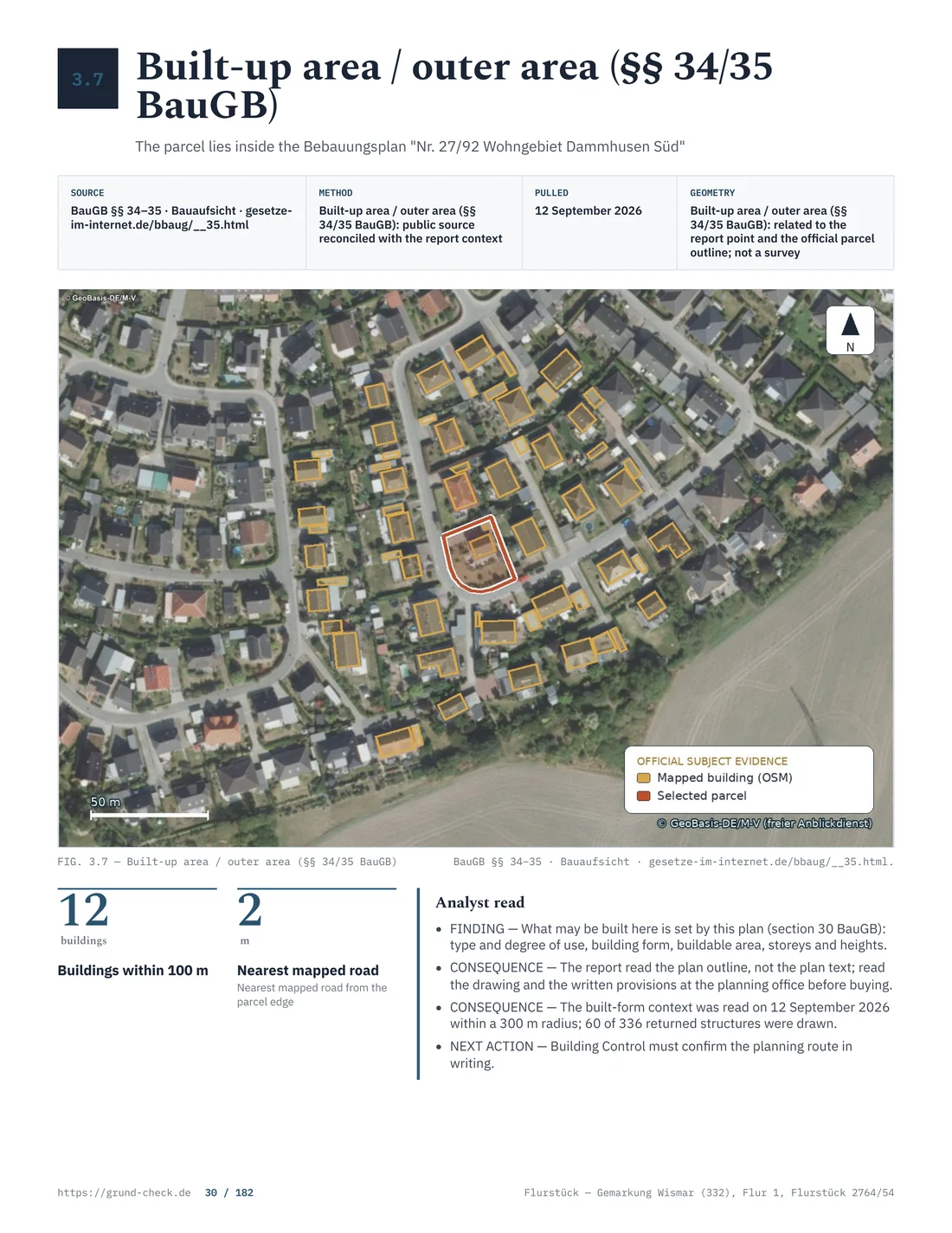
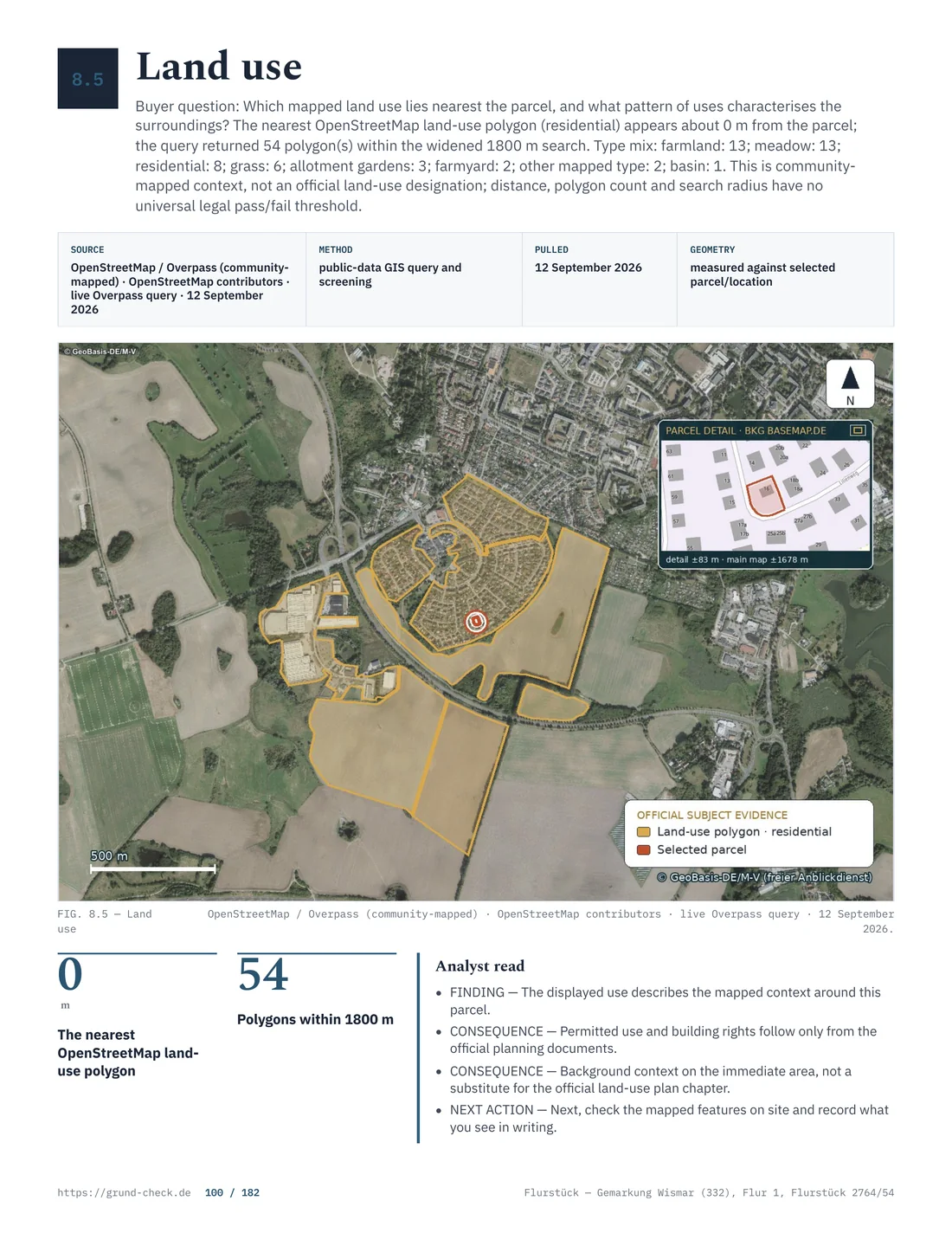
Whether an area can be considered Bauerwartungsland at all also depends on where it lies. Within a built-up part of a settlement, a gap in the development can already be buildable under § 34 BauGB and would then no longer be Bauerwartungsland, but already Rohbauland or even building-ready land. In the outer area under § 35 BauGB, by contrast, building is the exception, and an expectation there needs considerably more concrete grounds than mere proximity to the settlement.
How this distinction works in an individual case is explained in the building in the outer area guide.
What differs between states
The definition of Bauerwartungsland is itself uniform nationwide, because the ImmoWertV is a federal regulation and is federal law applying the same way everywhere. Land-use planning under the BauGB also follows the same procedure nationwide, with the municipality as the planning body.
What differs is how quickly an expectation arises and how a parcel is ultimately taxed. How briskly a municipality pushes its land-use planning forward is, in practice, a matter of state law and even local practice. Each state also sets its own transfer tax rate, and the property tax after a reclassification is fixed by the municipality through its own by-law.
A nationwide overview of transfer tax rates is being prepared as a separate comparison page; until then, the costs and taxes guide sets out the main differences.
The four stages at a glance
| Stage | Legal basis | Feature |
|---|---|---|
| Agricultural or forest land | § 3 Abs. 1 ImmoWertV | none of the following stages reached |
| Bauerwartungsland | § 3 Abs. 2 ImmoWertV | concrete facts allow a building use to be expected |
| Rohbauland | § 3 Abs. 3 ImmoWertV, §§ 30, 33, 34 BauGB | designated for building, but connection unsecured or shape inadequate |
| Baureifes Land | § 3 Abs. 4 ImmoWertV | buildable under public law and in fact |
What to check before buying
- Ask the municipality in writing for the state of the land-use plan and any development-plan procedure.
- Read building already present in the immediate surroundings as a factual indicator of development, not proof of it.
- Check whether the area is still classed as agricultural and could fall under a Grundstückverkehrsgesetz approval.
- Compare the asking price with the reference land value for Bauerwartungsland in the relevant zone, not with the price for building-ready land.
- Assess your own realistic holding period, with the ten-year income tax rule in mind.
Separate expectation from reality. A GrundCheck report shows whether a parcel advertised as Bauerwartungsland actually has a recognisable planning status, or whether only its location suggests one. Check a parcel.
Typical sales pitches and what is behind them
Terms like Bauerwartungsland, building land soon, or land set to appreciate are marketing language, not an official classification. Only the actual state of land-use planning decides which development stage a parcel belongs to. A seller who talks about a certain reclassification without producing a preparatory resolution or a designation in the land-use plan is, first and foremost, selling a story.
Ask the relevant building authority in writing for the actual planning position and request confirmation of any fee and the expected response time. That answer should come before any higher price a seller justifies with the prospect of future building land.
It is also worth asking for that answer in writing, with a date and a file reference, rather than accepting it only verbally. If the municipality's assessment changes later, this shows on what basis the purchase price was negotiated, which matters most where the seller has no interest of their own in sharpening a vague prospect.
Legal basis and sources
- Development stages and land value: § 3, § 16 and § 42 ImmoWertV.
- Land-use planning: § 1 and § 5 BauGB.
- Permissibility and compensation: § 33, § 34, § 35 and § 42 BauGB.
- Tax: § 23 EStG, Art. 105 GG and § 179 BewG.
- Reference land values: § 196 BauGB.
- Agricultural structure: § 2 GrdstVG.
- Environmental protection and readjustment: § 1a and § 45 BauGB.
Rules and figures were checked in August 2026. This information is general in nature and not legal advice for a particular plot.
Read next: land value and Bodenrichtwert, zoning and buildability and costs and taxes.