
Closing process
Buying German land from abroad
What a non-resident buyer actually has to solve to buy a German plot: language at the notary, power of attorney, money transfer and the waiting.
On this page
The legal position is simpler than most people expect
Germany places no nationality or residence restriction on buying land. A citizen of any country, resident anywhere, may buy a plot in Germany on the same terms as a German buyer, with the same taxes, the same notary and the same land register. There is no permit, no minimum investment and no requirement to be in the country.
Two narrow exceptions exist and neither concerns nationality. For agricultural and forest transactions, approval depends on § 2 GrdstVG and the implementing law of the state where the parcel lies. Section 2(3)(2) GrdstVG lets each state exempt transactions up to a state-defined area; there is no uniform national two-hectare threshold. The Brandenburg implementing act is one state example. Any required approval applies equally to German and foreign buyers. The municipality may also have a pre-emption right under §§ 24 to 28 BauGB, regardless of who the buyer is.
Distance changes the practical process: how you sign, how you pay, how you check the plot and how long the whole thing takes.
- What cannot be done remotely, and what can
- Signing without being there
- Financing from outside Germany
- Buying through a company, and whether it helps
- Owning land gives you no right to live here
Source: BGB §§ 311b, 873 and 925, BeurkG, GwG and GBO; checked August 2026
What cannot be done remotely, and what can
Almost all of the due diligence works by post and e-mail. Municipal planning statements, register extracts, Baulasten enquiries and utility answers all arrive as documents, and the cadastral map is online and free in the official cadastral viewer. What genuinely requires physical presence is the notary appointment, and even that can be delegated.
What no document replaces is one visit to the plot. Photographs hide slope, water standing in the corner, the neighbour's shed over the line and the fact that the access track belongs to somebody else. If you buy without ever standing on the land, budget for a local surveyor or architect to go instead and send photographs against the cadastral map.
The language question at the notary
The deed is read aloud in German. If you cannot follow it, § 16 BeurkG requires the notary either to translate personally or to bring in an interpreter, and you may ask for a written translation of the text as well. Both are chargeable and both need booking in advance.
A practical sequence that works: ask for the draft in the usual two weeks under § 17 Abs. 2a BeurkG, send it immediately for written translation, mark your questions on the translation, and have those questions answered in writing before the appointment. That turns the reading from an ordeal into a formality.
Check the parcel before you book a flight. A GrundCheck preflight report resolves the listing to the official parcel and sets out the planning context and risk flags, which is the part of the work that does not need you to be in Germany. Check a parcel.
Signing without being there
Three routes exist. Attend in person, which is cleanest. Sign at a German consulate, which some consulates offer and others do not. Or grant a power of attorney to someone in Germany, which is the usual answer.
The power of attorney for a land purchase should itself be notarised. Signed outside Germany it normally also needs an apostille under the Hague Convention, or full legalisation for countries outside it, and a certified translation into German. Allow two to three weeks for that chain and start it early; it is the item that most often delays a cross-border completion. Ask the German notary to supply the wording, because a power drafted abroad in general terms is frequently rejected as too vague for the land registry.
Money: the part that surprises people
Expect questions about the source of funds. § 10 GwG obliges the notary to identify the parties and, where a company or a nominee is involved, to establish who ultimately owns it. Since 2023 cash is effectively out: property purchases must be settled by traceable transfer. Have bank statements and, where the money comes from a sale or an inheritance, the underlying documents ready.
Then the mechanics. Paying from a non-euro account exposes the price to the exchange rate and to your bank's spread, which on a 250,000 € purchase easily separates a good transfer from a careless one by a four-figure sum. Fix the rate when the notary issues the payment instruction, not weeks earlier, because the instruction date is when the money is actually due. Send from an account in your own name; a payment from a third party creates questions the notary must resolve before the transfer is treated as made.
- Attend the notaryIdentity and declaration made directly
- Power of attorneySettle form, scope and recognition in advance
- Later ratificationRepresentative signs; buyer ratifies in the required form
Source: BGB §§ 311b, 873 and 925, BeurkG, GwG and GBO; checked August 2026
Financing from outside Germany
German banks lend on German land to non-residents, but on tighter terms. Expect a lower loan-to-value than a resident would get, often sixty to seventy percent, income documents translated, and a preference for borrowers with income in euros. A bare building plot is in any case financed less generously than a house, because there is no building to secure.
Whatever the lender, the mortgage is registered as a Grundschuld and costs extra at the notary and the registry, roughly the same again as the base fee calculated on the loan amount. Build the timing in: the bank's documents have to be with the notary before the appointment, not after, and a lender abroad that has never dealt with a German land registry will need several weeks longer than one that has.
Financing from a bank in your own country, secured on property you already own there, is often the faster route for a building plot. It avoids the German valuation, the translated income documents and the Grundschuld entirely, and it leaves the German parcel unencumbered, which simplifies the closing. The trade-off is the exchange rate exposure and, if the loan is in another currency, a debt that moves against a euro-denominated asset. Whichever way the money comes, have the confirmation in writing before the notary appointment is booked, because a deed signed without funding in place is still a deed.
Choosing the notary, and who instructs whom
The notary is neutral, but somebody has to pick one, and in practice whoever instructs first sets the pace. Sellers and agents usually propose their own. That is not a problem in itself because the notary owes the same duty to both sides, but it does mean the draft arrives written from the seller's habits, and a buyer at a distance is slower to notice what is missing from it.
Two things are worth insisting on regardless of who chooses. That the notary corresponds with you directly, by e-mail, in writing, rather than through the agent, because an intermediary who summarises legal points is a source of error. And that you receive the draft in the full two-week period, not a shortened one arranged for the convenience of a diary. Notaries across Germany are used to buyers abroad and most will handle the correspondence in English informally, even though the deed itself must be German.
Buying through a company, and whether it helps
A foreign or German company can hold German land, and the same rules apply. What changes is the paperwork: a current extract from the company register, translated and apostilled, proof of who may sign, and identification of the beneficial owner under § 11 GwG. All of it has to be current at the date of the deed, which for a foreign register usually means obtained within the previous few weeks.
The structure is sometimes suggested as a way to reduce transfer tax on a later sale. Treat that idea with care. The rules on share transfers were tightened repeatedly and now catch most arrangements that once worked, and the running cost of maintaining a company usually exceeds anything saved on a single plot. For one building plot bought to build a house, personal ownership is normally simpler and cheaper.
A realistic timetable
| Step | Who acts | Typical time |
|---|---|---|
| Parcel identity and free map checks | buyer | 1 day |
| Planning statement from the Gemeinde | municipality | 1 to 3 weeks |
| Register, Baulasten, utility answers | authorities, seller | 2 to 4 weeks |
| Power of attorney, apostille, translation | buyer, foreign notary | 2 to 3 weeks |
| Draft deed with the buyer | German notary | 2 weeks before signing |
| Signing, priority notice registered | notary, Grundbuchamt | 1 to 3 weeks |
| Payment instruction and transfer | notary, buyer | days |
| Transfer tax assessment and payment | tax office, buyer | 4 to 8 weeks |
| Registration as owner | Grundbuchamt | after clearance |
Three to five months from first enquiry to registration is a fair expectation. Nothing in that timetable is unusual or a sign that something has gone wrong.
Owning land gives you no right to live here
This is the misconception that causes the most disappointment, and it is worth stating plainly. Buying property in Germany confers no residence permit, no visa and no advantage in any immigration procedure. There is no investor route attached to real estate. A non-EU owner visits on whatever basis would apply anyway, normally ninety days in any hundred and eighty within the Schengen area, and building a house does not change that.
For EU and EEA citizens the question does not arise, since free movement already applies. For everyone else, the practical consequence is a planning one: if the intention is to build and then spend long periods on site, the residence question has to be solved separately and first, because a half-built house and a visa refusal is an expensive combination. Take that advice from an immigration lawyer, not from a property agent, and do not let a seller present ownership as a step towards residence.
The extra costs of buying at a distance
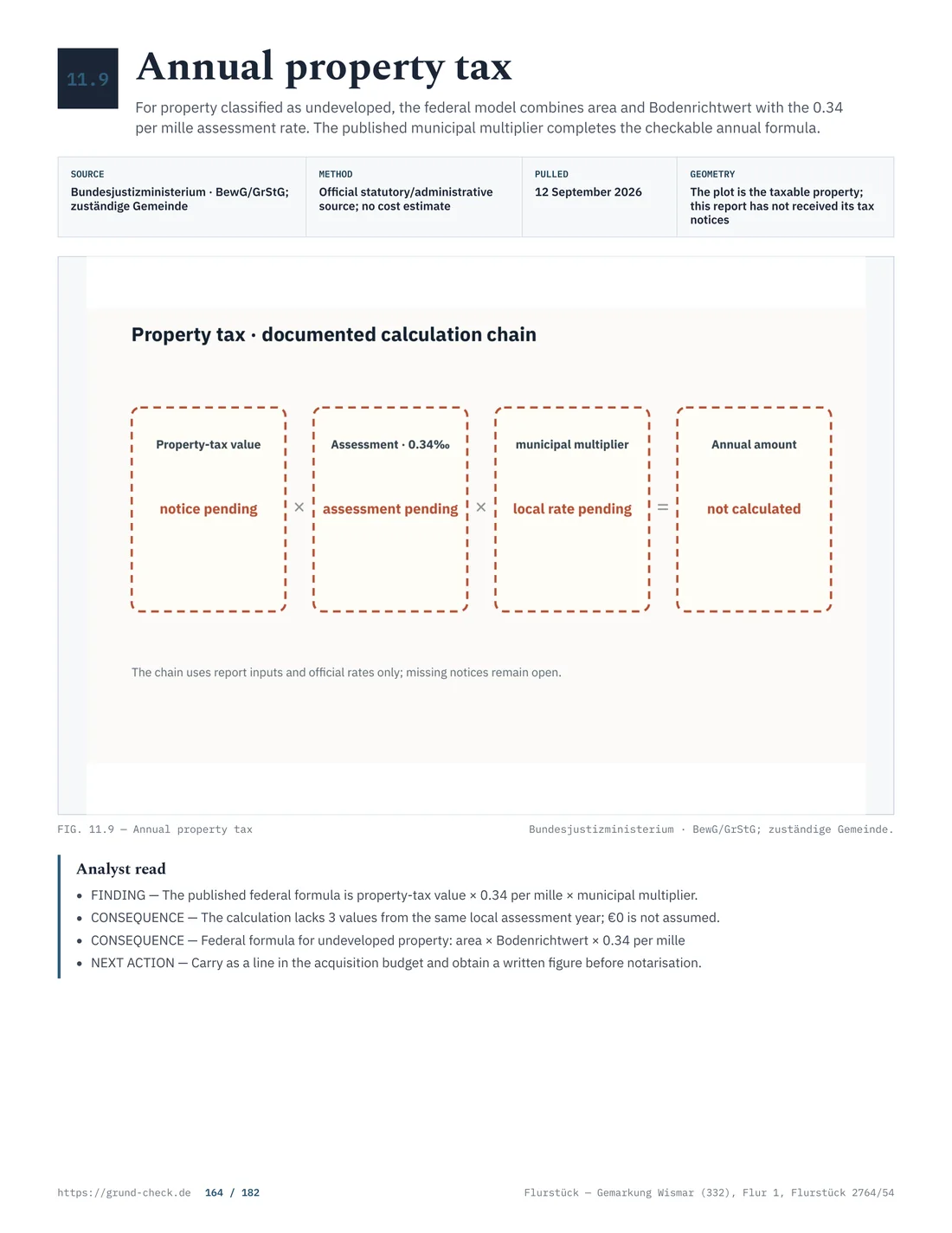
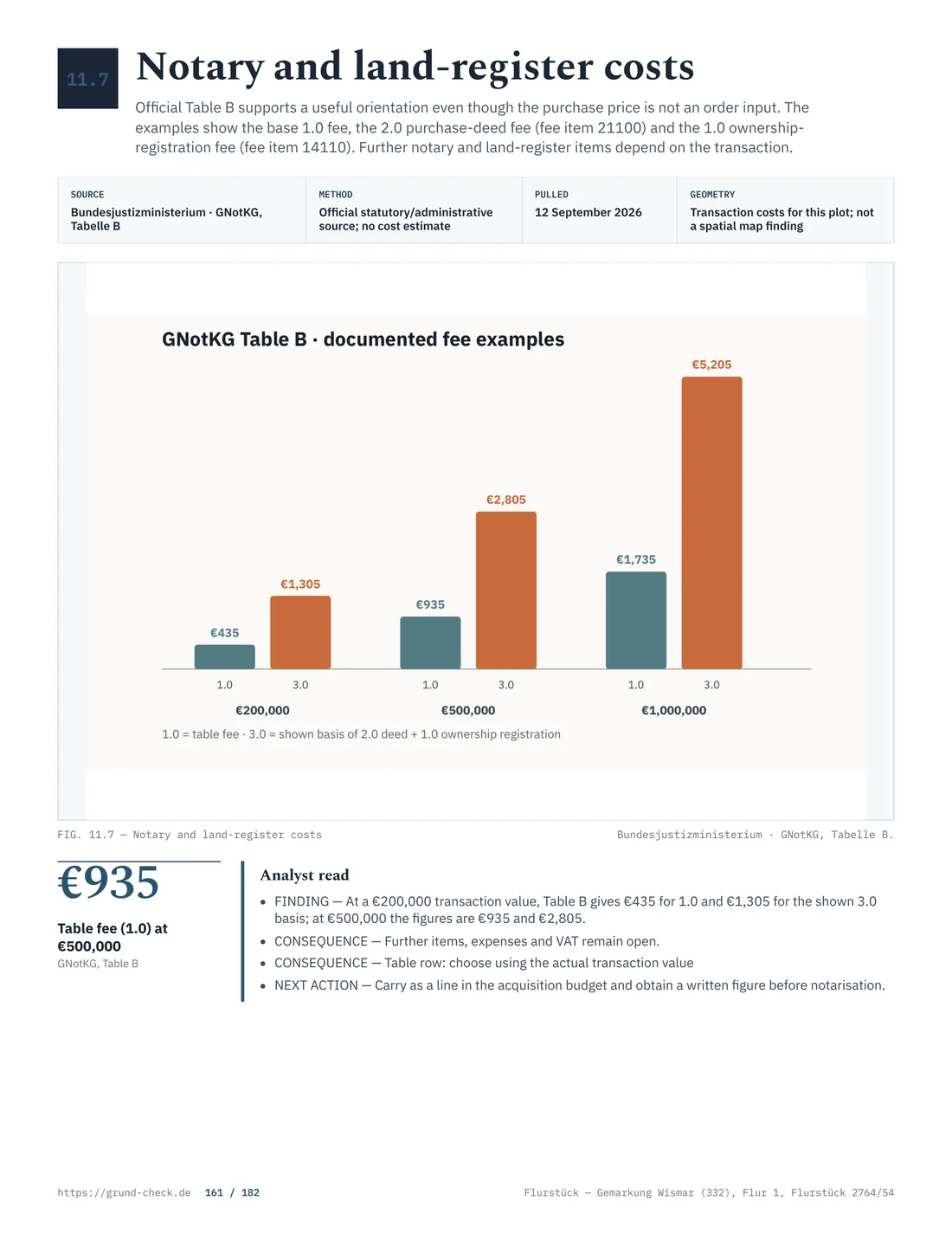
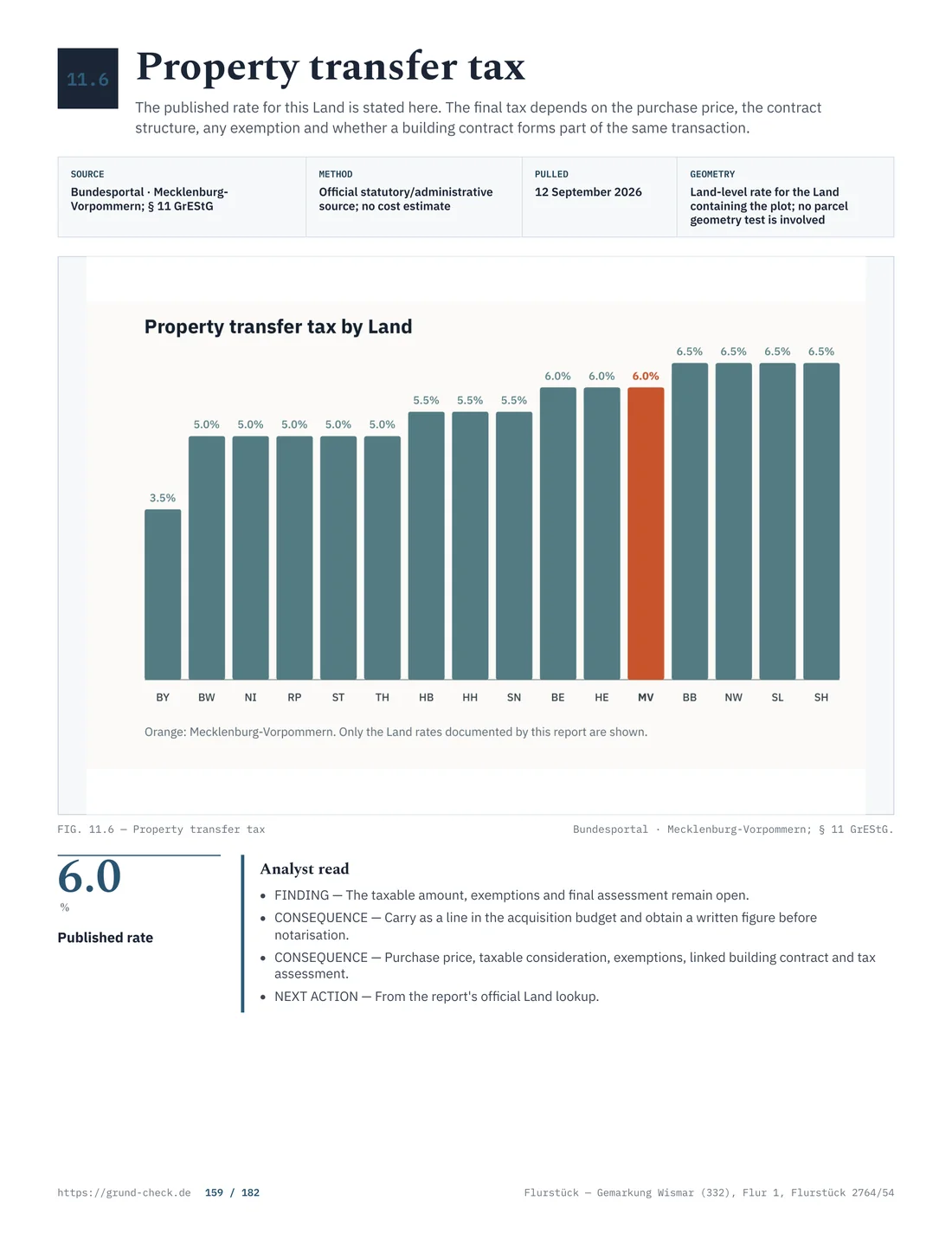
On top of transfer tax at the rate charged by the state where the property lies and roughly one to one and a half percent for notary and registry, a cross-border purchase adds a written translation of the deed, an interpreter at the appointment, a notarised and apostilled power of attorney, certified translations of identity and income documents, and the currency spread. Together these commonly run to a low four-figure sum, and none of it appears in any percentage rule of thumb. The costs guide sets out the rest of the budget.
Who acts for you on the ground
A purchase run from another country needs one person in Germany who can receive post, visit the plot and sign under the power of attorney. Choosing that person badly is the most expensive mistake available to a remote buyer, because the power of attorney for a land purchase is a wide instrument.
Three sensible options. A German lawyer instructed by you, which costs a few hundred euros for the closing and gives you someone with professional liability insurance. A surveyor or architect for the site work, who is useful anyway once building starts. Or a trusted private person, which is cheap and carries the obvious risk. What is not sensible is granting the power to the seller's agent, whose interest is the completion rather than your position.
Whichever you choose, limit the power in writing: to this parcel, to a maximum price, to a period of a few months. A German notary will draft those limits into the wording, and a narrow power is accepted by the land registry just as readily as a broad one.
After you own it
The land register can hold a foreign address, and correspondence will go there. Two things follow. The annual Grundsteuer notice arrives from the municipality and has to be paid from abroad, so a standing arrangement or a local contact saves missed deadlines. And a plot that is not looked after can attract municipal orders about traffic safety, weeds or fire risk, which also arrive by post. Someone in Germany who can open mail and act on it is worth arranging before you need one.
Tax on any later sale is a separate question. Germany taxes the gain on a private sale made within ten years of the purchase, and the double taxation treaty with your own country decides where that gain is finally taxed. The ten years run from the date of the purchase contract, not from registration, which is worth noting because the two can be months apart. Take advice on that before selling rather than before buying.
One administrative point closes the loop. A non-resident owner needs a German tax number for the transfer tax assessment, and the tax office issues one during the purchase without any application from you. Keep the reference: the same office writes again if the land is ever sold, and correspondence sent to an address you have since left is treated as delivered. Tell the tax office and the municipality in writing whenever your address changes, because neither of them learns it from anywhere else.
One parcel, one document, before anything is booked. Order a GrundCheck preflight report and start the process with the parcel identity and the planning picture already settled. Check a parcel.
Inheritance, and the question to settle early
A German parcel is German property for succession purposes, and the estate of a foreign owner touches two legal systems at once. Within the European Union the succession regulation generally applies the law of the deceased's habitual residence, with the option to choose the law of nationality instead, and that choice has to be made in the will while the person is alive. Outside the Union, German rules on immovable property in Germany carry more weight.
Whatever the answer, the practical effect on the heirs is the same: to be registered as owners they will need documents recognised in Germany, which for a foreign probate means translation, apostille and sometimes a separate German certificate of inheritance. That process costs money and takes months, and it lands on people who are not expecting it. A short clause in an existing will, drafted with the German parcel in mind, removes most of the difficulty for a fraction of the later cost.
Where these rules are written
- Notarial language and drafts: § 16 and § 17 BeurkG. Reading of the deed: § 13 BeurkG.
- Identification and source of funds: § 10 and § 11 GwG.
- Contract and transfer: § 311b, § 873, § 883 and § 925 BGB; tax clearance § 22 GrEStG.
- Farmland approval: § 2 GrdstVG with the state implementing act for land transactions. Municipal pre-emption: §§ 24 ff. BauGB.
- Free parcel data: official cadastral viewer, GEOBROKER. Land values: official land-value portal.
Rules and figures were checked in August 2026. This is general information for buyers, not legal or tax advice on your situation. Read next: the notary process, the due diligence checklist and costs and taxes.
Two special cases deserve their own look: the hereditary building right, buying at a forced auction.
State-law checks
Foreign and domestic buyers face the same state-specific building, agricultural-land and register procedures. The parcel’s location, not the buyer’s nationality, determines them.