
Access and infrastructure
Utility checks before buying German land
What the connection charges are, which office issues each one, and the seven pieces of paper worth having before the notary appointment.
On this page
"Erschlossen" is a word in the listing, not a guarantee
German listings call land erschlossen, teilerschlossen or unerschlossen. None of those words binds anyone. Under § 123 BauGB the Erschließung (provision of roads and utility infrastructure) of an area is the municipality's own task. This duty is set by federal law. The same section ends with a sentence worth reading before you budget: nobody has a legal claim to it. A municipality can put a sewer in its plan for 2029, move it to 2034, and owe you nothing for the delay.
So the useful question is not whether the plot is serviced. It is which of these four situations applies to your parcel, in writing:
- the main runs in the public road, and nothing has been applied for;
- the operator has confirmed in writing that a connection is possible, with a price and a lead time;
- the line has already been laid up to the plot boundary;
- the house connection exists, is metered and has been paid for.
Sellers regularly describe the first as if it were the fourth. The gap between them is often a five-figure sum and a year of waiting.
- Finding the right office when you do not know it yet
- Water and sewer: two payments, two different laws
- No public sewer? The private route is not simply your decision
- Internet: orientation map first, written answer second
- Seven documents to have before the notary appointment
Source: BauGB § 123 and §§ 127 to 135, NAV, AVBWasserV, WHG and municipal by-laws; checked August 2026
Finding the right office when you do not know it yet
Half the delay in a utilities check comes from letters landing on the wrong desk. Four addresses cover almost everything.
- Electricity and gas: the grid operator, which is not the same company as the supplier on a bill. The responsible grid operator depends on the service area; the larger towns have their own Stadtwerke.
- Water and sewer: the municipality's Bauamt will name the responsible body in one phone call. Where a Zweckverband exists, send the question there and not to the town hall, and download its Satzungen from its own site.
- Private treatment plants, wells, rainwater: the untere Wasserbehörde at Landkreis level.
- Road contributions: the municipality itself, usually the Kämmerei or the Tiefbauamt.
Identify the plot the way the offices do. Give Gemarkung, Flur and Flurstück (official cadastral parcel) rather than a postal address, since a field on the edge of a village often has no street number and two parcels can share one. Attach a map extract and state the use you plan, because both the connection load and the contribution class depend on it.
A request that gets a usable answer
Offices answer narrow questions faster than open ones. A workable enquiry fits on one page and asks for four things:
- whether a connection is possible for this parcel and this use;
- what it costs under the price sheet or Satzung in force today, split into the fixed part and the part that depends on distance or load;
- how long it takes from order to commissioning;
- how long the answer stays valid.
Close with a request for the reply in writing; email is enough. Send a separate letter to each body. One letter to the town hall covering five networks usually comes back as one sentence.
Electricity: the cost structure and when a Baukostenzuschuss appears
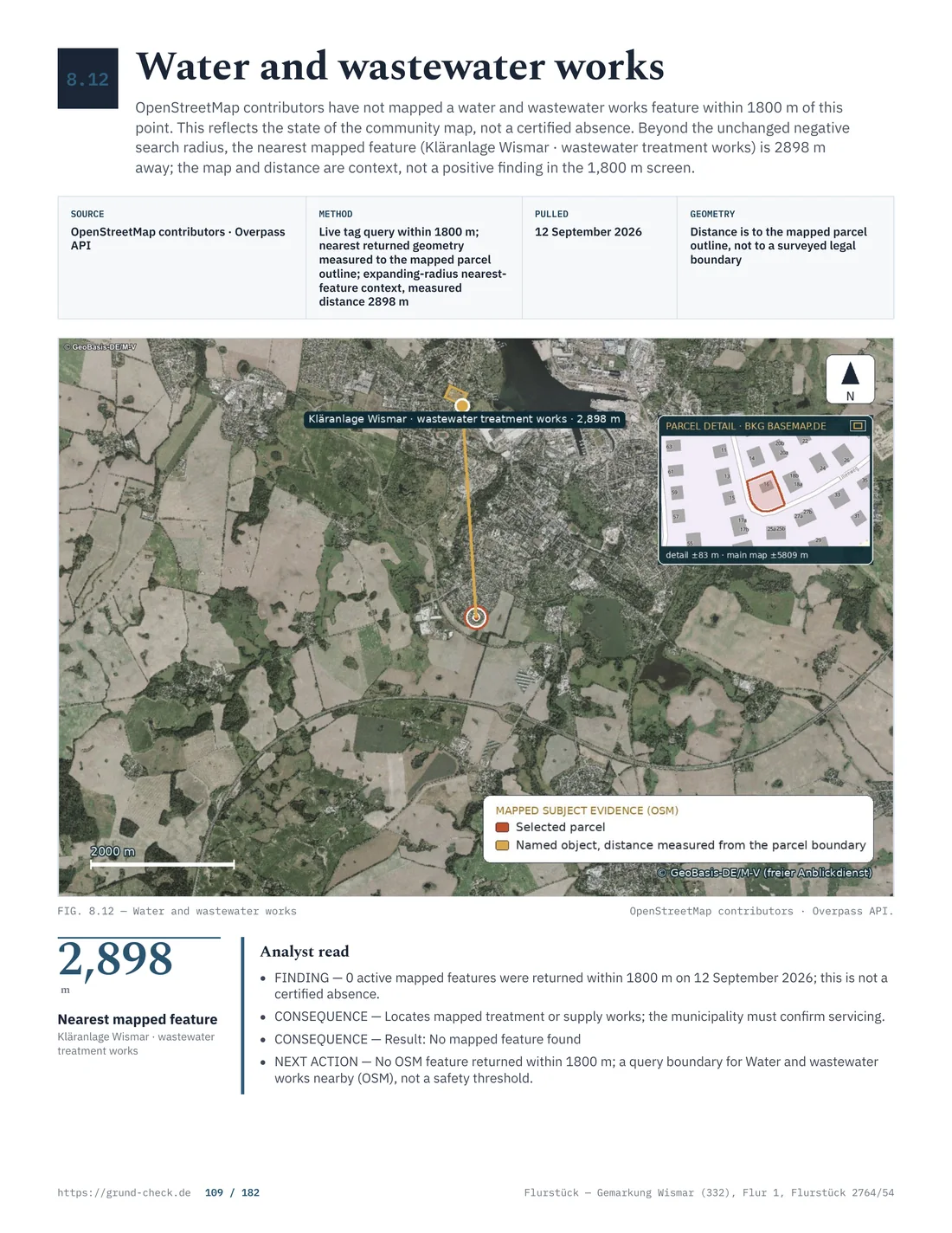
§ 18 EnWG obliges the grid operator to connect customers to the low-voltage grid on general terms. That duty falls away where a connection would be economically unreasonable, which is exactly the case that matters on a remote plot with several hundred metres to the nearest cable.
Inside a built-up area, a standard house connection usually lands between 2,000 and 4,000 € including VAT. Price sheets are built the same way almost everywhere: a flat rate covering the first stretch of cable, then a price per further metre of trench. The flat part is predictable, the metres are not, and that is where two quotes for the same plot diverge.
The item that catches people out is the Baukostenzuschuss, a one-off payment towards reinforcing the local grid. § 11 NAV keeps it narrow: in low voltage it may only be charged on the part of the demand that exceeds 30 kW, and it may never cover more than half of the operator's cost. The grid operator publishes the E.DIS Netz rate for the part above that threshold; at the time of writing it is 50 € net per kW.
Treat that as a planning rule rather than a fee table. A conventional house drawing 25 to 30 kW pays no Baukostenzuschuss at all. Add a heat pump, an induction kitchen and two wall boxes, ask for 45 kW, and 15 kW sit above the line, which is around 750 € net. Decide the kW figure before you request the offer, because the offer is priced on the number you name.
Gas follows the parallel rule in § 11 NDAV, with the same 50 percent ceiling but no 30 kW threshold. Before paying for a gas connection at all, check whether the heating you actually intend to install still needs one.
Not sure which of these questions apply to your parcel? A GrundCheck preflight report resolves the address, pulls the official parcel data and flags the planning and risk context for one plot, so you know what to ask before you start writing letters. Check a parcel.
Water and sewer: two payments, two different laws
Start by finding out who you are dealing with. The water and sewer network frequently belongs to a Zweckverband covering several municipalities rather than to the town hall. The association writes the rules and sends the invoices, and its area does not always follow municipal boundaries.
§ 12 of the state municipal code (BbgKVerf) lets a municipality impose connection and use by Satzung, water supply and wastewater included. The same provision allows the Satzung to grant exceptions, in particular where a plant on the property meets a higher environmental standard than the public facility. Whether an exception exists for your parcel is a question for the text of the Satzung, not for the seller. The contribution framework comes from state law. The amount is fixed in a municipal by-law for the network.
Then keep the two payments apart, because they get confused constantly.
- Anschlussbeitrag is a one-off contribution for the ability to connect. Its basis is § 8 of the state Kommunalabgabengesetz together with the association's own Beitragssatzung, and it has nothing to do with the Baugesetzbuch. It is normally a rate per square metre of assessable area multiplied by a factor for the number of full storeys the plot may carry. For scale: the MAWV association south-east of Berlin charges 0.96 € per square metre for drinking water from 1 January 2026, roughly 770 € on an 800 m² plot with single-storey buildability. Rates between associations differ several times over, so only the current Satzung of your association counts.
- Gebühren are the running charges for consumption. The regional average household paid 1.82 € per cubic metre of drinking water plus about 88 € a year in standing charge, and 2.16 € per cubic metre for wastewater in 2025.
One historical question deserves its own paragraph. If the plot was already connected in GDR times or during the 1990s, ask in writing whether any Anschlussbeitrag is still open and when the claim arose. Many associations only enacted a valid Beitragssatzung in the late 2000s and then billed connections that had existed for decades. In its decision of 12 November 2015 the Federal Constitutional Court held that reaching back to cases where the limitation period had already expired was an unconstitutional retroactive effect. Whether that helps one particular parcel depends on dates, so collect the dates.
Roads: the BauGB charge that really does exist
This is where the Baugesetzbuch applies. § 127 BauGB covers the first construction of public roads, paths, squares, parking and green areas and noise protection installations. Water mains and sewers are not Erschließungsanlagen in that sense.
Three points set your exposure. The municipality has to carry at least ten percent of the eligible cost itself (§ 129 Abs. 1 BauGB). The charge arises only once the facility is finally completed (§ 133 BauGB), which is why a notice can land years after the purchase. And the state abolished the separate Straßenausbaubeitrag for rebuilding existing roads by state law dated 19 June 2019, backdated to 1 January 2019, while the Erschließungsbeitrag for first construction was left untouched. Sellers and buyers mix the two up in almost every conversation.
Where a developer built the estate, a different mechanism applies. Since the old § 124 BauGB was folded into § 11 BauGB in 2013, road construction is often handed to a developer by Erschließungsvertrag, and the cost then sits inside your purchase price instead of arriving later as a municipal notice. Ask the municipality which of the two governs this plot, and whether the road counts as finally completed.
No public sewer? The private route is not simply your decision
Under § 66 BbgWG the municipality carries the duty to dispose of wastewater. A private treatment plant becomes possible when the water authority releases the municipality from that duty for the individual property, on the municipality's application, in line with the municipal Abwasserbeseitigungskonzept, and transfers the duty to the user with the user's consent. The usual grounds are disproportionate connection cost or a thin settlement structure.
The first document is therefore not a manufacturer's brochure. It is the entry for your parcel in the Abwasserbeseitigungskonzept, plus the position of the untere Wasserbehörde at Landkreis level.
Budget the running cost, not merely the purchase. A small biological plant costs roughly 300 to 600 € a year to operate once maintenance, electricity and sludge removal are counted. Maintenance intervals follow the approval class and the manufacturer's manual and run from one to three visits a year. Sludge removal costs somewhere between 150 and 400 € each time, usually every one to two years.
Rainwater and wells
Rainwater is a separate question from foul water and tends to surface late, at the building application. § 54 BbgWG expects rainwater to be infiltrated on the plot where groundwater is not put at risk, and The state's Versickerungsfreistellungsverordnung removes the permit requirement for harmless infiltration. Whether that works on your land depends on the soil and the groundwater level, which is one more reason to read the soil report before committing. Where a plot drains into the public sewer instead, many associations bill sealed area separately under a split wastewater charge.
A well is not a substitute for a connection. Taking groundwater for a household and its garden needs no permit under § 46 WHG, but the drilling itself must be notified to the untere Wasserbehörde at least a month in advance under § 49 WHG, and water used for drinking falls under the drinking water regulation with its testing duties.
- Main in the roadThe parcel is not connected yet
- Connection at the boundaryPrivate pipework and commissioning remain
- Working house connectionConfirm capacity and charges in writing
Source: BauGB § 123 and §§ 127 to 135, NAV, AVBWasserV, WHG and municipal by-laws; checked August 2026
Internet: orientation map first, written answer second
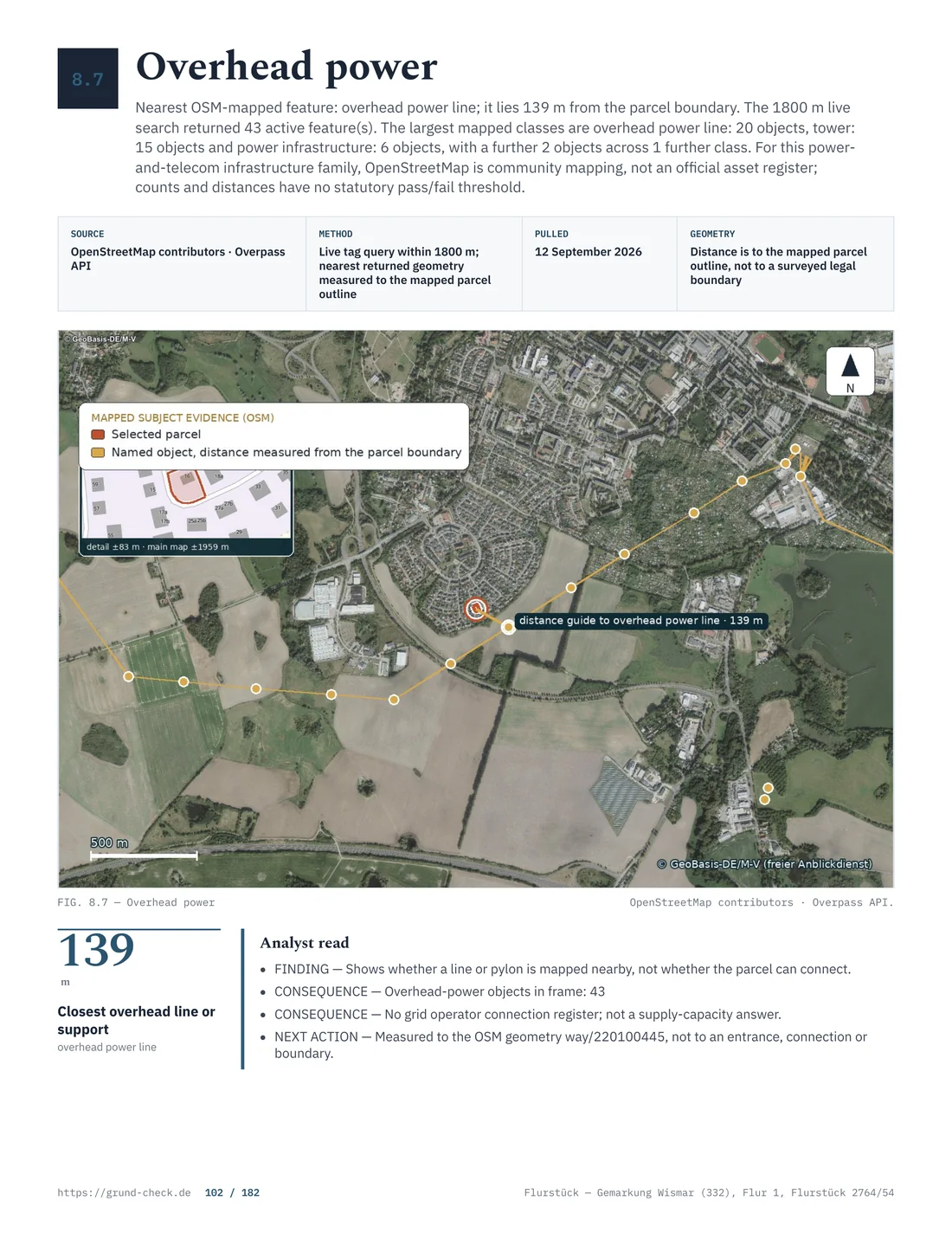
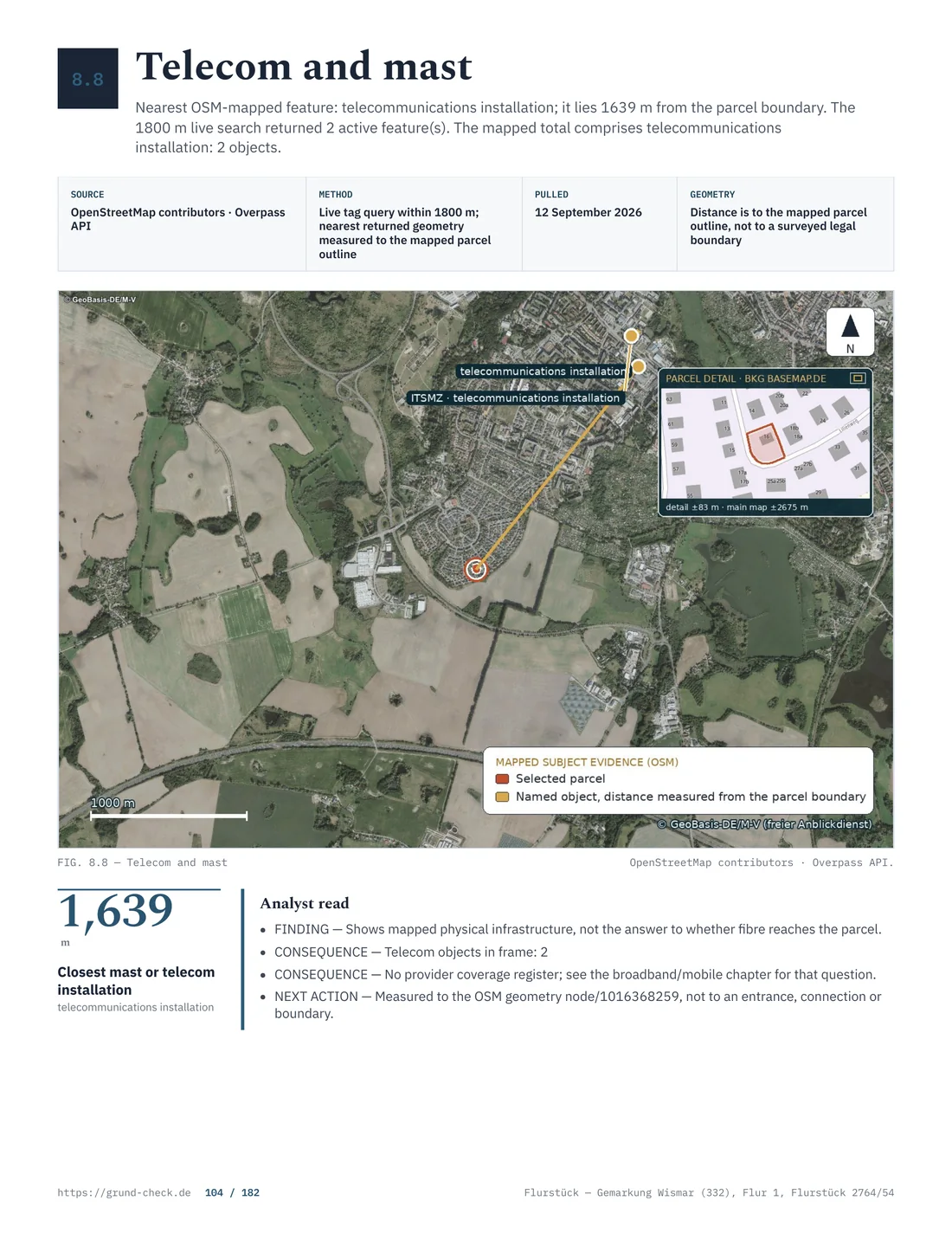
The Breitbandatlas is part of the federal Gigabit-Grundbuch run by the Bundesnetzagentur and shows availability down to address level. Use it to shortlist, then ask the operator for a written feasibility answer for the exact address, including who pays for the last metres onto the plot.
There is a legal floor underneath all of it. §§ 156 ff. TKG give every household a right to a minimum service, and since December 2024 that means at least 15 Mbit/s down, 5 Mbit/s up and latency no worse than 150 ms. If no provider supplies that, you can apply to the Bundesnetzagentur. It is a floor that keeps a household online, not a promise of fibre.
When the line has to cross someone else's land
The legal route matters as much as the technical one. If a cable, water pipe or sewer has to run over a neighbouring plot, the right to keep it there belongs in the land register: a Grunddienstbarkeit under § 1018 BGB in Abteilung II in your favour, usually alongside a beschränkte persönliche Dienstbarkeit for the operator, and in some cases a Baulast (public-law building obligation) on the serving plot. A neighbour's spoken assurance lasts exactly as long as that neighbour owns the land. Our articles on private easements and rights of way and on Baulasten and building obligations go through the wording to look for.
Seven documents to have before the notary appointment
- Electricity connection offer naming the flat rate, the metre allowance, the price per further metre, and whether a Baukostenzuschuss applies at the kW figure you declared.
- Gas offer, or written confirmation that no gas is planned, if your heating concept depends on it.
- Statement from the water and sewer body: whether connection and use are compulsory, the current Beitragssatzung with its rate table, the tariff class for the parcel, and whether any contribution is still open.
- Statement from the municipality on Erschließungsbeitrag: whether the road is finally completed, whether a contribution is still to come, and whether an Erschließungsvertrag governs the plot.
- For plots without a sewer: the entry in the Abwasserbeseitigungskonzept and the position of the untere Wasserbehörde on a private plant.
- Written broadband feasibility answer from at least one operator for the exact address.
- Land register extract Abteilung II plus the Baulastenverzeichnis entry, checked against every line route that leaves your own boundary.
Each of them needs a date on it. An offer from 2024 is a document, not evidence.
Who bills you, and what drives the amount
| Position | Who invoices | What drives the amount | Typical order of magnitude |
|---|---|---|---|
| Standard electricity house connection | Grid operator (E.DIS or a municipal utility) | Flat rate plus trench metres beyond the allowance | 2,000–4,000 € incl. VAT in a built-up area |
| Baukostenzuschuss, electricity | Grid operator | Only the demand above 30 kW, capped at 50 % of cost | 0 € up to 30 kW; about 50 € net per kW above it at E.DIS |
| Gas connection | Gas network operator | Distance and local reinforcement, capped at 50 % of cost | Operator price sheet; no 30 kW threshold |
| Anschlussbeitrag, water and sewer | Municipality or Zweckverband | Rate per m² of assessable area times the storey factor | Under 1 € to several € per m²; check the Satzung |
| Running water and sewer charges | Municipality or Zweckverband | Metered consumption plus standing charge and sealed area | Regional average 2025: 1.82 € and 2.16 € per m³ |
| Erschließungsbeitrag for the road | Municipality | Eligible cost of first construction, minus the municipal 10 % share | Arises only on final completion; ask if it is still open |
| Private treatment plant | Installer, then the maintenance firm | Approval class, plant size, sludge intervals | Roughly 300–600 € a year to run |
The table is a document map, not an estimate for your plot. Every row should end up next to the piece of paper that fixes the number.
Where these rules are written
- § 123 BauGB, § 127 BauGB, § 129 BauGB, § 133 BauGB and § 11 BauGB on Erschließung, contributions and development contracts.
- § 18 EnWG, § 11 NAV and § 11 NDAV on the duty to connect and on Baukostenzuschüsse, with the Bundesnetzagentur summary of both.
- state municipal code (BbgKVerf), Kommunalabgabengesetz (KAG) and state water act (BbgWG) on compulsory connection, contributions and wastewater duties.
- BVerfG, decision of 12 November 2015, 1 BvR 2961/14 on contributions for long-standing connections.
- § 46 WHG and § 49 WHG on groundwater use and the duty to notify a well.
- §§ 156 ff. TKG and the Bundesnetzagentur page on the right to a minimum service, plus the Breitbandatlas in the Gigabit-Grundbuch.
- official regional water-charge statistics for the current water and wastewater charges.
Every provision above was checked against the official text linked next to it in August 2026. Rates set by associations and grid operators change on their own schedule, so take the figures as orders of magnitude and the linked price sheets and Satzungen as the binding source.
Start from the parcel, not from the listing. Order a GrundCheck preflight report and get the official parcel identity, planning context and risk flags in one document you can put in front of your bank. Check a parcel.
Related checks
Utilities sit next to the wider access question in access and infrastructure, and the money side belongs in costs, taxes and fees. What you may build, and therefore how much capacity you need, comes out of the zoning and buildability check and, for plots outside a built-up area, building in the Außenbereich.