
Planning
Building in the Außenbereich: § 35 rules
What § 35 BauGB really allows in the German countryside, which projects survive it, and how to get a binding answer before the money moves.
On this page
The price gap tells you the whole story
For 2025 Brandenburg's valuation boards recorded 219 € per square metre as the state average for a building plot for a detached house, 318 € in the metropolitan ring and 111 € further out. In the same year cropland sold for 1.17 € per square metre, grassland for 0.87 € and forest for 0.71 € (market report 2025). The Amt für Statistik puts the average farmland price for 2024 at 13,218 € per hectare, which is 1.32 € per square metre.
A parcel of open countryside is therefore worth roughly one two-hundredth of a building plot. That factor is not a market oddity. It is the value of a single planning decision, and in the Außenbereich (open countryside under planning law), the decision has usually already gone against building. When a rural parcel is offered at ten or twenty euros a square metre, the seller is charging you for a permit that does not exist. This guide is about finding out, cheaply, whether it ever will.
Außenbereich is defined by what it is not
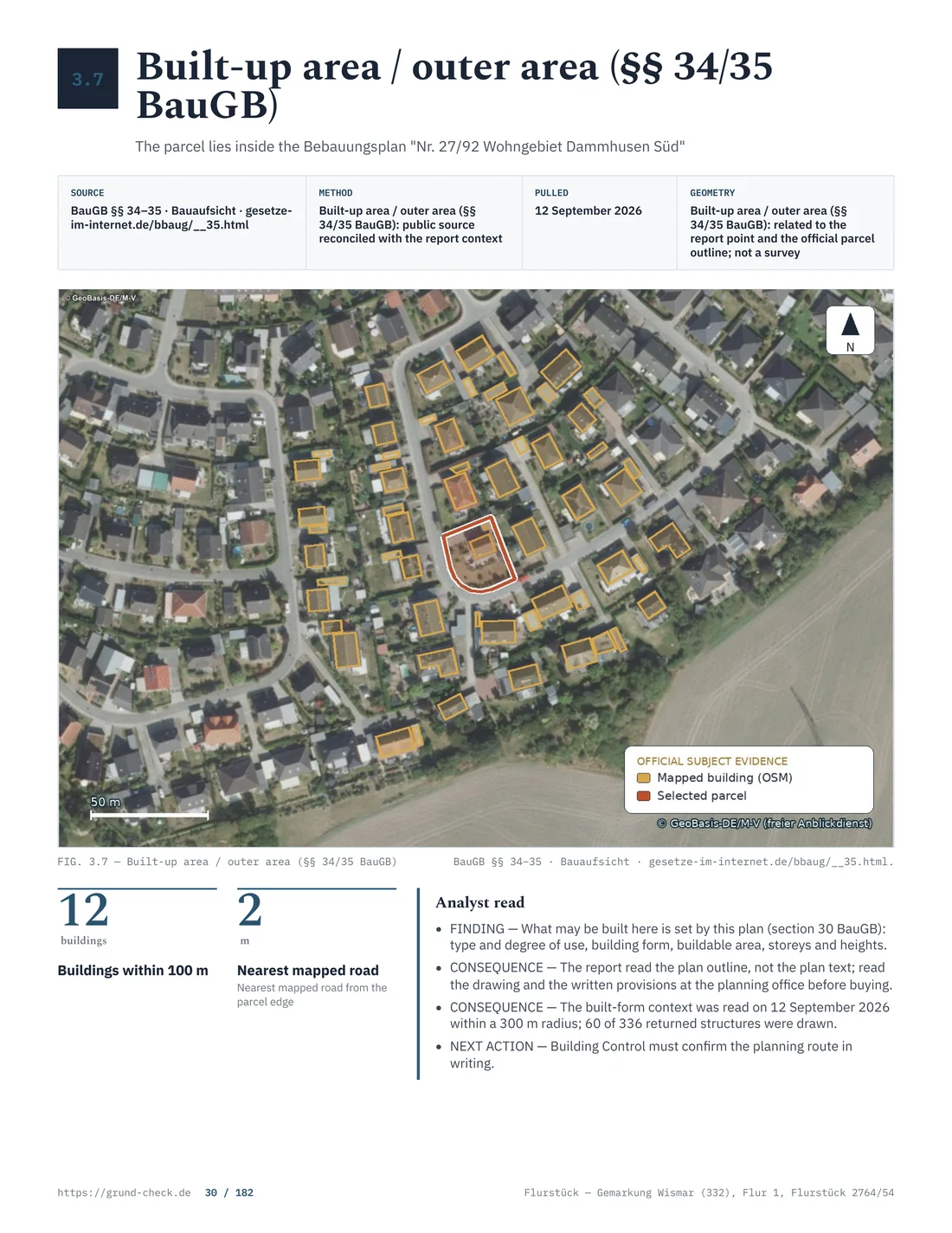
German planning law knows three situations. Federal law supplies the three planning categories. State law adds the building-code requirements, and a municipal by-law can define the settlement boundary. Inside a binding Bebauungsplan (binding local development plan), § 30 BauGB governs. Inside the coherently built-up part of a settlement, § 34 BauGB governs. Everything else is Außenbereich and falls under § 35 BauGB. There is no map of it and no register entry. It is a factual assessment of where the built-up area stops, made by the building authority and reviewable by the courts.
That has two consequences for a buyer. The last plot in a village street is often already outside, because a single building on the edge does not extend the settlement. And nobody at the viewing can tell you the answer with authority except the Gemeinde, in writing.
The rule: keep the landscape free of building
§ 35 BauGB exists to protect open land from scattered development. It does this in two steps. A short list of privileged projects in Absatz 1 may be built unless public interests stand against them. Everything else, called a sonstiges Vorhaben, falls under Absatz 2 and may be refused as soon as it impairs public interests. The difference between standing against and merely impairing sounds like wording. In practice it decides most cases, because almost any new house in open country impairs something on the list.
Which projects are privileged, and what "dienen" means
Absatz 1 privileges, among others, a project that serves an agricultural or forestry holding and occupies only a small part of its land, horticultural production, public supply of electricity, gas, telecommunications, heat and water, projects that must stand in the countryside because of their special demands on the surroundings or their effect on it, wind and hydro energy installations, and certain biogas and solar installations linked to a holding.
The word that does the work is dienen, to serve. A building is privileged only if a sensible farmer would build it for the holding, and if it stands in proportion to that holding. A large house with a token stable does not qualify because the stable exists. It fails because the house does not serve the farm. Courts look at whether the operation is a real business run with the intention of making a profit, kept up over time and of a size that supports the building. Hobby horse keeping, a few fruit trees or a paddock for private riding are not agriculture in this sense.
§ 201 BauGB sets the boundary of the term: arable farming, meadow and pasture management including animal husbandry where the feed can largely be produced on the holding's own land, market gardening, commercial fruit growing, viticulture, professional beekeeping and professional inland fishing. Anything outside that list is not Landwirtschaft, whatever the sales brochure calls it.
Is the parcel actually in the Außenbereich? A GrundCheck preflight report resolves the address to an official parcel and sets out the planning and protection context around it, so you know what you are asking the municipality before you ask. Check a parcel.
Everything else: the public interests that refuse your house
§ 35 Abs. 3 BauGB lists what counts as an impairment, and the list is not exhaustive. The ones that stop houses most often in rural areas are these: the project contradicts the Flächennutzungsplan or a landscape plan; it impairs nature conservation, landscape protection, soil or the character of the landscape; it damages the appearance of the place; it conflicts with flood protection; it causes uneconomic expenditure on roads or other public facilities; and it creates, strengthens or extends a Splittersiedlung, a scattered pocket of buildings that does not form a proper settlement.
That last one deserves attention because buyers read it backwards. Two isolated houses on the other side of the lane feel like proof that building is possible here. In law they are the argument against you: a third house strengthens the scattered pocket, which is precisely what the section is designed to prevent. Neighbouring buildings help only when they are numerous and connected enough to make the parcel part of the built-up area, at which point you are no longer in the Außenbereich at all.
- Bebauungsplan§ 30 BauGB
- Built-up settlement§ 34 BauGB
- Neither§ 35 BauGB: outer area
Source: BauGB §§ 30, 34 and 35; checked August 2026
The rescue clauses in Absatz 4, and their conditions
A few projects tied to existing rural buildings are treated more leniently under § 35 Abs. 4 BauGB. They are not privileged, but certain objections may no longer be raised against them. The ones that matter to buyers:
- Converting a former farm building to housing. Conditions are strict: the building must be worth preserving and keep its external form in essentials, the previous use must have ended no more than seven years ago, the building must have been lawfully erected more than seven years ago, it must stand in spatial and functional connection with the farmstead, no more than five dwellings may result per farmstead, and the owner must undertake not to build a replacement.
- Rebuilding a comparable house on the same spot where the existing one has defects, has been used by the owner for a long time and a hardship would otherwise arise.
- Prompt rebuilding after destruction by fire, a natural event or another extraordinary event, of a comparable building in the same place.
- Extending an existing dwelling to no more than two dwellings, where the extension is reasonable in proportion.
- Extending a lawfully established commercial operation where the extension is proportionate to the existing building.
Each of these is a factual case to be proved, not a category to be claimed. Before you rely on one, get the municipality and the Landkreis to confirm in writing that the conditions are met on this parcel, with the dates that matter: when the previous use stopped, when the building was erected, what was lawfully permitted.
Bestandsschutz protects what stands, not what you plan
An existing, lawfully erected building in the Außenbereich may stay and be maintained even though it could not be permitted today. That protection is narrow. It covers the substance and the permitted use. It does not cover an extension, a change of use, a rebuild after the substance has largely gone, or a return to use after the building has stood empty long enough for the protection to lapse. A ruin with four walls is not a building right. Ask for the original permit. If nobody can produce it, treat the structure as unpermitted until the Bauaufsicht says otherwise, because an unpermitted building can be ordered removed at the owner's cost.
- Privileged, para. 1Prove service and access
- Favoured, para. 4Only listed existing-building cases
- Other, para. 2Public interests normally weigh against it
Source: BauGB § 35 paras. 1 to 5; checked August 2026
The demolition undertaking in Absatz 5
For most of the privileged projects other than farm buildings, including wind, solar and biogas installations, the permit is granted only against a written undertaking to remove the structure and undo the soil sealing once the permitted use ends for good. The authority may require security for it. If you are buying land with such an installation on it, ask who carries that obligation and whether the security still exists.
Municipal by-laws that can move the line
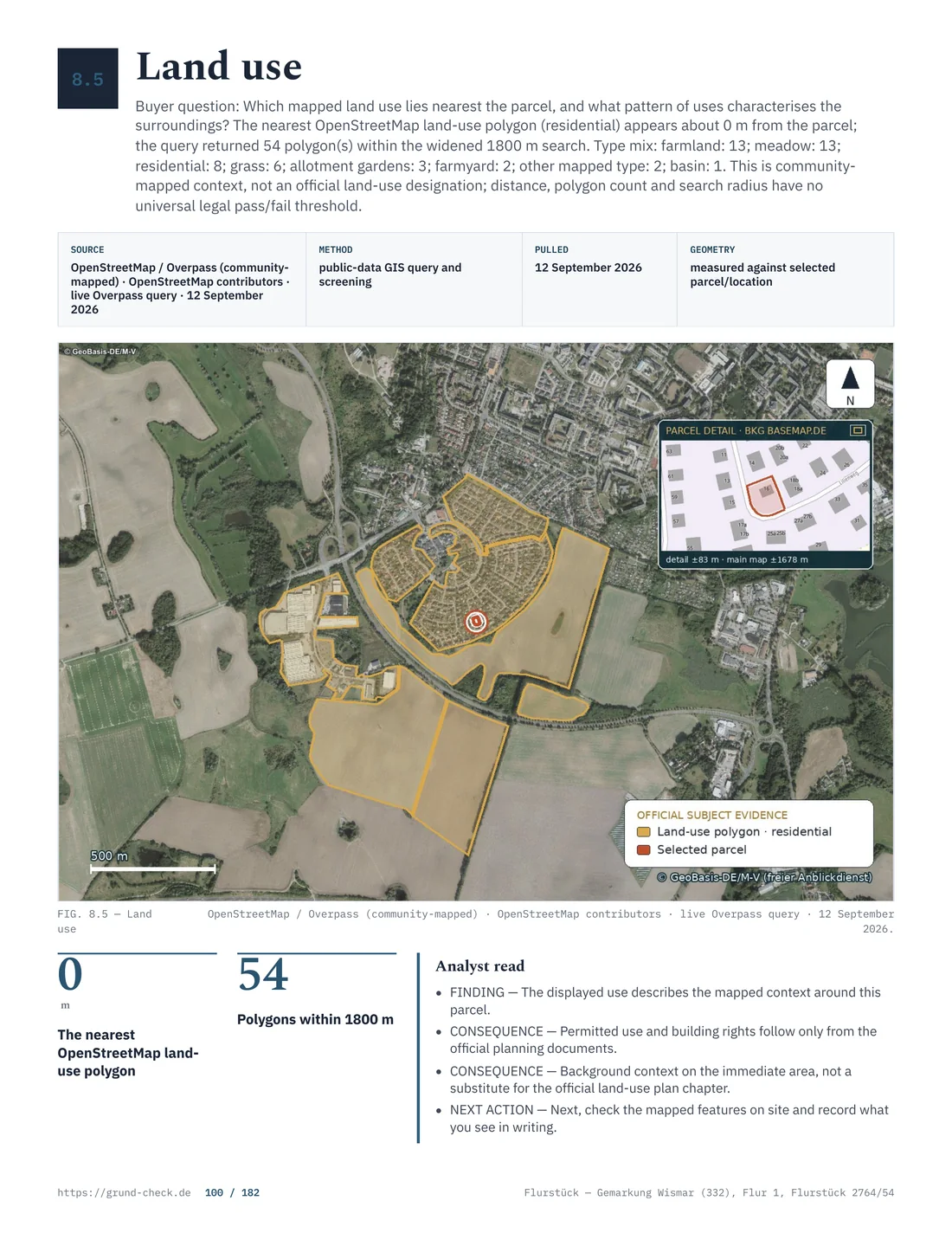
The Gemeinde has three instruments under § 34 Abs. 4 BauGB to settle where the built-up area ends: a Klarstellungssatzung draws the boundary, an Entwicklungssatzung brings built-up outer-area land into § 34, and an Ergänzungssatzung adds adjoining land. Under § 35 Abs. 6 BauGB a municipality may also adopt an Außenbereichssatzung for an already built-up part of the outer area, allowing a buyer reviewing the Außenbereich status to see which standard objections may be removed.
Ask directly whether any of these covers your parcel, and ask for the by-law text rather than a summary. These instruments are the only realistic route by which countryside land becomes ordinary building land, and they are municipal political decisions with their own timetables. A draft is not a by-law.
Nobody owes you a road or a water main
Even a project that clears § 35 needs secured Erschließung (legal access and servicing). In the outer area the municipality is generally not going to provide it. § 123 BauGB makes Erschließung the municipality's task but states plainly that there is no legal claim to it. So access, water, wastewater and power become your problem and your cost, and access across someone else's land needs a registered easement, not a friendly arrangement. Work through the utility connection check and the access and infrastructure guide before you treat a rural parcel as viable.
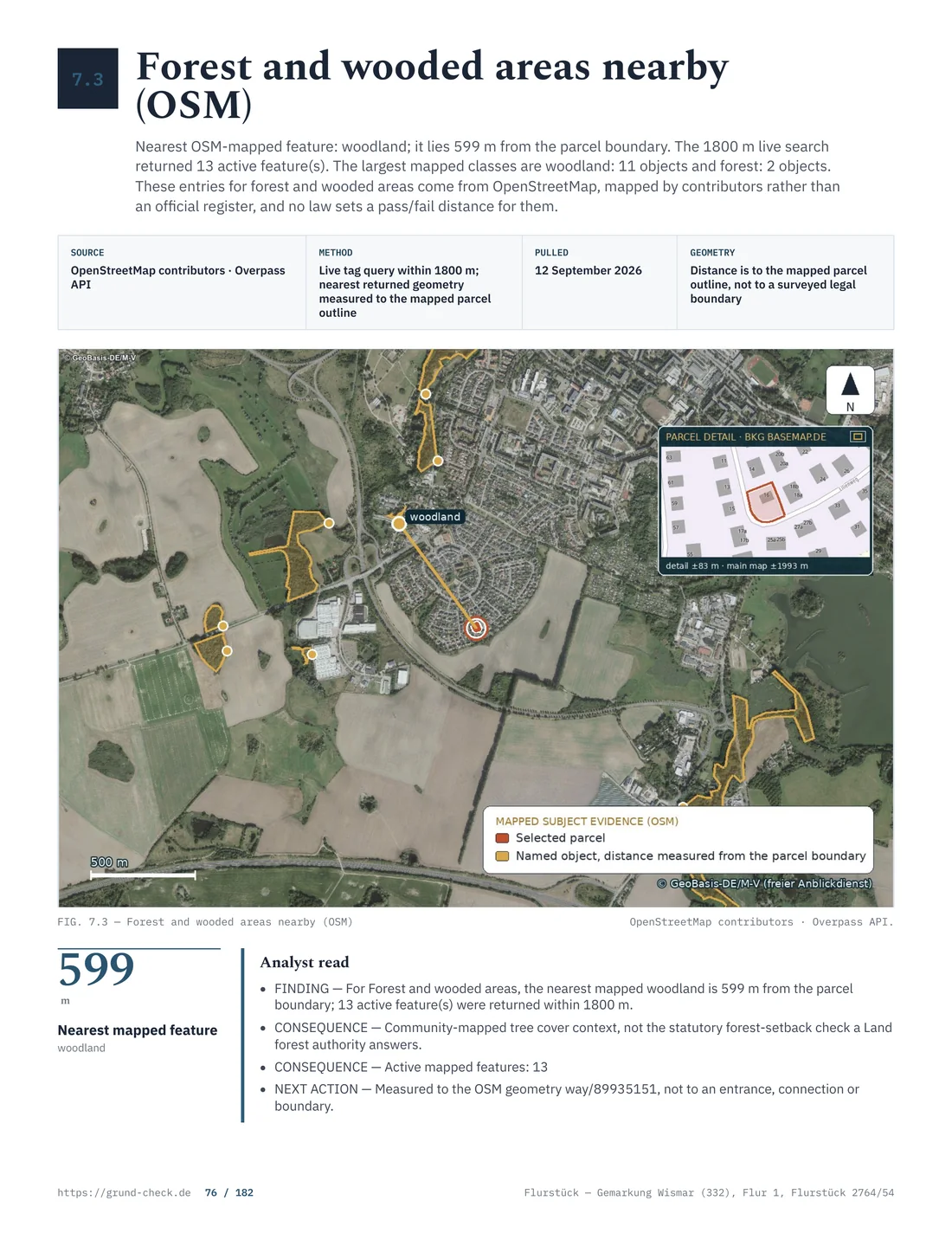
Two smaller constraints catch people out on wooded or overgrown plots. Cutting trees, hedges and scrub is prohibited between 1 March and 30 September under § 39 BNatSchG, which can cost you a building season. And setbacks still apply: § 6 of the applicable state building code requires 0.4 times the wall height and at least three metres, with three metres sufficient for ordinary houses of building classes 1 and 2 up to three storeys.
The cheap test that settles it before you pay
One instrument answers the question with binding effect: Brandenburg's Vorbescheid under § 75 BbgBO. The building authority must answer an individual, separately decidable question about a project before any full application, and it is bound by its answer. Ask a single precise question, for example whether a detached house of a stated footprint and ridge height is permissible in planning terms on this parcel under § 35 BauGB.
Three things make this the right move on countryside land. In Brandenburg the answer is valid for seven years under § 73 Abs. 1 BbgBO; other states set different periods. The fee is charged by time spent under the Brandenburg Building Fees Ordinance, so one narrow question costs little. And the municipality is drawn in: under § 36 BauGB its agreement is needed for a § 35 decision, but if it does not refuse within two months, agreement counts as given.
Make the purchase depend on the answer. A notarised contract can be made conditional on a positive Vorbescheid, or given a withdrawal right with a deadline. Sellers who will not wait the few weeks this takes are telling you something.
What to have before the notary appointment
- Written confirmation from the Gemeinde that the parcel is or is not Außenbereich, dated and quoting the parcel numbers, so the Außenbereich status is unambiguous.
- The Flächennutzungsplan entry for the area, and any Außenbereichssatzung or Satzung under § 34 Abs. 4 BauGB.
- For a claimed privileged use: proof of the holding, its land, and how the building serves it.
- For a claimed Absatz 4 case: the original permit, the date the previous use ended and the date the building was erected.
- Confirmation on protected areas, protected species, biotopes, flood zones and monuments touching the parcel.
- Written answers on access, water, wastewater and power, with prices and lead times.
- A Vorbescheid on the decisive question, where the purchase stands or falls on it.
| Project | Where it sits in § 35 | Realistic outcome |
|---|---|---|
| Building for a genuine farm or forestry holding | Abs. 1 Nr. 1, if it serves the holding | Possible, with proof of the operation and secured access |
| Detached house, no holding | Abs. 2, sonstiges Vorhaben | Usually refused; almost any impairment is enough |
| Barn converted to dwellings | Abs. 4 Nr. 1 | Possible if all conditions are met, including the seven-year dates |
| Rebuild after fire | Abs. 4 Nr. 3 | Possible if prompt, comparable and in the same place |
| Extension of an existing house | Abs. 4 Nr. 5 | Possible up to two dwellings, if proportionate |
| Weekend or holiday cabin | Abs. 2 | Refused as a rule; existing cabins rely on Bestandsschutz |
| Horses kept for pleasure | Not Landwirtschaft under § 201 | No privilege; judged as any other private project |
What this does to price, timing and finance
Treat the classification as the main price driver, because it is. Land that will not carry a house is worth farmland money, and the correct offer on it is farmland money. Where the answer is genuinely open, the honest structure is a lower price plus a condition: purchase subject to a positive Vorbescheid within a fixed period. Banks read it the same way. Most lenders will not finance countryside land as building land without the planning answer in the file, and a valuation will follow the planning status rather than the asking price, which leaves the buyer to bridge the gap in cash.
To sanity-check any price, look up the Bodenrichtwert for the location free of charge at BORIS land-value portal, published by the valuation boards, and read the development status attached to it. The parcel geometry is free too, in the state cadastral viewer. If the zone value is quoted for agricultural land and the asking price is twenty times that, the gap is the seller's hope, not your equity.
Cheap land is cheap for a reason worth reading. Order a GrundCheck preflight report and get the parcel identity, planning context and risk flags in one document before you make an offer on countryside land. Check a parcel.
Where these rules are written
- Outer-area permissibility, privileged and other projects, by-laws: § 35 BauGB; the built-up area and its by-laws: § 34 BauGB; plans: § 30 BauGB.
- What counts as agriculture: § 201 BauGB. Municipal agreement and the two-month deadline: § 36 BauGB. No claim to Erschließung: § 123 BauGB.
- Vorbescheid, its seven-year validity and setbacks: applicable state building code, §§ 6, 73 and 75. Fees: state building fee ordinance.
- Cutting season for trees and scrub: § 39 BNatSchG.
- Prices and land values: state property market report 2025, farmland purchase values, BORIS land-value portal.
Rules and figures were checked in August 2026. This is general information for buyers, not legal advice on your parcel. Read next: how buildability is decided, the permit and pre-application route, buying forest land and costs and taxes.
State-law limits
Federal planning law defines the Außenbereich, while state building, water, forest and nature law can add separate constraints. Check both levels before relying on planning status.