
Closing process
Buying land at a forced auction
How the enforcement court auctions a plot, what deadlines apply, and what bidders need to check before the auction date.
On this page
What a forced auction is
A forced auction, Zwangsversteigerung, is a sale of land ordered by a court rather than by the owner. A creditor, usually a bank holding an unpaid Grundschuld, applies for the procedure at the competent local court acting as the enforcement court. The basis is the Act on Forced Auction and Forced Administration, known as the ZVG.
Under § 15 ZVG, the enforcement court orders the auction on application. The application has to show an enforceable title and, for a Grundschuld, submission to immediate enforcement. A buyer looking for an auctioned plot enters an already running procedure at a later stage and cannot influence how it began.
- Who can apply for an auction
- Enforcement protection: when the debtor wants time
- Setting the date and the deadlines
- The auction date itself
- Existing tenancies
Source: ZVG §§ 15, 19, 37, 43, 66, 74a, 85a and 90; checked August 2026
Who can apply for an auction
Most often a bank applies, where its Grundschuld is no longer being serviced. It is also possible for any other creditor with an enforceable title, for co-heirs wanting to dissolve a community of heirs, and for public authorities. The tax office and the municipality can collect outstanding tax claims through administrative enforcement; for immovable property, § 322 AO expressly directs that the provisions of the ZVG apply.
For the bidder it later makes almost no difference who applied. The procedure at the auction date, the minimum bid and the value thresholds are regulated identically regardless of the creditor.
Seizure and the land register entry
With the order, the plot is seized. § 22 ZVG fixes two possible moments: service of the order on the debtor, or, where this happens earlier, receipt at the land registry of the request to enter the auction notice. From that moment the debtor can no longer effectively sell the plot or encumber it further.
The auction notice then sits in Abteilung II of the land register, visible to anyone interested. The land register and ALKIS guide explains how the land register itself is structured.
Enforcement protection: when the debtor wants time
The procedure does not stop automatically just because the debtor pays something or negotiates. Two routes exist. Under § 30 ZVG, the creditor can grant a temporary suspension, for example because a payment plan was agreed; this is possible twice, and a third such grant counts as withdrawing the application.
Under § 30a ZVG, the debtor can independently request a suspension of up to six months where this is likely to avert the auction and equity allows it given their personal and economic circumstances. The application fails where the delay is not economically reasonable for the creditor. For a prospective bidder this means: a date once scheduled can be lifted again at short notice.
Assess the property before your first bid. A GrundCheck report shows the parcel, the planning framework and risk factors, so a bid rests on more than the court's own listing. Check a parcel.
The market value and the two value thresholds
Before the auction date, the enforcement court determines the market value, if necessary after hearing an expert. This value is the yardstick for two protective rules in favour of creditors, which at the same time cap the market outcome of the auction.
Where the highest bid stays below five tenths of the market value, the court has to refuse the knockdown of its own motion under § 85a ZVG; nobody has to apply for this threshold to be checked, it applies mandatorily. Where the bid stays between five and seven tenths, a creditor whose claim is not thereby covered can apply for the knockdown to be refused under § 74a ZVG, provided the applicant creditor does not object and can credibly show a disproportionate disadvantage of their own. Only above seven tenths is a bid safe against both objections.
Where the knockdown is refused on this basis, the court sets a new date of its own motion; under § 74a ZVG the two dates should generally be no less than three and no more than six months apart. The determined market value itself can only be challenged by a party through an immediate appeal against the valuation decision. The later knockdown or its refusal, by contrast, can no longer be contested with the argument that the value was calculated wrongly, as § 74a Abs. 5 ZVG makes explicit.
Setting the date and the deadlines
§ 37 ZVG lists what the notice setting the date must contain: description of the plot, time and place, a reference to the enforcement, and a call to register any rights not yet apparent from the land register. Under § 43 ZVG, the announcement has to be made at least six weeks before the date; where an earlier temporary suspension applied, two weeks are enough. In addition, the underlying decision has to be served on the debtor at least four weeks beforehand.
For prospective bidders this means: between the first public announcement and the auction date there is a plannable window for a review of their own, even though an interior inspection, unlike a normal purchase, is usually not possible.
The minimum bid
§ 44 ZVG allows only a bid at the auction that covers the rights ranking ahead of the applicant's claim together with the costs of the procedure; this floor is called the minimum bid, the geringstes Gebot. It is almost always lower than the eventual knockdown price, because it only reflects the senior positions and not the full market value.
Which registered rights are included in this minimum amount, and which the buyer additionally takes over on top of the cash bid, is decided by the court at the auction date after hearing the parties. § 52 ZVG sets the basic rule: a right continues where it was taken into account in the minimum bid and is not covered by payment; all other rights are extinguished by the knockdown.
- No bid above 5/10Court must refuse the award
- Between 5/10 and 7/10Check whether an entitled party applies
- At or above 7/10Value thresholds no longer bar the award
Source: ZVG §§ 15, 19, 37, 43, 66, 74a, 85a and 90; checked August 2026
The auction date itself
Under § 66 ZVG, the date opens with the announcement of the particulars relating to the plot, the applicant creditors, their claims, the moment of seizure, the determined market value and the registered rights. The court then fixes the minimum bid and the auction conditions before the bidding hour begins.
A party whose right would be endangered by an unfulfilled bid can demand security immediately after a bid is made, under § 67 ZVG. Under § 68 ZVG, the security is one tenth of the determined market value; any excess is released. In practice bidders therefore bring a certified cheque or a bank guarantee for this amount, without which few court clerks treat a bid as serious.
Paying the cash bid
The knockdown creates the duty to pay. § 49 ZVG provides that the buyer settles, as a cash payment before the distribution date, the part of the minimum bid covering the costs of the procedure and the senior claims, together with the part of the winning bid exceeding the minimum bid. The cash bid accrues interest from the day of the knockdown regardless of how quickly the transfer is made.
Payment has to reach an account of the court cashier's office early enough to be booked there before the distribution date. In practice only a few weeks remain for this. A buyer who has not settled the financing beforehand does not immediately lose the knockdown because of that alone; but where the cash bid stays unpaid, the claim becomes enforceable under § 132 ZVG directly against the buyer, without the title first having to be separately served, as § 133 ZVG makes clear. Secured financing therefore belongs before your own bid, not after.
Existing tenancies
Where a tenant or a leaseholder lives or works on the plot, the knockdown initially changes nothing about that. § 57 ZVG refers to the BGB provisions on the principle that a sale does not break a lease; the buyer steps into the existing agreement, with a special right of termination of their own, set out in §§ 57a and 57b ZVG, effective on the next permitted date. Anyone buying a let plot at auction is not automatically buying the use of it, but first takes over the contract.
The knockdown and the transfer of ownership
The knockdown is the central moment of the procedure. Under § 90 ZVG, the buyer becomes owner of the plot with the knockdown itself, unless the decision is later set aside with final effect on appeal. This clearly distinguishes an auction from an ordinary purchase: there, ownership only arises with the land register entry under § 873 BGB; here, it arises already with the court decision itself. The land registry afterwards only enters the new owner to bring the register up to date.
At the same time, under § 91 ZVG, every right that is not expressly meant to continue is extinguished. A right can continue by way of exception where the holder and the buyer agree this at the distribution date, or through a publicly certified document.
Where the knockdown is challenged
An immediate appeal is available against the decision on the knockdown. Under § 100 ZVG, though, it can only be based on a breach of certain procedural provisions, in particular §§ 81 and 83 to 85a ZVG, or on the knockdown having been granted on conditions other than those determined. Mere regret about the level of one's own bid is not enough. Otherwise, under § 96 ZVG, the general appeal rules of the Code of Civil Procedure apply on top.
Partition auction among co-owners
A separate case is the auction to dissolve a community, for instance among heirs or a separated couple. § 753 BGB provides for a forced auction as the statutory route where a division of the plot in kind is not an option and the co-owners cannot agree. § 180 ZVG declares the general provisions applicable accordingly, with one particular feature: an individual co-owner can apply for a suspension of up to six months where that appears appropriate after weighing the conflicting interests.
For an outside bidder, such a partition auction runs technically like any other procedure; the difference lies in its purpose, and in the fact that a co-owner can bid themselves and thereby turn their own share into sole ownership.
Tax and costs after the knockdown
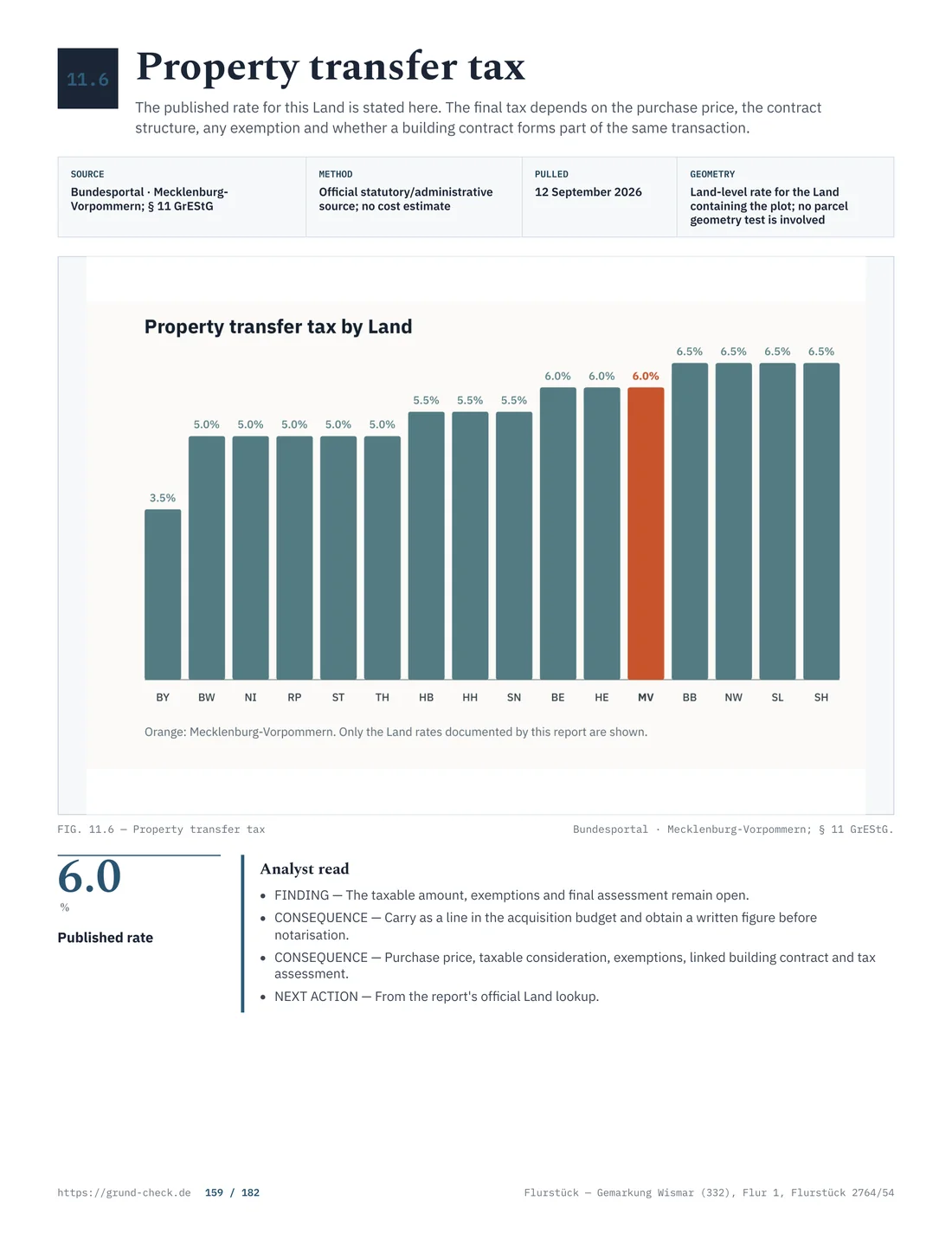
A common misconception is that buying at auction is more favourable for tax purposes than an ordinary purchase. § 1 Abs. 1 Nr. 4 GrEStG expressly subjects the highest bid in a forced auction procedure to transfer tax, at the same rate as any other acquisition. Each state sets the tax rate itself, exactly as with an ordinary land purchase; the costs and taxes guide gives an overview.
On top of this come court costs for the procedure and the knockdown, as well as the security deposit, which is offset once the cash bid is paid. A notary is not needed for the transfer of ownership itself, because the knockdown decision replaces the notarial deed; for later financing, though, a bank usually asks for the same documents as with an ordinary purchase.
What differs between states
The procedure itself runs to the same rules nationwide. Order, deadlines, value thresholds and knockdown are federal law, sitting in the ZVG and the Code of Civil Procedure, and every local court applies them the same way, even though organising the courts themselves falls under the authority of the relevant state.
Follow-on costs look different, though. Each state sets its own transfer tax rate on the highest bid. After the knockdown, the municipality also fixes the ongoing property tax through its own by-law, regardless of whether the plot was bought in the ordinary way or at auction.
A complete overview of state transfer tax rates is being prepared as a separate comparison page; until then, the costs and taxes guide sets out the main differences.
The process at a glance
| Step | Responsible | Deadline or moment |
|---|---|---|
| Application for forced auction | creditor | once the claim falls due |
| Order and seizure | enforcement court | with service on the debtor |
| Entry of the auction notice | land registry | on the court's request |
| Determination of market value | enforcement court, expert | before the date is set |
| Announcement of the date | enforcement court | at least six weeks beforehand |
| Auction date and knockdown | enforcement court | on the fixed day |
| Payment of the cash bid | buyer | after knockdown, usually shortly after |
| Transfer tax | tax office, buyer | after the assessment notice |
| Correction of the land register | land registry | on the court's request |
What a bidder should check before the date
- The determined market value and the expert report it rests on, available in the court file.
- The minimum bid and the auction conditions, in particular which rights continue.
- Whether the plot is let or leased, and on what terms.
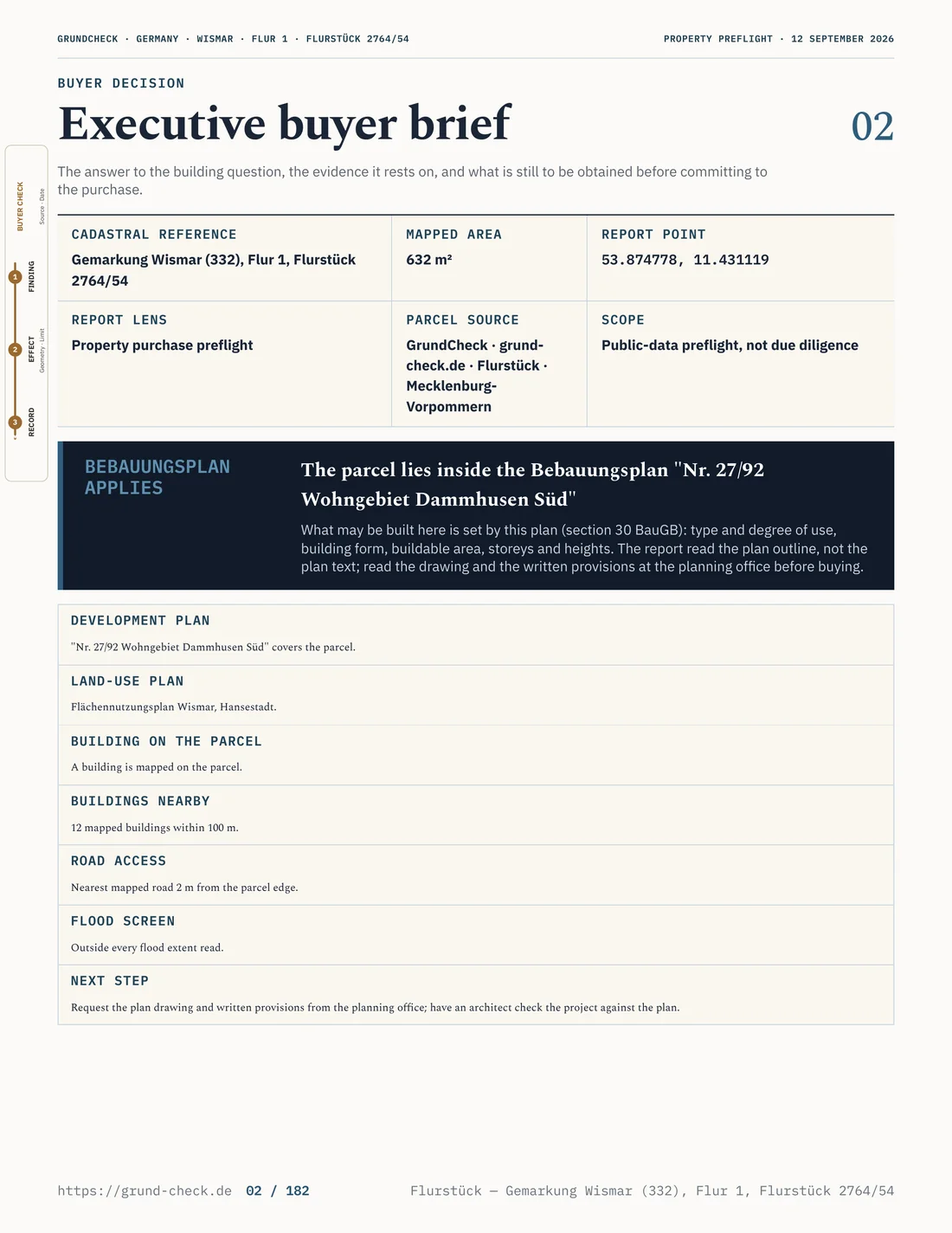
- The planning position at the municipality, since a forced auction changes nothing about that.
- The amount of security required and the form in which it is accepted.
- Whether any inspection is possible at all, or only a view from outside.
The planning review itself does not differ from an ordinary purchase. The zoning and buildability guide and the boundaries and survey guide show what matters when classifying a parcel where an interior inspection is not possible.
Assess the parcel before you bid. A GrundCheck report brings together the planning framework and risk flags for a parcel, even where only a court file and an outside view are available. Check a parcel.
Risks that do not appear in the court's listing
The expert's report describes condition and value, but it does not replace a legal review of your own. A building obligation, an unresolved suspected contamination or a missing secured access do not necessarily show up in it, because they sit outside the land register. Anyone planning to build later on a plot bought at auction should check the same registers as with an ordinary purchase, only before the date and without the cooperation of a willing seller.
The easements and building obligations guide shows which register is responsible and how to phrase an enquiry, even without any contact with the current owner.
Access to the plot also needs clarifying before the date, unless it is already secured by a public road. A track merely tolerated across a neighbouring plot does not automatically become a secured right through the knockdown. How such a situation should be assessed in law is explained in the easements and rights of way guide.
Legal basis and sources
- Procedure and deadlines: § 15, § 22, § 30, § 30a, § 37 and § 43 ZVG.
- Enforcement by public authorities: § 322 AO.
- Minimum bid and continuing rights: § 44 and § 52 ZVG.
- Date and security: § 66, § 67 and § 68 ZVG.
- Cash bid and enforcement against the buyer: § 49, § 132 and § 133 ZVG.
- Tenancy and lease: § 57 ZVG.
- Value thresholds: § 74a and § 85a ZVG.
- Knockdown: § 90, § 91, § 96 and § 100 ZVG.
- Partition auction: § 180 ZVG and § 753 BGB.
- Tax: § 1 GrEStG.
Rules and figures were checked in August 2026. This information is general in nature and not legal advice for a particular plot or an ongoing procedure.
Read next: due diligence checklist, notary process and closing and land register and ALKIS.