
Legal review
Easements and rights of way on German land
Which private rights over a German parcel survive a sale, how to read the entry, and what a line across the plot does to what you can build.
On this page
Rights that stay when the owner leaves
A private burden on German land is not a contract with the current owner. It is a right in the land itself, entered in Abteilung II of the Grundbuch, and it binds every future owner without needing to be renegotiated. Buyers who skim that section or rely on the seller’s summary may acquire obligations they never examined.
The entries are short, often a single line of abbreviations, and the substance is in the underlying deed, the Bewilligung. That document is the one to ask for. Federal law governs the private easement, state law governs setbacks and Baulasten, and the municipality applies the public-law consequences to the plot. A line reading "Geh- und Fahrtrecht für den jeweiligen Eigentümer des Flurstücks 41/2" tells you a right of way exists. Only the deed says how wide it is, where it runs, who maintains the surface and whether it covers construction traffic.
- Grunddienstbarkeit: a right attached to another plot
- Nießbrauch, Wohnungsrecht and Reallast
- The utility line, and what it does to your building envelope
- Moving a burden, and getting one deleted
- How a new easement comes into being
Source: BGB §§ 1018, 1020, 1023, 1090, 1030 and 917; GBO; checked August 2026
Grunddienstbarkeit: a right attached to another plot
The workhorse of German property burdens is the Grunddienstbarkeit under § 1018 BGB. One plot, the servient one, is burdened for the benefit of another plot, the dominant one. The right can require the owner to tolerate something, such as a driveway or a pipe, or to refrain from something, such as building above a certain height.
Two features matter to a buyer. The right belongs to whoever owns the dominant plot at the time, so the neighbour you meet today is not the neighbour who will exercise it in ten years. And the burden is enforceable in rem, meaning against the land, so a purchase price negotiated in ignorance of it does not undo it.
Beschränkte persönliche Dienstbarkeit: a right attached to a person
§ 1090 BGB creates the same kind of burden for a named person or a company rather than for a neighbouring plot. Utility line rights are the common case: the grid operator holds a right to keep a cable or a pipe across the parcel, and that right does not expire when the plot is sold.
These rights are not transferable in general, and they end with the death of the individual or the dissolution of the company, but a corporate holder can persist for generations and a successor company can take over by agreement. For a building plot the practical question is never who holds it but where the line runs and what corridor has to stay clear.
Read Abteilung II with the parcel in front of you. A GrundCheck preflight report gives the parcel identity and the surrounding context, so an entry about a strip along the eastern boundary can be located rather than guessed at. Check a parcel.
Nießbrauch, Wohnungsrecht and Reallast
Three further entries turn up on rural and family-transferred land, usually where a plot has moved between generations.
- Nießbrauch, § 1030 BGB: a right to use the property and take its fruits. A parcel subject to one can be bought, but the holder keeps the use, which is close to buying nothing for the duration.
- Wohnungsrecht, § 1093 BGB: a right to occupy a building or part of it, common where parents transferred a house to children.
- Reallast, § 1105 BGB: a recurring obligation charged on the land, historically deliveries or care for a relative, today usually a payment.
All three reduce value substantially and all three are removable only with the holder's consent. If one appears in an extract, the price conversation changes completely, and the deletion has to be arranged before completion rather than promised for later.
The entry’s rank determines its security
Rank is not cosmetic. § 879 BGB gives rights in the same section priority in the order of their entry, and § 17 GBO makes the registry process applications in the order they arrive. A right of way registered before a mortgage survives a forced sale of the plot; one registered after it may be extinguished by that sale.
For a buyer this decides how safe a benefit is. If your purchase depends on a right of way over a neighbouring plot, check its rank on the neighbour's sheet, not just its existence. A first-rank right is worth what it says. A right behind three mortgages is worth what the bank decides.
The utility line, and what it does to your building envelope
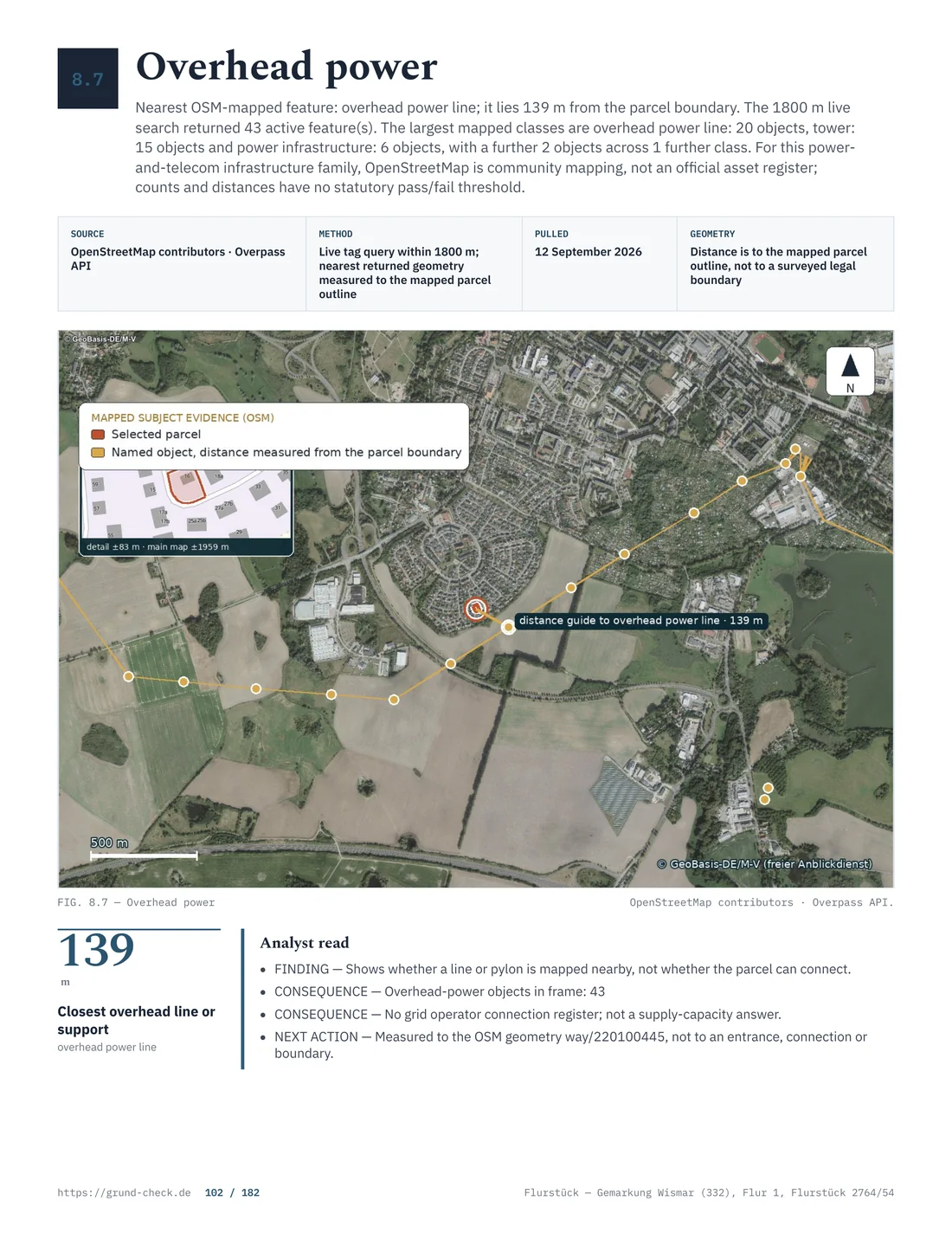
The most common burden on a German building plot is a strip for a cable, a water main or a gas pipe. The corridor is typically a few metres wide, and inside it you may not build, plant deep-rooted trees or change the ground level, and the operator may enter to work on the line.
The consequence is geometric rather than legal. A four-metre protected strip across the middle of a 25-metre-wide plot can leave no compliant building position once the setbacks under § 6 of the applicable state building code are added, which for an ordinary house of building classes 1 and 2 is three metres to each boundary. Before you accept a plot with a line across it, draw the corridor and the setbacks on the cadastral map and see what rectangle is left. That five-minute exercise has ended more purchases than any legal argument.
Notwegrecht: the emergency right, not a substitute for one
§ 917 BGB gives the owner of a plot with no connection to a public road a claim against the neighbours to tolerate access, against payment. It sounds like a solution to a landlocked parcel and it is a poor one.
The claim only arises where access is genuinely lacking, it must be pursued against a specific neighbour and may need a court to settle, the route and the payment are decided in that process, and the result is not registered unless the parties agree to register it. A building authority asked whether access is secured for a permit will look for a registered right or a public road, not for a possible claim. A parcel whose access rests on § 917 is a parcel with an access problem. The access guide sets out what secured access actually requires.
Moving a burden, and getting one deleted
§ 1023 BGB lets the burdened owner demand that the exercise of a right of way be moved to another part of the plot, at the owner's own cost, if the current position is particularly burdensome and the new one is equally convenient for the holder. It is a real tool for freeing a building position, and it is narrower than it sounds: the holder must not be worse off, and the cost falls on the person asking.
Sound it out before buying, not after. Ask the holder in writing whether a relocation would be accepted and on what terms. An agreement in principle from the neighbour, obtained while the seller still wants the sale to happen, is worth far more than a right to litigate later.
An entry disappears in one of three ways. The holder consents to the deletion and the registry removes it under § 875 BGB, which is the normal route and requires a notarised or certified declaration. The right expires by its own terms, for example on a date or on the death of the holder, and the deletion is then applied for with proof. Or the right is extinguished in a forced sale because of its rank.
What does not work is disuse. § 1028 BGB deals only with a structure that interferes with an easement and does not turn an unused right of way into a lapsed one. A track nobody has driven for twenty years is still a registered right. Where a seller says a burden is obsolete, the answer is a deletion consent before completion, not a reassurance.
The lines that were never registered
One trap belongs specifically to the eastern states. Utility lines and installations that were in use on 3 October 1990 received a limited personal easement in favour of the operating utility by operation of law, under Article 9 § 9 of the Grundbuchbereinigungsgesetz and the implementing ordinance that extended it to water and wastewater. The right came into existence without any entry in the land register, and operators were given a long window in which to have it recorded, with the good-faith protection of § 892 BGB suspended for these rights until the end of 2010.
The window has closed, but the practical lesson stands. On a German parcel, an empty Abteilung II does not prove that no line crosses the ground. Look at the plot, look at the aerial imagery, look for inspection covers, marker posts and cable warning tape in any trial pit, and ask the local grid and water operators in writing whether anything of theirs runs across the parcel. Their answer is worth more than the silence of the register.
- GrunddienstbarkeitRight benefiting another parcel
- Personal easementRight benefiting a named person
- Usufruct or ReallastUse or a recurring obligation
Source: BGB §§ 1018, 1020, 1023, 1090, 1030 and 917; GBO; checked August 2026
How a new easement comes into being
Two things are needed, under § 873 BGB: agreement between the owner and the beneficiary that the right shall exist, and entry in the land register. Neither alone does anything. The registry also needs the owner's declaration of consent in the form required by § 29 GBO, which means publicly certified at minimum, so a notary is involved either way.
This matters when a purchase depends on a new right being created, for example an access over the seller's remaining land after a division. The right does not exist until it is registered, and registration takes weeks to months after the deed. The protection in the meantime is the same as for the purchase itself: a priority notice under § 883 BGB secured at the same time, and a payment step that does not release the money before the notice is in place. A promise in the contract to grant a right later, without that machinery, is worth exactly as much as the seller's continued goodwill.
Rights your plot enjoys, and how to verify them
Abteilung II shows what burdens your parcel. It does not show what your parcel is entitled to on somebody else's land, because that entry sits on the other plot's sheet. Buyers regularly discover this after completion, when the access they were shown turns out to rest on nothing.
If the plot depends on a driveway, a turning area, a well or a drainage run over a neighbouring parcel, ask the notary to obtain an extract for that parcel too. Check three things on it: that the right exists as an entry rather than as an arrangement between the current owners, that it is worded to benefit the owner of your parcel for the time being rather than a named individual, and where it stands in the rank order. Under § 1029 BGB, possession of an easement by the owner of the dominant plot enjoys some protection, but that is a remedy against interference, not a substitute for a registered right.
Three mistakes buyers make
Reading the entry instead of the deed. The one-line register entry is a label. Width, route, permitted use and maintenance all live in the Bewilligung, and the difference between a right of way for agricultural access and one that covers construction traffic decides whether you can build.
Treating an unused right as a dead one. Twenty years without use changes nothing. Only a deletion changes something, and a deletion needs the holder's consent in proper form before completion.
Accepting a verbal assurance about relocation. A neighbour who says the track can be moved to the edge has said nothing enforceable. Get it in writing while the seller still needs the sale to complete, or price the plot as if the right stays exactly where it is.
Two registers, two families of burden
A Baulast (public-law building obligation) belongs to the public-law register, not to the land register.
| Grunddienstbarkeit and friends | Baulast | |
|---|---|---|
| Legal family | private law, BGB | public law, § 84 of the applicable state building code |
| Where it is recorded | Grundbuch, Abteilung II | Baulastenverzeichnis at the Landkreis |
| Who benefits | a neighbouring plot or a named person | the building authority, and indirectly a neighbour |
| Who can release it | the holder, by consent | the authority, by waiver |
| Binds a buyer | yes | yes |
| Shows in a land register extract | yes | no |
The last row is the one that costs money. A clean Grundbuch says nothing about Baulasten, and the two registers have to be checked separately. The Baulasten guide covers the public-law side.
What a burden does to price and financing
A utility strip along an edge usually costs little. The same strip across the middle can remove the buildable rectangle and take a large share of the value with it. A Wohnungsrecht or Nießbrauch removes the use for the duration and is priced accordingly. Lenders read Abteilung II carefully, and a burden that limits building will show up in the valuation whether or not the buyer noticed it.
The negotiating position is straightforward when the work is done early. A burden discovered before the offer is a price argument. The same burden discovered after signing is a lesson.
Before the notary appointment
- A Grundbuch extract no older than four weeks, with every entry in Abteilung II listed.
- The Bewilligung for each entry you cannot read at a glance, obtained through the notary.
- A sketch on the cadastral map showing every corridor and strip, with the setbacks added.
- The rank of any right you are relying on, checked on the other plot's sheet.
- Written deletion consents for anything the seller says is obsolete.
- Separately, an extract from the Baulastenverzeichnis at the Landkreis.
Find the strips before the architect does. Order a GrundCheck preflight report and take a clear parcel picture into the register review. Check a parcel.
Where these rules are written
- Easements: § 1018, § 1023, § 1028 and § 1090 BGB.
- Use rights and charges: § 1030, § 1093 and § 1105 BGB.
- Rank and deletion: § 879 and § 875 BGB, § 17 GBO.
- Emergency access: § 917 BGB. Setbacks: § 6 of the applicable state building code.
- Register access and fees: § 12 GBO, GNotKG charges, where an extract is 10 € or 20 €.
Rules and figures were checked in August 2026. This is general information for buyers, not legal advice on your parcel. Read next: Baulasten, register and cadastre and boundaries and survey.
State-law limits
Private easements follow federal civil law, while Baulasten and setback consequences depend on the applicable state building code.