
Building permission
Soil surveys and foundation choice
What a soil survey report covers, who is liable for it, and what further approvals matter for groundwater and contaminated ground.
On this page
Why a soil survey report matters before building starts
A soil survey report, the Baugrundgutachten, establishes the ground’s bearing capacity and identifies the soil layers present, and, from that, what foundation a building there needs. Without this investigation, a structural engineer plans on assumptions rather than measurements. Settlement cracks, an unexpectedly expensive underpinning, or in the worst case a stop to construction because of unforeseen ground conditions are the result when that assumption turns out to be wrong.
No statute directly obliges a private developer to commission a soil survey report. What is required instead is a result: a sound demonstration of structural stability for the specific project. How that demonstration has to be produced in an individual case, and whether the building authority checks it itself or relies on a declaration from a qualified planner, is set by the building code of the relevant state.
Even without a direct statutory requirement, a ground investigation may still be needed: a lender or structural engineer may require reliable foundation data. The project, site and requirements of the professionals involved determine the scope of the investigation.
- Commission the ground investigationContract for work under § 631 BGB
- Boreholes and samplesRecord layers and groundwater
- Written reportFoundation recommendation
- Structural designStability demonstration
- Authority checkWhere state law requires it
- Water or soil protectionPermit or notification where triggered
Source: BGB §§ 631 and 633; WHG §§ 8 and 9; building code of the relevant state; checked August 2026
What the report delivers, and what it does not
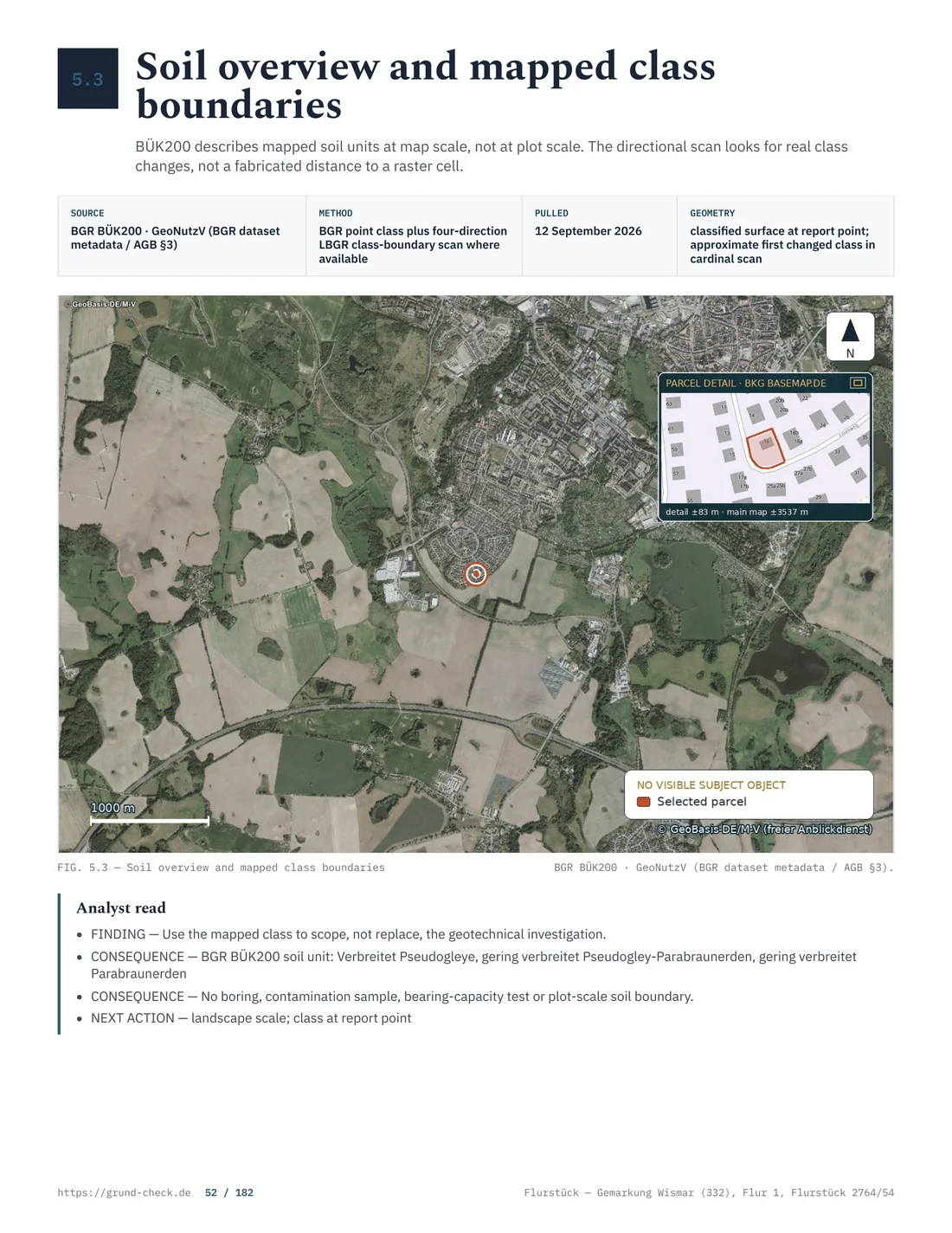
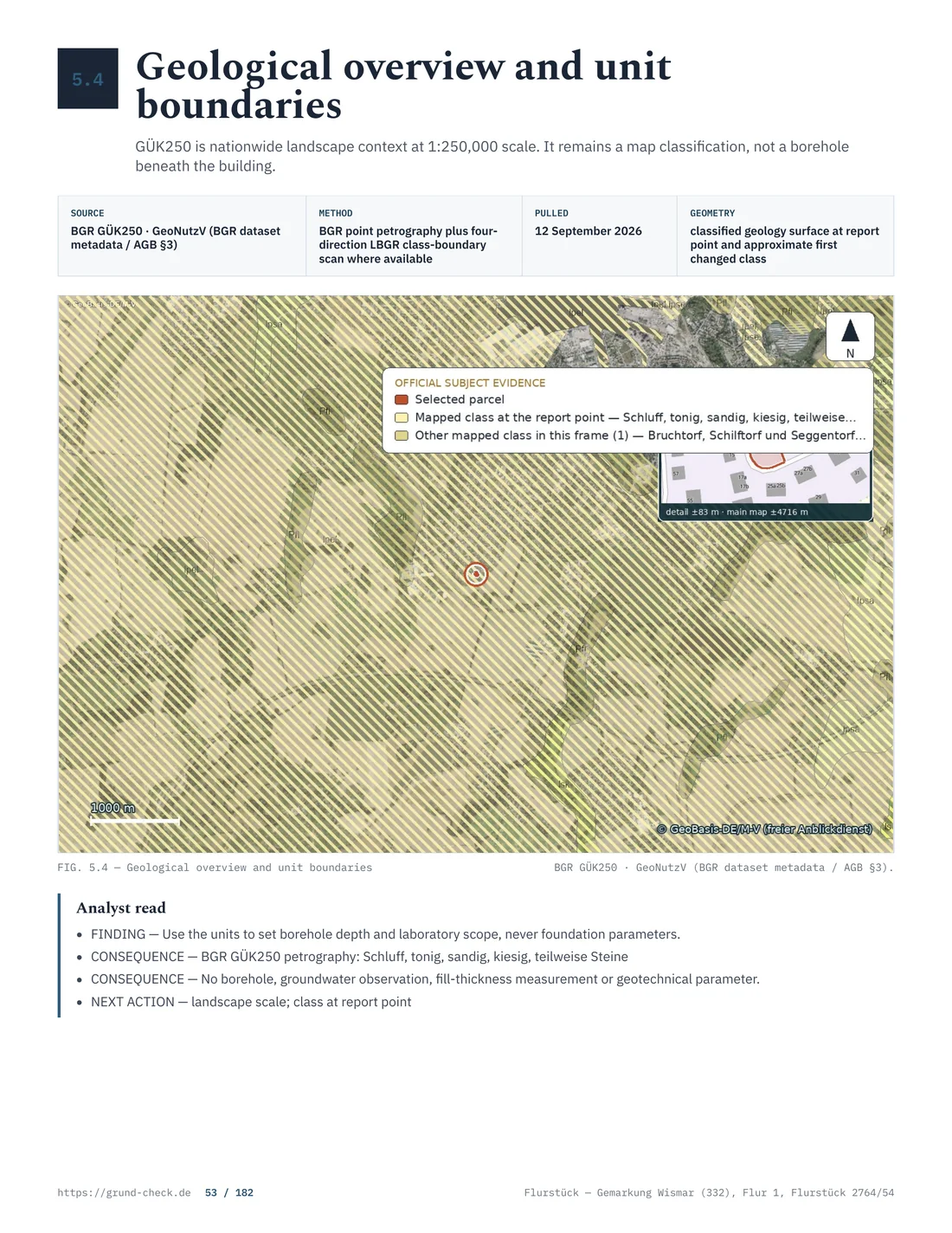
A ground investigation typically consists of boreholes or probes at several points across the area, soil samples, and a written evaluation with recommendations for the foundation. It answers how deep load-bearing ground lies, how high the groundwater table sits, and whether fill material, organic layers or varying soil quality should be expected.
It does not answer whether the plot is buildable under planning law at all, or what type of building would be permitted there. That question is settled by the development plan or by the classification under § 34 or § 35 BauGB, not by the soil surveyor. The zoning and buildability guide explains how that classification works.
Foundation types depending on the ground
Which foundation a building needs follows directly from the result of the ground investigation. Where the soil is load-bearing and even, a shallow foundation with a strip or raft footing is often enough. Where load-bearing ground only appears at greater depth, or soil quality varies sharply, deep foundations on piles or a soil replacement, in which unsuitable material is exchanged for compacted material, come into consideration.
This decision is not a formality. A shallow foundation sized too lightly for unsuitable ground leads to settlement that only shows up years later as cracks, once a correction is far more expensive than the original investigation would have been.
On sloping ground, or where soil quality varies sharply within the same plot, a combined foundation can also make sense, with individual parts of the building founded at different depths. Such solutions take more planning effort but are often cheaper than a blanket deep foundation for the whole area, because they apply extra depth only where the ground actually requires it.
Who commissions the report, and who is liable
The investigation is, in law, a contract for work. § 631 BGB obliges the appointed expert to produce the promised work, here the report, and the developer to pay the agreed fee. This means the general rules of contract-for-work law apply, not those of a mere advisory conversation.
Under § 633 BGB, the report has to be free of defects: it must meet the expected professional standard and accurately reflect the actual ground conditions. Where the result is wrong because boreholes were spaced too far apart or a recognisable fill layer was missed, a defect can exist regardless of whether the mistake was intentional or merely negligent.
Defect rights and the extended limitation period
Where a mistake only comes to light after construction, the developer has the rights under § 634 BGB: demand supplementary performance, have the defect remedied and claim the cost back, withdraw from the contract or reduce the fee, or claim damages. For a soil survey report, damages claims are usually the relevant one, because a foundation that has already been built cannot simply be undone.
The limitation period matters here. Under § 634a Abs. 1 Nr. 2 BGB, defect claims relating to a building, and to a work whose intended outcome is a planning service for one, become time-barred only after five years, not under the ordinary short period. A soil survey report counts as such a planning service, because its result feeds directly into the building's foundation. The period starts with the acceptance of the report, not with the completion of the building. Without this connection to a building, the ordinary three-year limitation period under § 195 BGB would otherwise apply, which in the case of a hidden ground defect would often already have expired before the damage even became visible.
Understand the ground risk before you commission anything. A GrundCheck report flags fill material, suspected contamination and flood risk for a parcel before the first borehole is drilled. Check a parcel.
When the building authority asks for proof
Whether and in what form the building authority checks a structural stability demonstration depends on the project and on the relevant state. For a simple house, in many states a declaration from a planner authorised to submit building applications is enough, while larger or more difficult projects go through a formal check by an approved checking engineer. The building permit and pre-application guide describes how these demonstrations fit into the permit procedure.
Regardless of how deep the check goes, professional responsibility for an accurate assessment of the ground stays with the appointed expert and the structural engineer. A granted building permit does not confirm that the ground was actually investigated or correctly assessed.
Groundwater and dewatering during construction
Where groundwater sits high, an excavation pit often has to be temporarily drained. Extracting, raising or discharging groundwater is a use of a body of water under § 9 Abs. 1 Nr. 5 WHG, as is lowering the groundwater table by suitable installations under § 9 Abs. 2 Nr. 1 WHG. Any such use generally needs a water-law permit or licence under § 8 Abs. 1 WHG.
This permit has to be applied for separately from the soil survey report itself, usually at the lower water authority of the district. A good soil survey report points to the groundwater level to be expected, but it does not replace the official permit for dewatering. Anyone who overlooks this step risks a stop to construction in the middle of the excavation phase.
Contamination and soil pollution in the ground
A ground investigation sometimes turns up more than pure load-bearing values, for example rubble, an oily smell or a conspicuous discolouration of the soil. In this case the Federal Soil Protection Act applies. § 4 Abs. 1 BBodSchG obliges anyone acting on the soil to behave in a way that avoids harmful soil changes, and § 4 Abs. 2 BBodSchG obliges the landowner to avert harmful soil changes threatening from their land.
A suspicion arising from the ground investigation should therefore not be passed over quietly, but reported to the lower soil protection authority. How such a report proceeds, and what triggers a remediation duty, is explained in the contaminated site guide.
Anyone who conceals the suspicion anyway only pushes the problem to a later point, usually the moment of a resale or a further building measure, when a fresh investigation brings the original finding to light regardless. The duties under § 4 BBodSchG then apply to the same owner, only with less room for an orderly solution.
Liability toward neighbours
A wrongly assessed foundation can also affect a neighbouring plot. Where the ground subsides during construction, or a neighbouring plot is affected by dewatering, liability under § 823 Abs. 1 BGB comes into consideration: whoever unlawfully injures another's property intentionally or negligently must compensate the resulting damage. Both the developer and the appointed professionals can be affected, depending on whose breach of duty caused the damage.
A carefully documented soil survey report also serves as evidence of one's own diligence here. Anyone who actually implements the recommended foundation, and documents any deviation with reasons, stands considerably better in a dispute than someone who leaves a report in a drawer.
The extent of such a damages claim is governed by § 249 BGB: the party liable generally has to restore the condition that would exist without the damage, for example through a later underpinning of the affected neighbouring building. Where that is not possible or disproportionate, the injured party can instead claim the money required for it.
Finds during drilling
Boreholes and test pits occasionally turn up more than just soil and groundwater. Where bones, wall remnants or unusual finds appear, an archaeological monument may be involved; the reporting duty and the period during which a find site must remain unchanged are set by the monument protection act of the relevant state. Signs of a legally protected biotope or of specially protected species near the boreholes also need to be taken seriously, because species protection under § 44 BNatSchG applies independently of planning law.
None of these finds automatically makes the project impossible. They do change the timetable, though, because additional professional or official clarification becomes necessary before the actual excavation, and this should be priced into the schedule for the ground investigation, not discovered afterwards.
Source: BGB § 634a(1) no. 2 and § 195; checked August 2026
When to commission the report
A soil survey report belongs at the start of planning, not at its end. Where it is only commissioned once the shell construction has already gone out to tender, unfavourable results can barely still be worked into the design without losing time and money. The investigation makes sense once the basic buildability of an area is settled, but before a structural engineer plans the foundation in detail.
Anyone buying an undeveloped plot should build this sequence into their own review. The further steps of a full land due diligence process are summarised in the due diligence checklist.
Cost, and what drives it
The cost of a soil survey report depends on the number of boreholes, how accessible the area is, and the scope of the laboratory analysis. An offer without a stated number of planned boreholes and investigation depth is hard to compare with another. Anyone gathering several offers should therefore look for identical scopes of work, not just the final price.
Because the report is a freely negotiable contract-for-work service, there is, unlike a notarial deed, no statutory fee schedule for it. The costs and taxes guide gives a rough sense of the other building-related costs around a plot.
Anyone saving on the price of the investigation is usually saving on the number of boreholes, not on the care of the evaluation. For a small, evenly shaped area, one extra borehole may change little; on a plot with visible changes in level or a former commercial use, it can hit exactly the spot on which the later foundation decision turns.
When flooding and a high groundwater table coincide
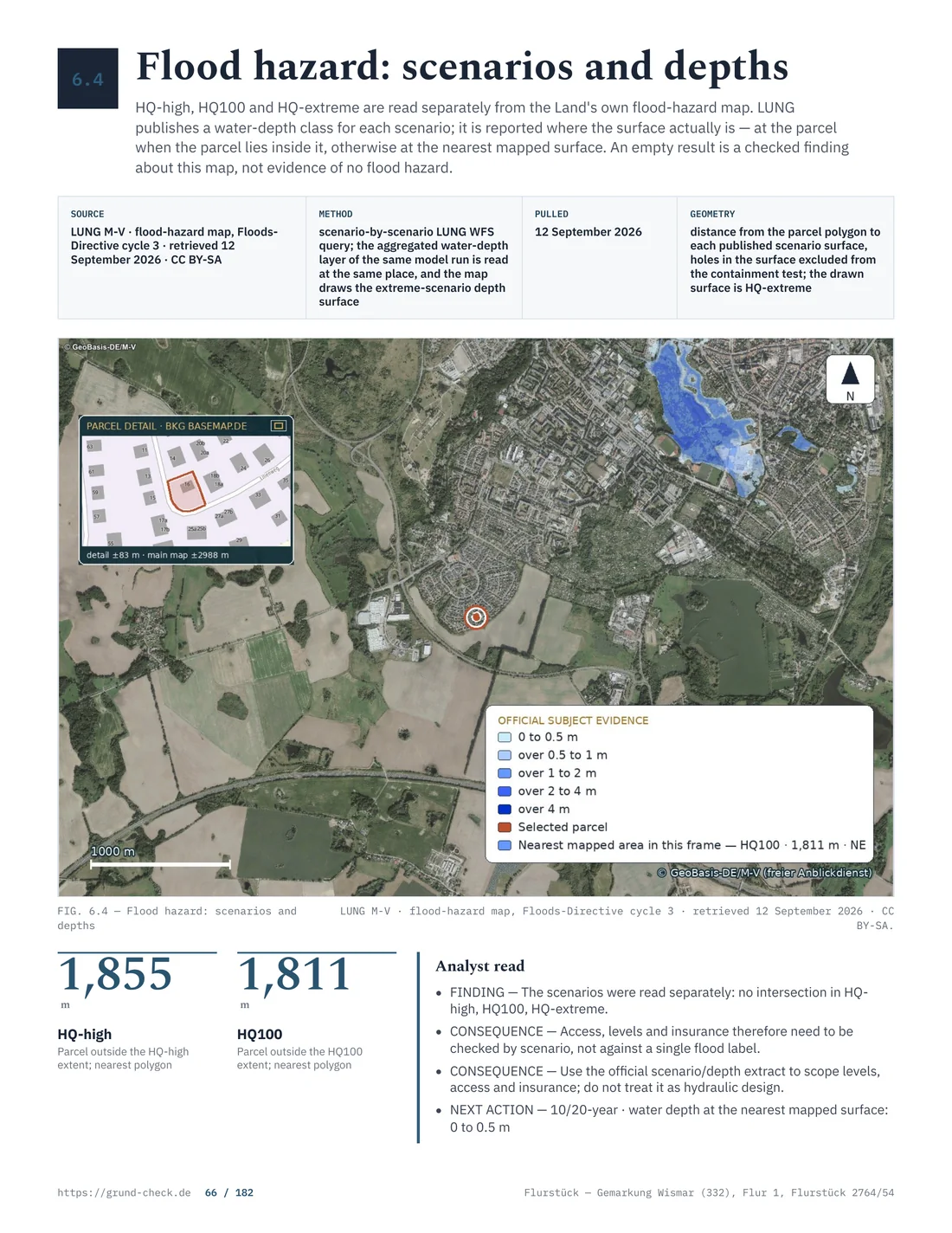
In areas with frequent flooding or a permanently high groundwater table, ground questions and water-law questions are closely linked. A foundation that would be technically feasible can be further restricted by flood protection conditions. The relevant rules are explained in the flood and nature risk guide.
A soil survey report that measures the groundwater level on a single dry summer day only gives an incomplete picture. Serious reports therefore point to seasonal fluctuations and recommend an additional measurement at a different time where there is uncertainty, before the foundation is finally fixed.
What differs between states
The contractual side of the soil survey report is regulated the same way nationwide, because contract-for-work law, defect liability and the five-year limitation period sit in the BGB, are federal law, and apply identically everywhere. The water-law permit requirement for lowering groundwater likewise follows the WHG nationwide.
Whether and how the building authority checks a structural stability demonstration, by contrast, is a matter of state law under the building code of the relevant state, as is which projects go through a formal check by an approved checking engineer and which do not. Responsibility for the water-law permit also sits with the lower water authority, which each state organises differently, and in some states the municipality itself carries out this task. Water law itself carries one particular feature: under Art. 72 Abs. 3 Satz 1 Nr. 5 GG, the states may deviate from the federal water-management rules, except for substance-related or installation-related provisions. The basic permit requirement for a groundwater use therefore stays the same nationwide, while organisational questions can differ under the relevant state's own water act.
A nationwide overview of building-code checking requirements is being prepared as a separate comparison page; until then, the building permit and pre-application guide sets out the main differences.
The process at a glance
| Step | Responsible | Result |
|---|---|---|
| Commissioning the ground investigation | developer, expert | contract for work under § 631 BGB |
| Boreholes and soil samples | soil surveyor | raw data on layers and groundwater |
| Written report with foundation recommendation | soil surveyor | basis for structural planning |
| Structural stability demonstration | structural engineer | part of the building application |
| Check by the building authority, where required | checking engineer, building authority | approval or conditions |
| Water-law permit, where needed | lower water authority | permit for dewatering |
| Reporting a suspected contamination, where present | lower soil protection authority | further action, remediation if needed |
Common mistakes in ground investigation
- The report is only commissioned once the foundation work has already gone out to tender.
- Too few boreholes for the size and irregularity of the area.
- A note on a high groundwater table is not linked to the water-law permit needed for the construction period.
- A suspected contamination from the investigation is not reported to the soil protection authority.
- The five-year limitation period is confused with the shorter ordinary period, so claims are made too late.
Know the file before you drill. A GrundCheck report brings together existing environmental and planning data for a parcel, so the ground investigation is targeted at the actual risk. Check a parcel.
What to settle before commissioning
A short list before the first call to an expert avoids later back-and-forth and makes offers from different firms easier to compare.
- The planned number and depth of boreholes stated in the expert's offer.
- Known previous uses of the plot that might point to fill material or contamination.
- The groundwater level to be expected, and whether dewatering will be needed during construction.
- Whether the building authority requires a check by an approved checking engineer for this particular project.
- The contractually agreed liability and the period within which defects can be claimed.
Legal basis and sources
- Contract for work and defect rights: § 631, § 633 and § 634 BGB.
- Limitation: § 634a and § 195 BGB.
- Liability: § 823 and § 249 BGB.
- Water law: § 8 and § 9 WHG.
- Soil protection: § 4 BBodSchG.
- Planning law for classifying the plot: § 34 and § 35 BauGB.
- State authority for building law: Art. 70 and Art. 72 GG.
- Species protection: § 44 BNatSchG.
Rules and figures were checked in August 2026. This information is general in nature and not legal advice for a particular building project.
Read next: contaminated sites, building permit and pre-application and due diligence checklist.
A soil report answers part of the question. Two further checks cover the rest: old mining and ground damage, the ordnance check before a purchase.